Before Babel: Did Mesopotamians Remember a Change in Human Language?
A Sumerian epic contains a passage, the "Spell of Nudimmud," about a time when all people spoke to the god Enlil "in one tongue," and Enki changed the speech in their mouths. Scholars debate whether it describes a past confusion of languages, like Babel, or a hoped-for future unity.
Ancient text: documented · Meaning of the passage: debated
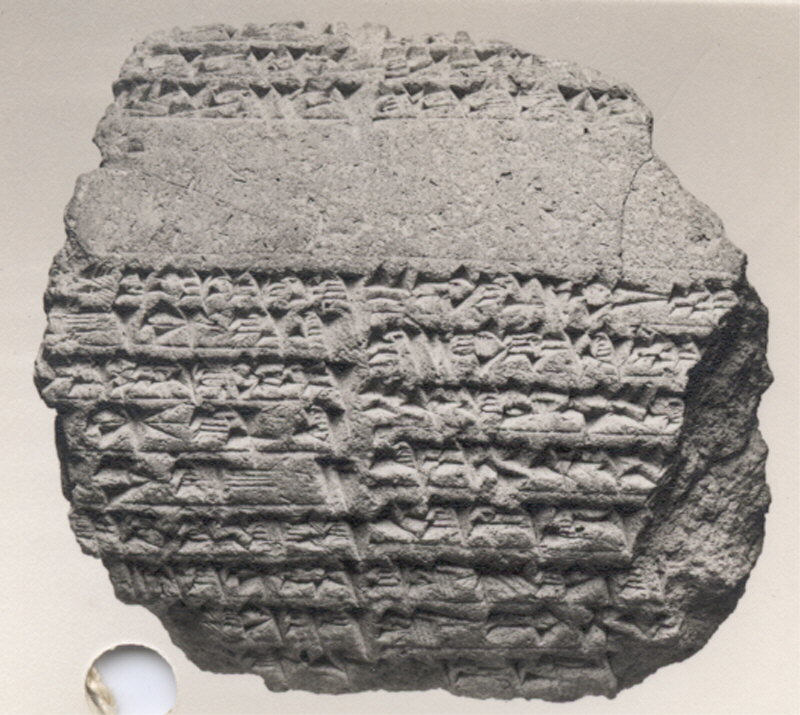
Authentic ancient artifactNebuchadnezzar II's clay cylinder recording his rebuilding of Etemenanki, Babylon's ziggurat (Metropolitan Museum of Art).Image credit
1 What Scripture says
"And the whole earth was of one language, and of one speech" (11:1). People in Shinar build a city and a tower with brick and bitumen; God confuses their language and scatters them. Genesis 10:8–12 credits Nimrod with Babel, Erech (Uruk) and Accad, and with Nineveh.
2 What evidence we might expect
Mesopotamian texts about the origin of different languages.
Monumental towers in Babylon.
Historical kings resembling Nimrod.
3 What ancient sources survive
Enmerkar and the Lord of Aratta
Language
Sumerian
Composed
Ur III period (c. 21st century BC) or a little later
Oldest surviving copy
Old Babylonian tablets, c. 1800 BC
Enmerkar of Uruk contends with the lord of Aratta. The epic also includes the earliest story of writing a message on a clay tablet, because the messenger cannot remember it.
The "Spell of Nudimmud" (lines 134–155) describes a time when "the whole universe, the people in unison" spoke to Enlil in one tongue, and Enki "changed the speech in their mouths… into which contention had been put." Thorkild Jacobsen and Samuel Kramer read it as a past event, close to Babel; Herman Vanstiphout and others read it as a spell hoping for a future time when all peoples will praise Enlil in one language.
Babylon's great ziggurat, Etemenanki ("House of the foundation of heaven and earth"), was rebuilt by Nabopolassar and Nebuchadnezzar II in the 7th–6th centuries BC on older foundations; its base measured about 91 by 91 meters. Modern reconstructions are informed estimates, not photographs.
Nimrod
Genesis calls Nimrod "a mighty hunter before the LORD" and founder of Mesopotamian cities. Proposed historical analogues include Sargon of Akkad (who founded Akkad), Tukulti-Ninurta I of Assyria, and the god Ninurta. None is secured; Nimrod may be a composite memory of early Mesopotamian kingship.
5 How interpretations compare
Traditional reading
A shared memory of one language
The Sumerian passage, read as past history, preserves the same memory as Genesis.
Scholarly reconstruction
Different direction
If the passage describes a future hope, it is not a Babel parallel, though it shows Mesopotamians reflecting on language and divine rule.
Source: H. Vanstiphout, Epics of Sumerian Kings: The Matter of Aratta (SBL, 2003)
Scholarly reconstruction
Babel as critique of Babylon
Genesis 11 mocks Babylon's ziggurats and their claim to reach heaven: God must "come down" even to see the tower.
6 The strongest supported reconstruction
Ziggurats, brick and bitumen building, and Mesopotamian reflection on language are all documented. A Sumerian text possibly recalls one original language; its meaning is debated. The specific Babel event cannot be identified archaeologically, and linguistics traces language diversity over a much longer span.
7 What remains possible or unknown
How to read the Spell of Nudimmud.
Which tower, if any particular one, Genesis 11 has in view.
8 How this material came to us
The epic was copied in Old Babylonian scribal schools and rediscovered in the 20th century; it is available in translation through Oxford's Electronic Text Corpus of Sumerian Literature.
What the evidence shows
Independently documentedA Sumerian epic describes all people once speaking to Enlil in one tongue, changed by Enki.