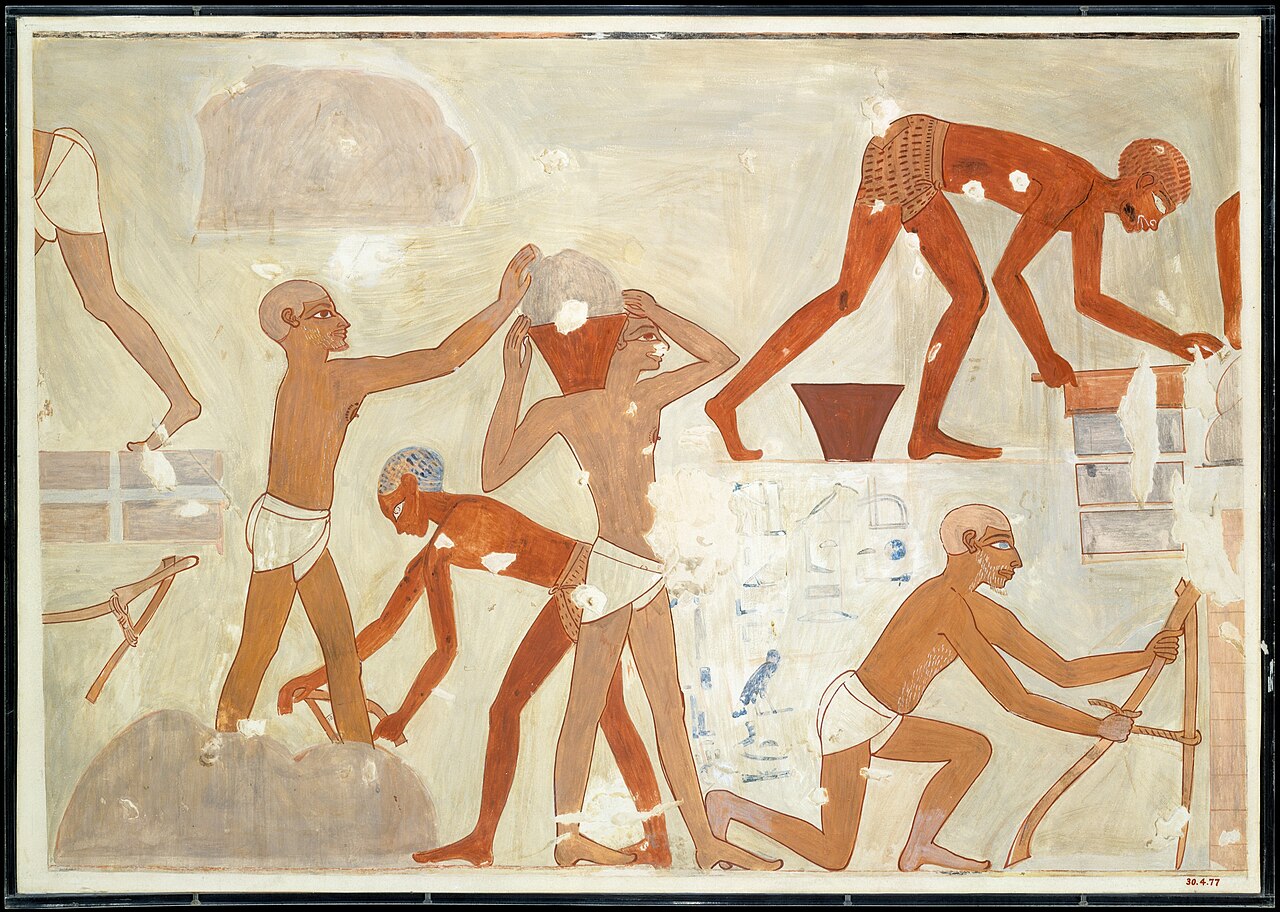
Exodus moves from slavery to deliverance, from deliverance to covenant, and from covenant to God dwelling among His people. It begins with Israel serving Pharaoh and ends with the glory of God filling the tabernacle.
Lessons
- 1A People Under OppressionExodus 1 · Jacob's family grows into a people in Egypt. A new Pharaoh fears them, forces them into brick-making and building, and orders their baby boys killed. Two midwives refuse.
- 2When Did the Exodus Happen?Exodus 12:40–41 · The Bible gives numbers that point to about 1446 BC. Place names point many scholars to the 13th century BC. Egypt's Merneptah Stele shows Israel in Canaan by about 1208 BC. Here is the evidence for each model.
- 3Moses Is BornExodus 2:1–10 · A Levite mother hides her baby, then sets him in a waterproofed basket among the Nile reeds. Pharaoh's daughter finds him, pays his own mother to nurse him, and names him Moses.
- 4Moses Flees to MidianExodus 2:11–25 · Grown up, Moses kills an Egyptian who is beating a Hebrew and flees to Midian. At a well he defends seven sisters, marries Zipporah, and becomes a shepherd while Israel groans in Egypt.
- 5The Burning BushExodus 3–4 · At the mountain of God, Moses sees a bush that burns without being consumed. God calls him to return to Egypt, reveals His name, answers every objection, and sends Aaron to help.
- 6"Let My People Go"Exodus 5–6 · Pharaoh answers Moses by doubling Israel's burden: same quota of bricks, no straw. Moses complains to God, who answers with His name and four promises of redemption.
- 7Blood, Frogs, Gnats, and FliesExodus 7–8 · Aaron's staff swallows the magicians' staffs. The Nile turns to blood, frogs cover the land, dust becomes gnats, and swarms of flies fill Egypt, but not Goshen. The magicians give up: "This is the finger of God."
- 8Livestock, Boils, and HailExodus 9 · Disease kills Egypt's livestock, boils break out on people and animals, and a hailstorm with fire destroys the flax and barley. For the first time Pharaoh says, "I have sinned."
- 9Locusts and DarknessExodus 10 · Pharaoh's own officials beg him to let Israel go. Locusts strip the land, then three days of darkness "which may be felt" cover Egypt, while Israel has light.
- 10The Last Warning and the Gods of EgyptExodus 11 · Moses announces the final plague: the death of every firstborn in Egypt, from Pharaoh's son to the slave girl's. What did the plagues say about Egypt's gods, and is there any Egyptian echo of them?
- 11PassoverExodus 12:1–13:16 · Each household sacrifices a lamb, marks its door with the blood, and eats in haste. At midnight Egypt's firstborn die, and Pharaoh drives Israel out. The night becomes a feast remembered forever.
- 12The Way Out of EgyptExodus 13:17–14:4 · Israel avoids the fortified coastal road, carries Joseph's bones, and follows a pillar of cloud and fire to camp "before Pi-hahiroth, between Migdol and the sea." Egypt's eastern frontier was real, fortified, and guarded.
- 13Pharaoh's PursuitExodus 14:5–14 · Pharaoh changes his mind and chases Israel with six hundred chosen chariots. Trapped between the army and the sea, the people panic. An Egyptian report of officials pursuing runaway slaves at the same frontier shows how such a chase worked.
- 14The Crossing of the SeaExodus 14:15–31 · Moses stretches out his hand, a strong east wind blows all night, and Israel walks through the sea on dry ground. The waters return over Pharaoh's chariots. Where did it happen, could wind do it, and what about the chariot wheels said to lie under the Gulf of Aqaba?
- 15The Song of the SeaExodus 15:1–21 · Moses and Israel sing, and Miriam leads the women with timbrels. The Song of the Sea is one of the oldest poems in the Bible, and a Dead Sea Scroll preserves a longer version of Miriam's song.
- 16Marah and ElimExodus 15:22–27 · Three days into the wilderness without water, Israel finds only bitter water at Marah. God shows Moses a tree that makes it sweet, and then brings them to Elim, with twelve springs and seventy palm trees.
- 17Manna and QuailExodus 16 · Hungry in the wilderness of Sin, Israel wishes it had died in Egypt. God sends quail in the evening and, every morning, a fine flake-like bread called manna, with a lesson about daily trust and the Sabbath.
- 18Water from the Rock and AmalekExodus 17 · At Rephidim there is no water, and the people nearly stone Moses. God sends water from the rock at Horeb. Then Amalek attacks, and Israel prevails while Moses' hands are held up.
- 19Jethro's CounselExodus 18 · Moses' father-in-law, the priest of Midian, brings Zipporah and her sons to the camp, rejoices at what God has done, offers sacrifices, and shows Moses how to share the burden of judging the people.
- 20Where Is Mount Sinai?Exodus 19 · Three months after leaving Egypt, Israel camps before the mountain. God offers a covenant, and the mountain shakes with thunder, fire and the sound of a trumpet. But where was it? Four main candidates, and what would settle the question.
- 21The Ten CommandmentsExodus 20 · God speaks the Ten Words from the mountain. They begin with deliverance, not demand, and they appear twice in the Bible, in Exodus 20 and Deuteronomy 5, with telling differences. The oldest copy outside the Dead Sea Scrolls is a scrap of papyrus from Egypt.
- 22The Book of the CovenantExodus 20:22–23:33 · After the Ten Commandments come Israel's first detailed laws: on servants, violence, property, the vulnerable, justice and festivals. They share their world with Hammurabi's famous code, sometimes word for word in subject, but differ in striking ways. And they include hard laws about slavery that deserve honest treatment.
- 23The Covenant SealedExodus 24 · Moses writes down God's words, builds an altar with twelve pillars, and seals the covenant with blood. The elders see the God of Israel and eat and drink before Him. Then Moses enters the cloud for forty days.
- 24The Tabernacle and the ArkExodus 25–27 · On the mountain God shows Moses the pattern of a portable sanctuary: an ark covered with gold and guarded by cherubim, a table, a lampstand, curtains, a courtyard and an altar. Portable shrines and royal war tents from Egypt and the desert show this kind of sanctuary belonged to the Late Bronze Age world.
- 25Priests and Their GarmentsExodus 28–31 · Aaron and his sons are set apart as priests, dressed "for glory and for beauty": an ephod, a breastplate with twelve stones for the twelve tribes, the Urim and Thummim, and a gold plate engraved "Holiness to the LORD." God fills Bezalel with His Spirit to make it all, and gives the Sabbath as a sign.
- 26The Golden CalfExodus 32 · While Moses is on the mountain, the people ask Aaron for gods to go before them. He makes a golden calf and proclaims a feast to the LORD. Moses breaks the tablets, Israel is judged, and Moses offers his own life for the people. Calf images were real, and the same words return in the kingdom of Jeroboam.
- 27Show Me Your GloryExodus 33–34 · Moses asks to see God's glory. God passes by, proclaims His name and character, renews the covenant, and writes new tablets. Moses comes down with his face shining, which a Latin translation turned into horns that lasted in art for a thousand years.
- 28God Dwells Among His PeopleExodus 35–40 · The people give so generously that Moses has to tell them to stop. Bezalel and the craftsmen build everything as commanded, and on the first day of the second year the tabernacle is set up. The cloud covers it, and the glory of the LORD fills it.
How Exodus came to us
Who wrote it, how it was copied, and how it reached the Bible you hold. These lessons follow the book through history.
- ★How Exodus Came to UsWho wrote Exodus, how it was copied and translated for three thousand years, the places where the copies differ, and how it became Scripture for Jews, Samaritans and Christians.
- 2Moses and the TorahWho wrote the five books of Moses, what the Bible itself says about Moses writing, and the oldest surviving words of Scripture.
- 6The SeptuagintJews in Egypt translated their Scriptures into Greek, creating the Bible of the early church and of the New Testament writers.
- 7The Dead Sea ScrollsA shepherd's discovery in 1947 gave us Bible manuscripts a thousand years older than any known before, and showed how faithfully the text was kept.
- 8Hebrew, Greek, and SamaritanThree ancient lines of copying, Hebrew, Greek, and Samaritan, let us compare the text and see where it was preserved and where it changed.
- 13Scribes, Jerome, and the MasoretesJerome gave the West its Latin Bible; Jewish scholars called the Masoretes guarded the Hebrew text letter by letter.
Journey of a Passage
- ¶Exodus 34:29: Moses' face: shining or horned?The Hebrew says the skin of Moses' face qaran, a verb related to qeren, "horn," which can also mean a ray of light. The Greek read "glorified"; Aquila and the Latin Vulgate read "horned"; and Western art gave Moses horns for a thousand years.
- ¶Exodus 20:8–17: The Ten Commandments: order, Sabbath, and a Samaritan commandmentThe Decalogue is one of the best-attested passages in the Bible, yet its witnesses differ in three ways: the order of "murder, adultery, theft," the reason given for the Sabbath (Exodus 20 versus Deuteronomy 5), and an extra commandment about Mount Gerizim in the Samaritan Pentateuch.
- ¶Exodus 12:40: 430 years in Egypt, or in Canaan and Egypt?The Hebrew says Israel's sojourn "in Egypt" lasted 430 years. The Samaritan Pentateuch and the Greek Septuagint say the 430 years covered Canaan and Egypt together, which leaves about 215 years in Egypt.