Israel camps at Rephidim, and there is no water. The people quarrel with Moses: "Wherefore is this that thou hast brought us up out of Egypt, to kill us and our children and our cattle with thirst?" Moses cries to the LORD, "They be almost ready to stone me."
"Behold, I will stand before thee there upon the rock in Horeb; and thou shalt smite the rock, and there shall come water out of it, that the people may drink." Moses does so in the sight of the elders. He names the place Massah and Meribah, "Testing" and "Quarreling," "because they tempted the LORD, saying, Is the LORD among us, or not?"
Then Amalek comes and fights Israel at Rephidim. Moses tells Joshua to choose men, while he stands on the hill with the rod of God. "When Moses held up his hand, Israel prevailed: and when he let down his hand, Amalek prevailed." When his hands grow heavy, Aaron and Hur sit him on a stone and hold up his hands, one on each side, until sunset. Joshua defeats Amalek.
"Write this for a memorial in a book," God tells Moses. Moses builds an altar and calls it "The LORD is my banner" (Yahweh Nissi).
Water in the rock
The granite and sandstone mountains of Sinai do hold water. Rain and flash floods seep into cracks and porous layers, and springs and seeps emerge at the foot of cliffs. Travelers have reported that breaking a surface crust at such a spot can release a trickle. None of this produces water for a nation, and Exodus does not say it did by natural means.
The split rock
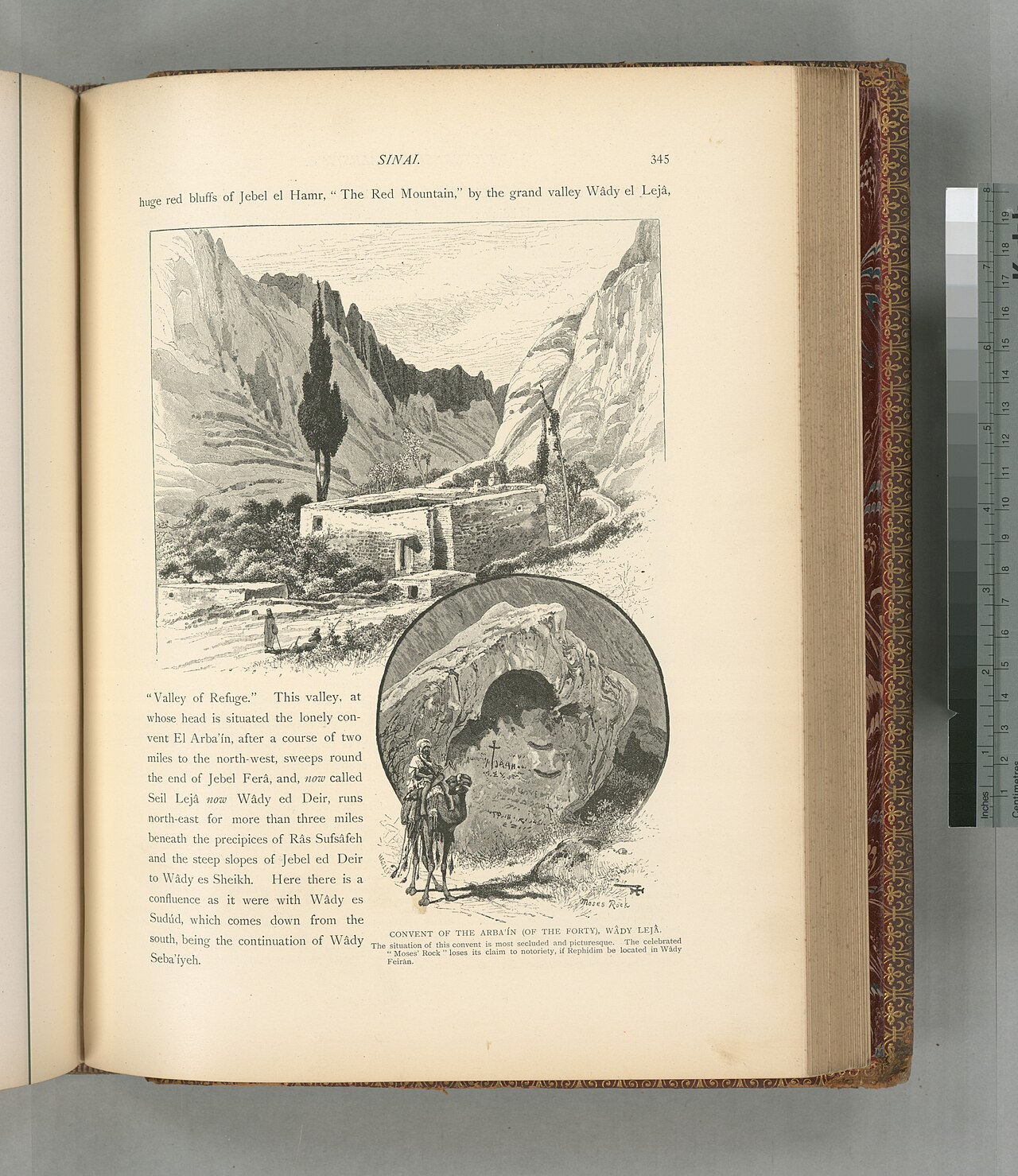
A tall boulder split down the middle near Jebel al-Lawz in northwestern Arabia has become famous as the "rock of Horeb" among those who place Sinai in Arabia. A rock in the Wadi Leja near Jebel Musa has been shown to pilgrims as Moses' rock since the Byzantine period. Both identifications rest on appearance and tradition; neither can be tested.
Who were the Amalekites?
The Bible describes Amalek as a nomadic people of the Negev and northern Sinai, descended from Esau's grandson Amalek (Genesis 36:12). They appear again with Saul (1 Samuel 15) and David (1 Samuel 30). No non-biblical text names them, which is unsurprising for a desert people who left few written records. Conflicts over wells and routes between herders and travelers are well attested in this region.
"Write this in a book"
Exodus 17:14 is the first time the Bible says Moses wrote something down. It matters for the question of how the Torah came to be (see How Exodus Came to Us).
The Case for the Biblical Account
Scripture's account
Water from the rock at Horeb; a battle with Amalek at Rephidim; Moses writes a memorial (Exodus 17).
What evidence would we expect?
Water-bearing rock and desert springs; nomadic groups contesting routes and water; a writing tradition associated with Moses.
The discoveries
Seeps and springs in Sinai's granite mountains; traditional and modern candidate rocks; abundant evidence of nomadic pastoralists in Sinai and the Negev.
Testing the discoveries
Rephidim is unidentified; candidate rocks are chosen by appearance; Amalek is not named outside the Bible.
The strongest reconstruction
The setting is realistic for the Sinai wilderness. The events themselves are known only from the biblical tradition.
What remains possible
Any of several locations; a miraculous provision through or beyond the rock's natural water.
The same story twice?
Numbers 20 tells of water from a rock at Meribah near Kadesh, nearly forty years later, when Moses strikes the rock instead of speaking to it and is barred from entering Canaan. Some scholars see two versions of one tradition; others, two events at two places. Paul alludes to a Jewish tradition that the rock "followed them" (1 Corinthians 10:4).
What the evidence shows
- Mountains in Sinai hold water in fractures and porous rock, released at seeps and springs.
- The split rock near Jebel al-Lawz is the rock Moses struck.
- Amalekites are attested outside the Bible. No non-biblical reference has been identified.
- "The LORD is my banner."
Continue the journey
Ancient MysteriesMount Sinai in Saudi Arabia?Is Jebel al-Lawz in northwestern Arabia the true mountain of God?More from this lesson
Investigations
Optional deep dives: the ancient sources, the physical evidence, and every interpretation side by side, including unconventional ones, each labeled for what it is.
Mount Sinai in Saudi Arabia?Midian argument: worth weighing · Physical features: undated · Identification: unverified
Is Jebel al-Lawz in northwestern Arabia the true mountain of God?
Since the 1980s, explorers have argued that Mount Sinai is Jebel al-Lawz in Saudi Arabia, in the land of ancient Midian. They point to a blackened summit, a stone platform with cattle petroglyphs, boundary markers, altars, and a split rock. The Midian connection is a serious biblical argument. The physical features have not been excavated or dated, and geologists and archaeologists explain them differently.
Open the full investigation →Why this matters to the rest of Scripture
- Meribah again, and Moses' fateful strike.
- The second water-from-the-rock episode.
- "Harden not your heart, as in the provocation… when your fathers tempted me."
- "They drank of that spiritual Rock… and that Rock was Christ."
- "Remember what Amalek did unto thee."
- Saul and the Amalekites.