Era 4 · Covenant and WildernessExodus
The Book of the Covenant
"Now these are the judgments which thou shalt set before them"
God gives Moses "judgments" to set before the people. They begin with worship: no gods of silver or gold, and an altar of earth or uncut stone.
Then the laws turn to daily life. A Hebrew servant serves six years and goes free in the seventh. Whoever strikes a man so that he dies shall be put to death, but there will be a place of refuge for accidental killing. Kidnapping is a capital crime. Injuries are compensated: "eye for eye, tooth for tooth, hand for hand, foot for foot." A master who knocks out a servant's eye or tooth must set the servant free.
An ox that gores and kills is stoned; if its owner was warned and did nothing, he is liable too. There are laws for theft, for damage to fields, for borrowed animals and for deposits.
Then the vulnerable: "Thou shalt neither vex a stranger, nor oppress him: for ye were strangers in the land of Egypt. Ye shall not afflict any widow, or fatherless child." No interest on loans to the poor; a cloak taken in pledge must be returned before sunset, "for that is his covering only… and it shall be, when he crieth unto me, that I will hear; for I am gracious."
Justice: no false reports, no following a crowd to do evil, no bribes, no bias for the rich or the poor in court. Return your enemy's straying ox. Let the land rest every seventh year, "that the poor of thy people may eat." Rest on the seventh day, "that thine ox and thine ass may rest." Three times a year all Israel's men will appear before the LORD: at Unleavened Bread, Harvest, and Ingathering.
Finally, a promise: "Behold, I send an Angel before thee, to keep thee in the way, and to bring thee into the place which I have prepared."
The Code of Hammurabi
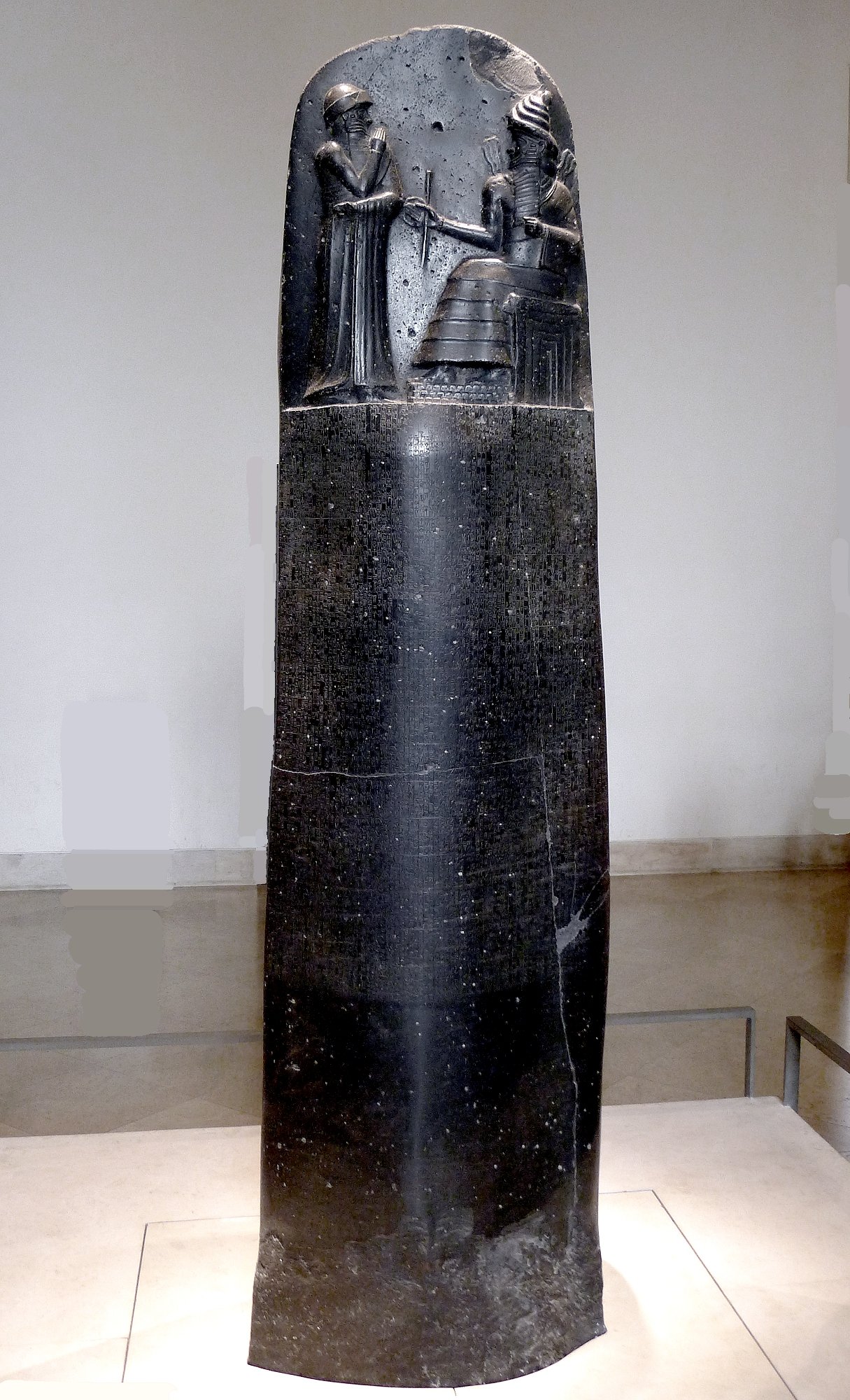
Found at Susa in 1901–1902 and now in the Louvre, this black basalt stele (about 1754 BC) records some 282 laws of King Hammurabi of Babylon beneath a relief of the king before the sun god Shamash, the god of justice. Earlier collections exist too: the laws of Ur-Nammu (about 2100 BC), Lipit-Ishtar and Eshnunna. Later, Hittite and Middle Assyrian laws. The Book of the Covenant belongs to this legal world.
The goring ox
| Hammurabi (§§ 250–252) | Exodus 21:28–32 |
|---|---|
| If an ox gores a man to death while walking along the street, there is no claim. | If an ox gore a man or a woman, that they die: then the ox shall be surely stoned… but the owner of the ox shall be quit. |
| If the ox was known to gore and the owner was warned but did not blunt its horns or control it, and it kills a free man, the owner pays half a mina of silver. | If the ox were wont to push with his horn in time past, and it hath been testified to his owner, and he hath not kept him in… the ox shall be stoned, and his owner also shall be put to death. If there be laid on him a sum of money, then he shall give for the ransom of his life. |
| If it kills a man's slave, he pays one-third of a mina. | If the ox shall push a manservant or a maidservant; he shall give unto their master thirty shekels of silver, and the ox shall be stoned. |
The sequence is remarkably close, which shows a shared legal tradition. The differences are telling: in Exodus the ox itself is stoned, because a life has been taken, and the owner's own life is forfeit (though ransom is allowed).
Different values
- Hammurabi's penalties vary by social class (noble, commoner, slave); Exodus applies "eye for eye" equally and frees a slave injured by his master.
- Hammurabi punishes some property crimes with death; Exodus requires restitution for theft and reserves death for crimes against persons and against God.
- Hammurabi's laws are the king's; Exodus' laws are God's, given to the whole people, and include worship, the Sabbath, and care for foreigners, widows and orphans.
- "Eye for eye" (lex talionis) in Exodus limits revenge to a just measure; Jewish tradition from early times interpreted it as monetary compensation.
The hard question: slavery
Exodus regulates servitude rather than abolishing it. A Hebrew debt-servant goes free in the seventh year. A daughter sold as a servant-wife must be treated as a daughter or freed. A master who kills a slave is punished; one who maims a slave must free him. But a master who strikes a slave who survives a day or two is not punished, "for he is his money" (21:21), and foreign slaves had fewer protections (Leviticus 25:44–46). These laws were more protective than many ancient codes, and they differ from modern race-based chattel slavery. They still trouble modern readers, and they should. Jewish interpreters narrowed them over centuries; Christian abolitionists appealed to Exodus' own story of a God who frees slaves.
The Case for the Biblical Account
Scripture's account
God gives Moses the laws of the Book of the Covenant (Exodus 20:22–23:33; named in 24:7).
What evidence would we expect?
Similar ancient Near Eastern law collections, showing a shared legal culture, and distinctive features reflecting Israel's faith.
The discoveries
The laws of Ur-Nammu, Lipit-Ishtar, Eshnunna and Hammurabi; Hittite and Middle Assyrian laws; close parallels in subject and order.
Testing the discoveries
The parallels are real and sometimes very close. Scholars disagree whether Exodus drew directly on Hammurabi (copies circulated for over a thousand years) or on a shared legal tradition.
The strongest reconstruction
The Book of the Covenant is ancient Near Eastern law transformed by Israel's theology: covenant with one God, care for the vulnerable, and the memory of slavery in Egypt.
What remains possible
That it was given at Sinai; that it preserves early Israelite customary law; or, in David Wright's view, that a later Israelite scribe reworked Hammurabi's laws.
What the evidence shows
- The Code of Hammurabi (c. 1754 BC) contains laws on the goring ox closely paralleling Exodus 21:28–32.Source: M. T. Roth, Law Collections from Mesopotamia and Asia Minor, 2nd ed. (1997)
- The Book of the Covenant and Mesopotamian law collections share a common legal tradition.Source: M. T. Roth, Law Collections from Mesopotamia and Asia Minor, 2nd ed. (1997)
- The Book of the Covenant was written as a direct revision of Hammurabi's laws.Source: D. P. Wright, Inventing God's Law: How the Covenant Code of the Bible Used and Revised the Laws of Hammurabi (Oxford, 2009)
- Israel's laws reflect God's care for the stranger, the widow and the orphan.
Continue the journey
Echoes Across CivilizationsAncient law collectionsDid other ancient peoples have laws like those in the Book of the Covenant?More from this lesson
Echoes Across Civilizations
Optional: how other ancient peoples told similar stories. Open one to compare, then come back to the lesson.
Ancient law collectionsBabylonian · Sumerian and Babylonian
Did other ancient peoples have laws like those in the Book of the Covenant?
- Babylonian: The Laws of Hammurabi Shared literary world
- Sumerian and Babylonian: The Laws of Ur-Nammu, Lipit-Ishtar and Eshnunna Shared literary world
Why this matters to the rest of Scripture
- Holiness in daily life: gleaning, wages, and love for the neighbor.
- Jesus on "an eye for an eye."
- The release of Hebrew servants, with provisions.
- Judah breaks the law of releasing slaves.
- Sabbath year and Jubilee.
- "To visit the fatherless and widows in their affliction."
- "Not now as a servant, but above a servant, a brother beloved."