Era 4 · Covenant and WildernessExodus
Where Is Mount Sinai?
"Ye shall be unto me a kingdom of priests, and an holy nation"
In the third month after leaving Egypt, Israel comes to the wilderness of Sinai and camps before the mount. God calls to Moses: "Ye have seen what I did unto the Egyptians, and how I bare you on eagles' wings, and brought you unto myself. Now therefore, if ye will obey my voice indeed, and keep my covenant, then ye shall be a peculiar treasure unto me above all people: for all the earth is mine: And ye shall be unto me a kingdom of priests, and an holy nation."
The people answer together: "All that the LORD hath spoken we will do." They wash their clothes and prepare for three days. Bounds are set around the mountain; no one may touch it.
On the third day, "there were thunders and lightnings, and a thick cloud upon the mount, and the voice of the trumpet exceeding loud; so that all the people that was in the camp trembled." Mount Sinai is wrapped in smoke, "because the LORD descended upon it in fire: and the smoke thereof ascended as the smoke of a furnace, and the whole mount quaked greatly." The trumpet grows louder; Moses speaks, and God answers him by a voice.
The candidates
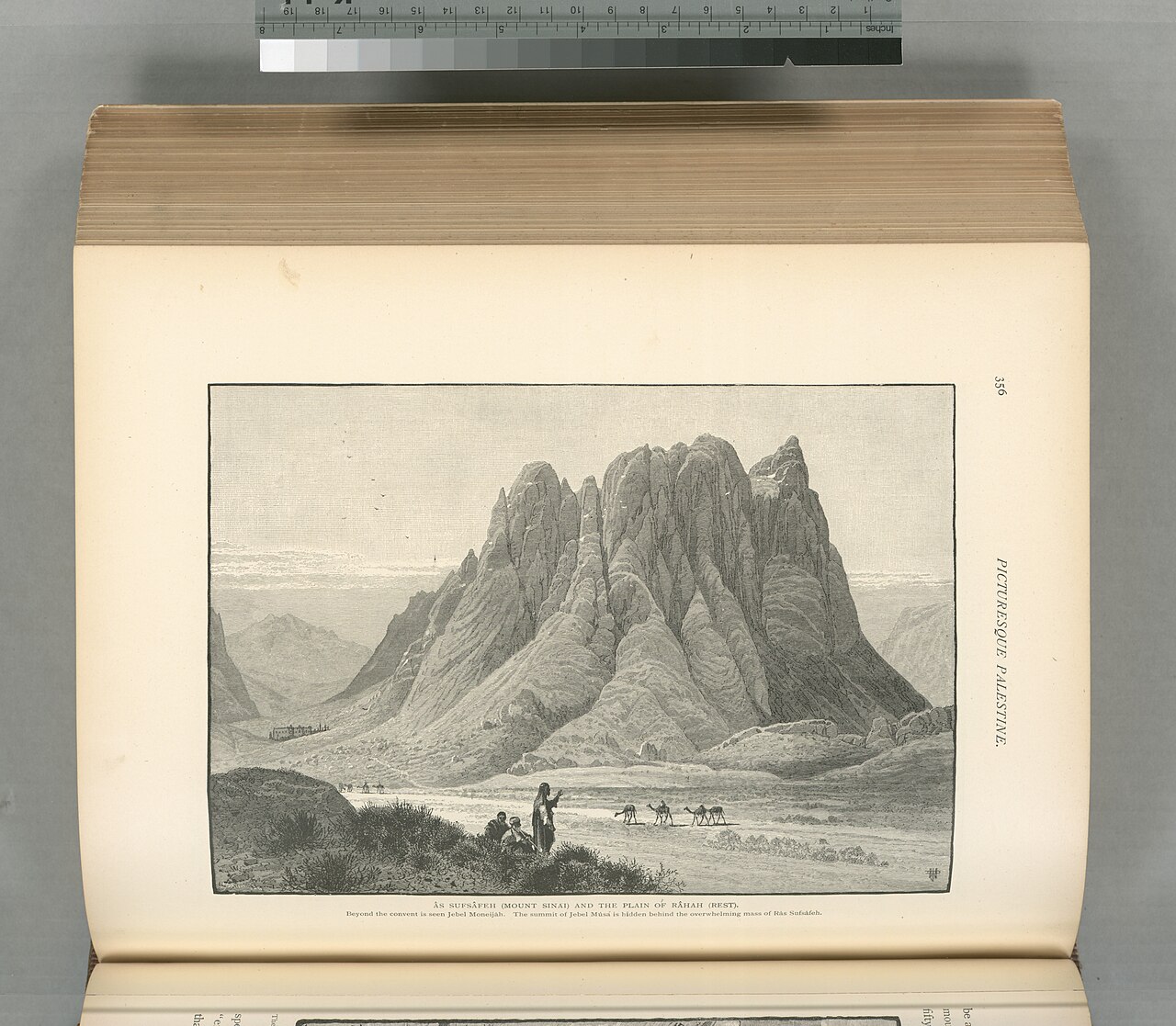
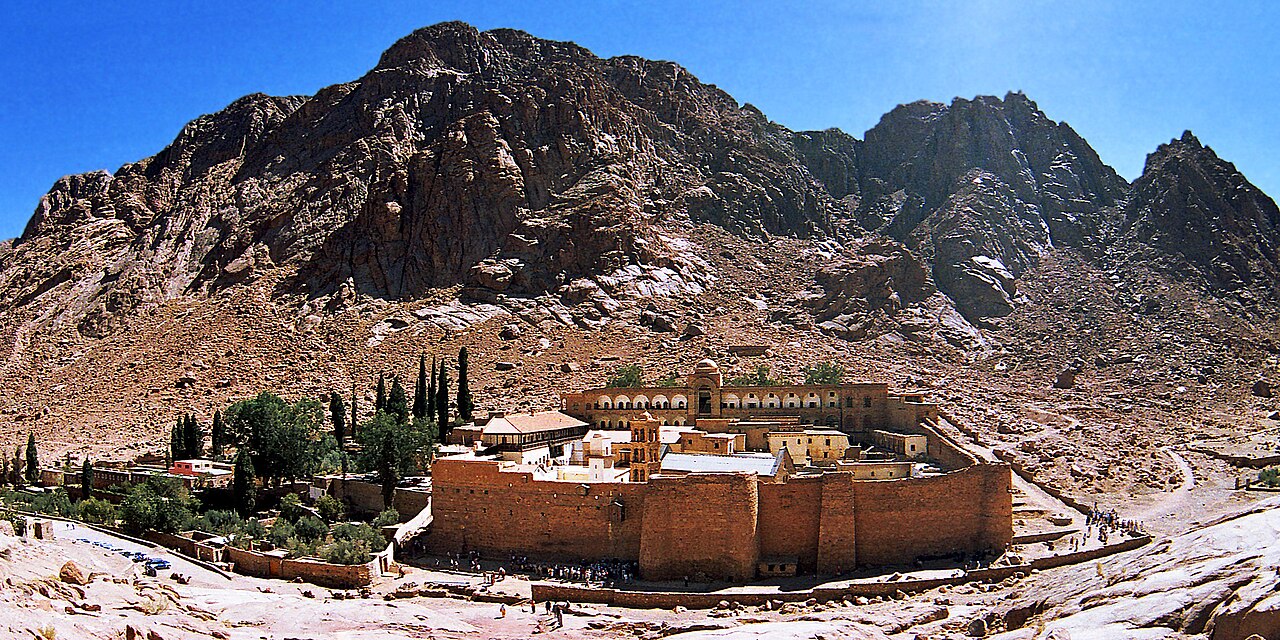
The traditional Mount Sinai (2,285 m), in the granite mountains of southern Sinai, beside St. Catherine's Monastery. Christian monks lived here by the 4th century; the pilgrim Egeria climbed it around 383 AD and was shown the sites of the burning bush and the golden calf. Justinian built the fortified monastery in the 6th century. A broad plain (er-Raha) lies before the mountain.
Strength: an unbroken tradition of at least 1,600 years, and a setting that fits the story well. Challenge: the tradition is Byzantine; no Bronze Age remains link the mountain with Israel.
A peak (2,580 m) in northwestern Saudi Arabia, in ancient Midian, promoted since the 1980s by Ron Wyatt, Bob Cornuke and Larry Williams, and later in films. Galatians 4:25 says "Sinai… in Arabia," and Moses met God near his Midianite home. Advocates point to a blackened summit, rock art of cattle on a stone platform they call the golden calf altar, stone circles and boundary markers, and a split rock nearby.
Challenge: "Arabia" in Paul's time included the Sinai peninsula and the Nabataean kingdom; the dark summit is dark rock, not burnt rock; cattle petroglyphs are common across Arabia and may be thousands of years older or younger; the structures have not been excavated and dated. See the investigation.
A plateau in the Israeli Negev, proposed by Italian archaeologist Emmanuel Anati after decades of surveys. It has tens of thousands of rock engravings and hundreds of ancient shrines, standing stones and campsites, showing it was a sacred mountain in prehistory.
Challenge: the main period of activity at Har Karkom is the Early Bronze Age (about 2350–2000 BC), long before either Exodus date. Anati proposed moving the Exodus earlier to match, which few accept.
Jebel Serbal in southern Sinai (favored by some early monks); Jebel Sin Bishar in west-central Sinai (proposed by Menashe Har-El, about a few days' march from Egypt); Jebel Helal in northern Sinai near Kadesh; volcanic peaks in Arabia such as Hala-l Badr (because of the fire and smoke).
Why the location is hard to fix
The Bible gives travel times (eleven days from Horeb to Kadesh by the Mount Seir road, Deuteronomy 1:2) and station names (Numbers 33), but few of the stations have been identified. A people living in tents for a year would leave little for archaeologists to find, especially if they moved on. And later Israel never made Sinai a pilgrimage site; only Elijah is said to have gone back (1 Kings 19:8).
The Case for the Biblical Account
Scripture's account
Israel camps before Mount Sinai (Horeb), in the wilderness of Sinai, three months after leaving Egypt; God descends on the mountain in fire (Exodus 19).
What evidence would we expect?
A mountain with a plain or valley able to hold a large camp; a plausible route from Egypt matching the travel times; human activity datable to the right period; features linked to the story.
The discoveries
Jebel Musa's ancient tradition and setting; Jebel al-Lawz's claimed features; Har Karkom's ancient sanctuaries; other peaks with partial arguments.
Testing the discoveries
Each candidate fits some criteria and fails others. None has securely dated remains connected with the Exodus period and the biblical narrative.
The strongest reconstruction
Mount Sinai's location has not been identified. That is a limit of the evidence, not proof that the mountain never existed.
What remains possible
Any of the candidates, or another mountain; new survey and dating work, especially in northwestern Arabia, could change the picture.
| Candidate | Strongest argument | Main weakness |
|---|---|---|
| Jebel Musa (south Sinai) | 1,600-year tradition; fits the story's setting | Tradition begins centuries after the events |
| Jebel al-Lawz (Arabia) | Midian connection; Galatians 4:25 | Claimed features undated or explained otherwise |
| Har Karkom (Negev) | Abundant ancient cult sites | Activity peaks long before any Exodus date |
| Jebel Sin Bishar (west Sinai) | Close to Egypt; fits a short journey | Little evidence beyond geography |
What the evidence shows
- Pilgrims were shown Jebel Musa as Mount Sinai by the late 4th century AD.Source: Egeria, Itinerarium (Travels), 381–384 AD; tr. J. Wilkinson, Egeria's Travels (3rd ed., 1999)
- Har Karkom has abundant prehistoric cult sites, mostly from the Early Bronze Age.Source: E. Anati, The Mountain of God: Har Karkom (1986)
- Jebel al-Lawz is Mount Sinai.Source: "Is Mt. Sinai in Saudi Arabia?" Bible History Daily, Biblical Archaeology Society; G. Franz, "Is Mount Sinai in Saudi Arabia?" Bible and Spade 13:4 (2000)
- Mount Sinai's location has been identified.
- "Ye shall be unto me a kingdom of priests, and an holy nation."
Continue the journey
Ancient MysteriesMount Sinai in Saudi Arabia?Is Jebel al-Lawz in northwestern Arabia the true mountain of God?More from this lesson
On the map
Location securely identified Probable identification Proposed or debated location Biblical route (roads schematic) Scholarly proposal
- Exodus proposal: southern Sinai (traditional). Rameses → Succoth → a crossing at the Gulf of Suez (or the nearby lakes) → down the west Sinai coast → Jebel Musa → north to Kadesh-barnea.
- Exodus proposal: northern lakes and Negev. Rameses → Succoth → a crossing in the frontier lakes → across north-central Sinai → a Sinai such as Har Karkom → Kadesh-barnea.
- Exodus proposal: Arabia (Midian). Rameses → across the Sinai peninsula → a crossing at Nuweiba in the Gulf of Aqaba → Jebel al-Lawz in Midian → Kadesh-barnea.
Investigations
Optional deep dives: the ancient sources, the physical evidence, and every interpretation side by side, including unconventional ones, each labeled for what it is.
Mount Sinai in Saudi Arabia?Midian argument: worth weighing · Physical features: undated · Identification: unverified
Is Jebel al-Lawz in northwestern Arabia the true mountain of God?
Since the 1980s, explorers have argued that Mount Sinai is Jebel al-Lawz in Saudi Arabia, in the land of ancient Midian. They point to a blackened summit, a stone platform with cattle petroglyphs, boundary markers, altars, and a split rock. The Midian connection is a serious biblical argument. The physical features have not been excavated or dated, and geologists and archaeologists explain them differently.
Open the full investigation →Why this matters to the rest of Scripture
- The stations from Sinai to Kadesh.
- "Ye are a chosen generation, a royal priesthood, an holy nation."
- "Ye are not come unto the mount that might be touched… But ye are come unto mount Sion."
- "This Agar is mount Sinai in Arabia."
- Elijah at Horeb hears the still small voice.
- Moses recalls the day at Horeb.