Era 4 · Covenant and WildernessExodus
Show Me Your Glory
"The LORD, The LORD God, merciful and gracious"
God says He will send an angel ahead, but will not go up among the people Himself, "for thou art a stiffnecked people." The people mourn and strip off their ornaments.
Moses pitches the tent of meeting outside the camp. When he goes in, the pillar of cloud stands at the door, "and the LORD spake unto Moses face to face, as a man speaketh unto his friend." Moses pleads: "If thy presence go not with me, carry us not up hence." God agrees.
Then Moses asks, "I beseech thee, shew me thy glory." God answers: "I will make all my goodness pass before thee… Thou canst not see my face: for there shall no man see me, and live." God will put him in a cleft of the rock and cover him with His hand as He passes; "thou shalt see my back parts."
Moses cuts two new tablets and climbs the mountain. "And the LORD passed by before him, and proclaimed, The LORD, The LORD God, merciful and gracious, longsuffering, and abundant in goodness and truth, Keeping mercy for thousands, forgiving iniquity and transgression and sin, and that will by no means clear the guilty." Moses bows to the ground and worships.
God renews the covenant and its commands: no covenant with the peoples of the land, no molten gods, the feasts, the firstborn, the Sabbath. "Write thou these words." Moses is there forty days and nights without bread or water, "and he wrote upon the tables the words of the covenant, the ten commandments."
When Moses comes down, "the skin of his face shone while he talked with him." Aaron and the people are afraid to come near. Afterward Moses wears a veil, removing it when he goes in to speak with the LORD.
The most-quoted words about God
Exodus 34:6–7, called the Thirteen Attributes in Jewish tradition and recited on fast days and the High Holy Days, echoes through the Bible: Numbers 14:18, Nehemiah 9:17, Psalms 86:15, 103:8 and 145:8, Joel 2:13, Jonah 4:2, Nahum 1:3.
Shining or horned?
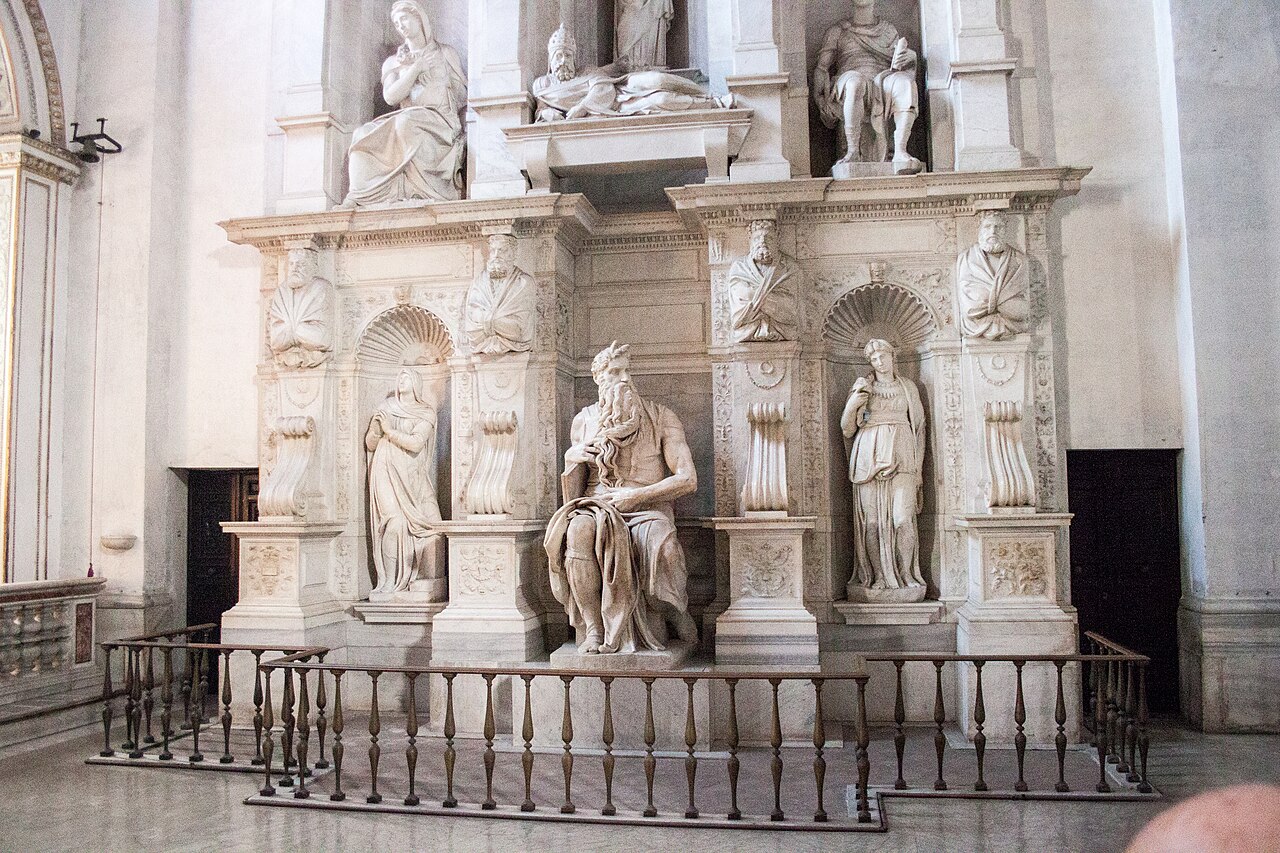
The Hebrew verb in Exodus 34:29 is qaran, from the noun qeren, "horn," which can also mean a ray of light (Habakkuk 3:4). The Greek Septuagint understood that Moses' face was "glorified." The second-century Greek translator Aquila rendered it "horned," and Jerome's Latin Vulgate (about AD 400) put it as cornuta, "horned." Jerome himself understood this as a sign of glory, but for over a thousand years Western artists showed Moses with horns.
The most famous example is Michelangelo's marble Moses (1513–1515) for the tomb of Pope Julius II, in Rome, with two small horns on his head. Follow the passage to see every witness, from the Hebrew to the English Douay-Rheims Bible, which still read "his face was horned."
The ritual decalogue
The commands of Exodus 34:10–26 differ from Exodus 20: they concern worship, festivals, firstborn, first fruits, and not boiling a kid in its mother's milk. Since Goethe, some scholars have called them a "ritual decalogue" and argued it was another version of the Ten Words. Traditionally they are the renewal terms of the covenant, emphasizing the areas where Israel had just failed: idolatry and worship.
The Case for the Biblical Account
Scripture's account
God reveals His glory and character to Moses, renews the covenant and the tablets, and Moses' face shines (Exodus 33–34).
What evidence would we expect?
A text history explaining how "shone" became "horned"; reuse of the divine attributes throughout Scripture; ancient interpretations of the veil.
The discoveries
The Hebrew qaran; the Septuagint, Aquila and Vulgate renderings; the horned Moses in medieval and Renaissance art; the attribute formula across the Old Testament.
Testing the discoveries
The textual history is well documented. The ritual decalogue's relation to Exodus 20 is debated.
The strongest reconstruction
The Hebrew describes Moses' face shining with reflected glory; "horned" is a translation choice that shaped Western art.
What remains possible
That qaran was deliberately ambiguous; Jewish and Christian interpreters have explored both images.
What the evidence shows
- The Vulgate renders Exodus 34:29 "his face was horned" (cornuta).
- Moses was shown with horns in Western art for centuries, including Michelangelo's statue.Source: R. Mellinkoff, The Horned Moses in Medieval Art and Thought (1970)
- Exodus 34:10–26 preserves an alternative version of the Ten Commandments.Source: W. H. C. Propp, Exodus 19–40, Anchor Bible 2A (2006)
- "The LORD, The LORD God, merciful and gracious."
Continue the journey
Journey of a PassageExodus 34:29: Moses' face: shining or horned?The Hebrew says the skin of Moses' face qaran, a verb related to qeren, "horn," which can also mean a ray of light.More from this lesson
Why this matters to the rest of Scripture
- Paul on Moses' veil and "the glory of God in the face of Jesus Christ" (4:6).
- "No man hath seen God at any time; the only begotten Son… he hath declared him."
- At the transfiguration Jesus' face "did shine as the sun," with Moses present.
- "I knew that thou art a gracious God, and merciful."
- Elijah in the cave at Horeb as God passes by.