Era 3 · Egypt and DeliveranceExodus
Pharaoh's Pursuit
"Fear ye not, stand still, and see the salvation of the LORD"
Word reaches Pharaoh that the people have fled. "Why have we done this, that we have let Israel go from serving us?" He harnesses his chariot and takes "six hundred chosen chariots, and all the chariots of Egypt, and captains over every one of them."
The Egyptians overtake Israel camped by the sea beside Pi-hahiroth. The Israelites look up and see them coming, and they are terrified. They cry out to the LORD, and turn on Moses: "Because there were no graves in Egypt, hast thou taken us away to die in the wilderness?… It had been better for us to serve the Egyptians, than that we should die in the wilderness."
Moses answers: "Fear ye not, stand still, and see the salvation of the LORD, which he will shew to you to day: for the Egyptians whom ye have seen to day, ye shall see them again no more for ever. The LORD shall fight for you, and ye shall hold your peace."
A pursuit in an Egyptian letter
Papyrus Anastasi V, a collection of model letters used to train scribes in the Ramesside period (13th century BC), preserves a report from an officer named Kakemur. He was sent from the royal palace "after these two slaves" who had escaped. He reached the enclosure-wall of Tjeku on the tenth day of the third month of summer; at the fortress he was told they had already passed the frontier, north of the Migdol of Seti. He writes asking for news of where they went and who was pursuing them.
The parallels are striking: the place Tjeku (biblical Succoth), a migdol, the eastern frontier, escaped slaves, and an official pursuit from the royal residence. It is not about Israel. It shows that the situation Exodus describes, servants escaping through this frontier and being pursued, was real enough for scribes to copy as a model letter.
Six hundred chariots
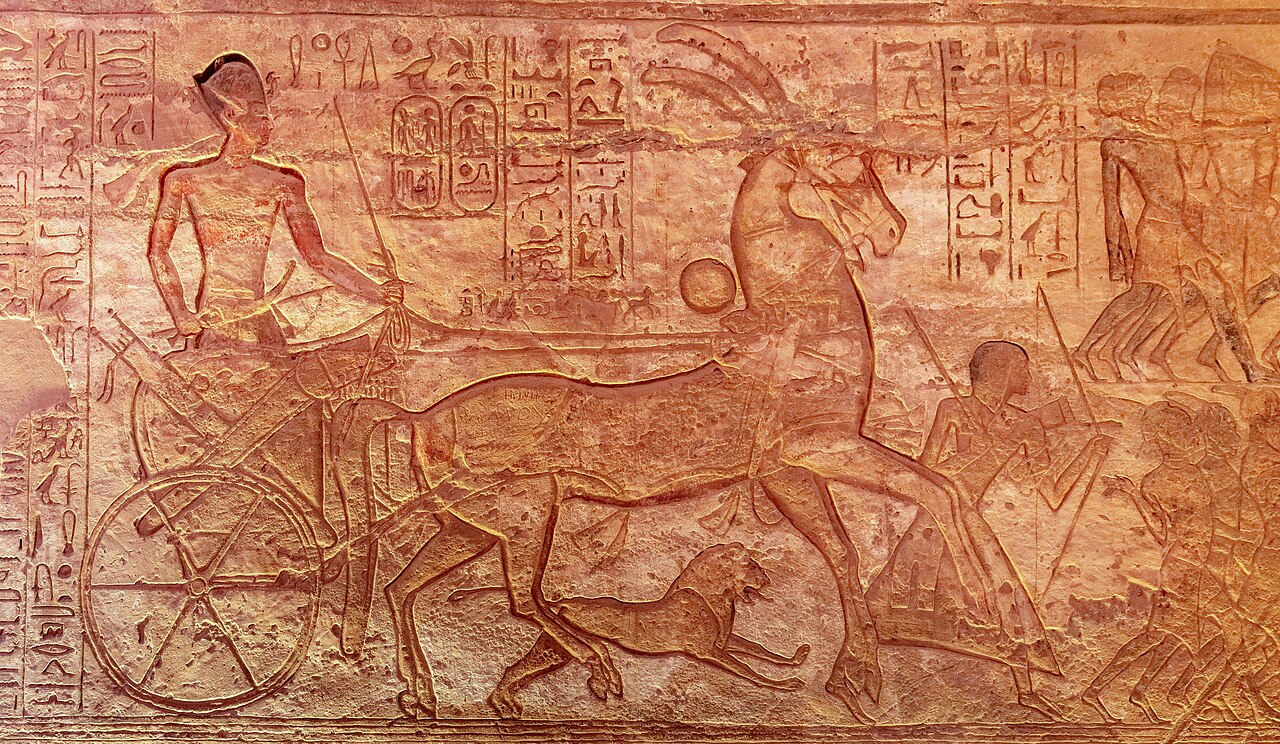
The chariot was the elite weapon of the New Kingdom army: light, two-wheeled, drawn by two horses, carrying a driver and a warrior. Egyptian battle reliefs show hundreds deployed at a time; Thutmose III claimed to capture 924 chariots at Megiddo, and Ramesses II fought the Hittites at Kadesh against thousands. A force of six hundred picked chariots is a realistic royal strike force.
The other direction: entering Egypt
Papyrus Anastasi VI records the opposite movement: an official reports that Shasu tribes from Edom have been allowed to pass the fortress of Tjeku "to keep them alive and to keep their cattle alive." Egyptian frontier officials controlled who came and went. Jacob's family entering Egypt in famine, and Israel leaving without permission, both fit that world.
The Case for the Biblical Account
Scripture's account
Pharaoh pursues the departing Israelites with chariots and overtakes them by the sea (Exodus 14:5–9).
What evidence would we expect?
Egyptian records of frontier control and the pursuit of escaped servants; a chariot force of the right kind.
The discoveries
Papyrus Anastasi V (pursuit of escaped slaves past Tjeku and a migdol); Papyrus Anastasi VI (Shasu admitted at Tjeku); New Kingdom chariot warfare in reliefs and texts.
Testing the discoveries
The papyri are genuine Ramesside documents. They concern small groups, not a nation, and do not mention Israel.
The strongest reconstruction
Exodus 14 describes the kind of pursuit Egyptian officials actually conducted at the eastern frontier, on a much greater scale and with a royal chariot force.
What remains possible
That Israel's memory of escape preserves an event of this type; or, for skeptics, that the narrative drew on known frontier realities.
What the evidence shows
- Egyptian officials pursued escaped slaves past the fortress of Tjeku and a migdol in the 13th century BC.Source: Papyrus Anastasi V 19.2–20.6, the pursuit of two runaway slaves; R. A. Caminos, Late-Egyptian Miscellanies (1954), pp. 254–258
- Egyptian frontier officials admitted pastoral groups from Edom in times of need.Source: Papyrus Anastasi VI 4.13–5.5, Shasu of Edom admitted at the fortress of Tjeku; Caminos, Late-Egyptian Miscellanies, pp. 293–296
- Pharaoh pursued Israel with six hundred chosen chariots. The scale is realistic; the event is attested only in Exodus.
- "The LORD shall fight for you."
Continue the journey
Connected elsewhere in ScriptureRefusing the Promised LandNumbers 14:3–4: "Were it not better for us to return into Egypt?" The same fear returns.More from this lesson
Why this matters to the rest of Scripture
- "Were it not better for us to return into Egypt?" The same fear returns.
- "Stand ye still, and see the salvation of the LORD with you."
- "In quietness and in confidence shall be your strength."