Era 4 · Covenant and WildernessExodus
How Exodus Came to Us
Authorship, ancient copies, translations, and what changed along the way
Exodus says more about its own writing than Genesis does. Three times it says Moses wrote: the memorial of the battle with Amalek (17:14), "all the words of the LORD" in the book of the covenant (24:4), and the words of the renewed covenant (34:27). The tablets themselves were written "with the finger of God" (31:18).
Jewish and Christian tradition holds that Moses wrote the whole Torah. Jesus refers to "the book of Moses" when quoting Exodus 3:6 (Mark 12:26). Many modern scholars see Exodus as the product of a longer process, in which older traditions, laws and songs were gathered and edited, reaching its present form in the first millennium BC. Many faithful readers hold a middle position: Moses as the source of foundational material, with inspired scribes preserving, arranging and updating it.
Exodus reaches us through different kinds of evidence, and they are not all the same kind of thing. There are Hebrew textual traditions (the Masoretic Text, and the Samaritan Pentateuch with its "pre-Samaritan" forerunners); there are surviving manuscripts, such as the Dead Sea Scrolls, which are a collection of many copies representing more than one of those traditions; and there are translations, above all the Greek Septuagint, which tell us about the Hebrew text their translators used. None of these is fully independent of the others: they share ancestors in copies that no longer exist. Comparing them shows a text copied with great care, with a number of real differences we can examine one by one.
The main witnesses, by kind
| Witness | What it is | Oldest copies |
|---|---|---|
| Masoretic Text | A Hebrew textual tradition: the standard text preserved by Jewish scribes, the basis of most English Old Testaments. | Aleppo Codex (c. 930; most of the Torah now lost), Leningrad Codex (1008) |
| Dead Sea Scrolls | Surviving manuscripts, not a single tradition: about 15–17 copies of Exodus from Qumran and nearby caves, plus passages in phylacteries and excerpts. Some are close to the Masoretic Text, some (like 4QpaleoExod-m) to the Samaritan, some to the Greek. | c. 250 BC – AD 68 |
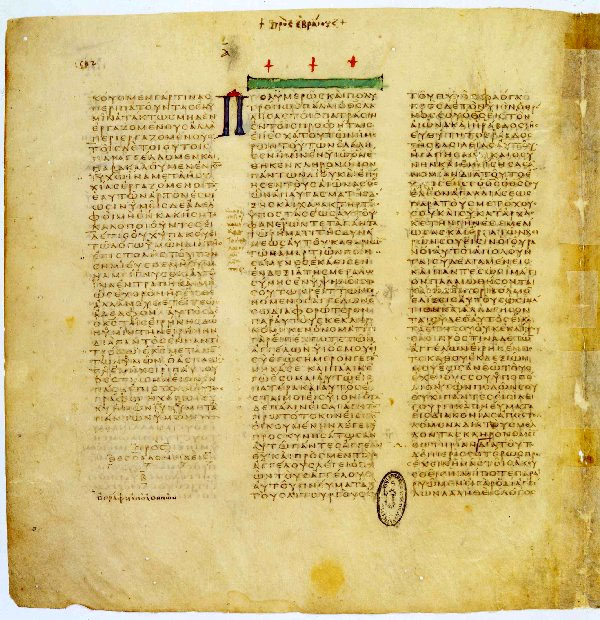
| Septuagint | A translation tradition, with many manuscripts of its own: the Greek translation made in Alexandria, the Bible of the New Testament writers. | Codex Vaticanus (4th century); earlier papyrus fragments |
| Samaritan Pentateuch | A Hebrew textual tradition: the Torah of the Samaritan community, an expanded text with harmonizations, built on an older Jewish "pre-Samaritan" form. | Medieval scrolls and codices, from an ancient tradition |
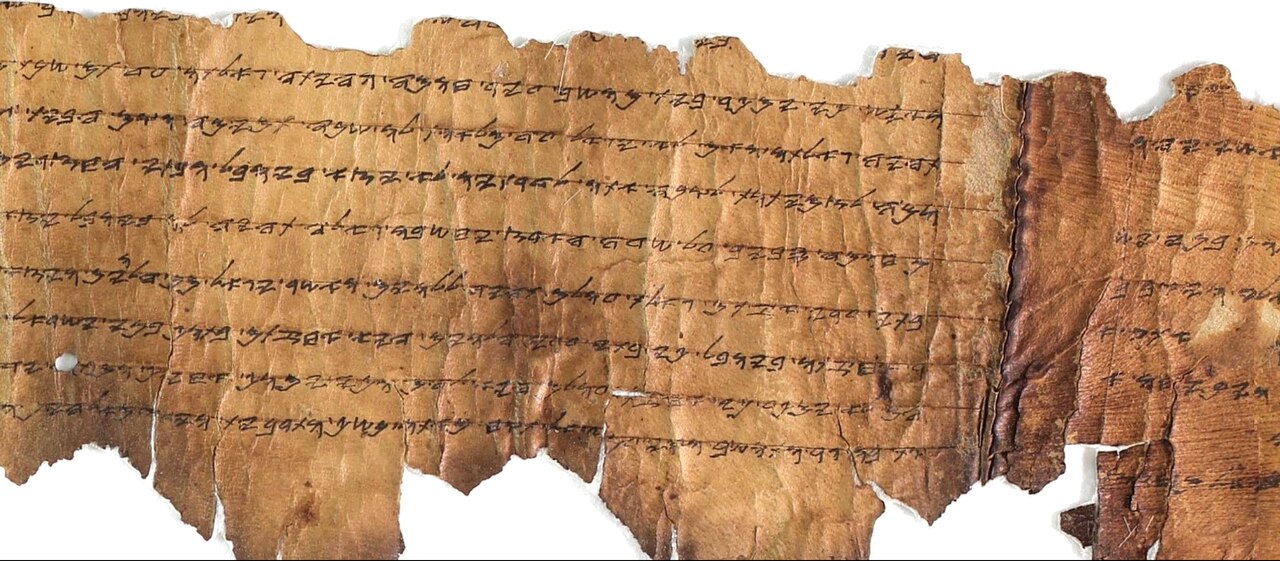
A scroll in the ancient script
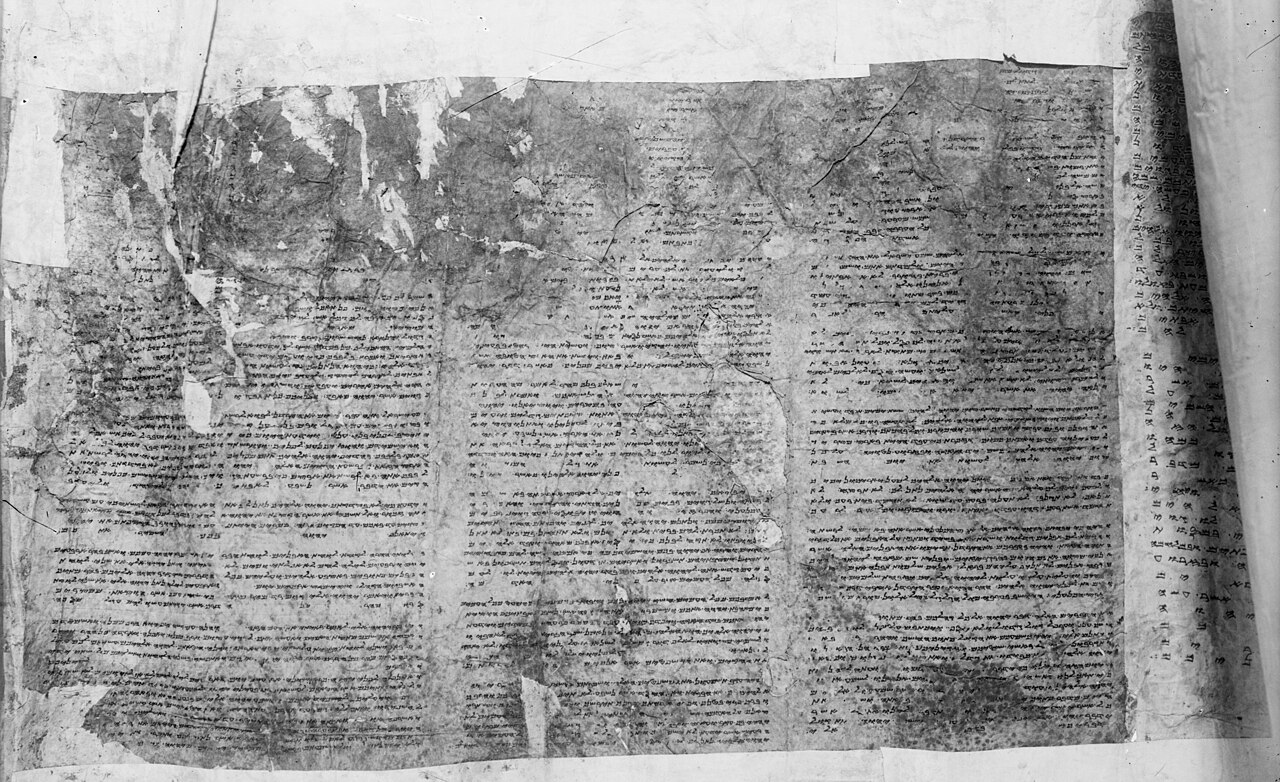
One of the most important Exodus scrolls, 4QpaleoExod-m, was written about 100–25 BC in the old paleo-Hebrew script that Israel used before the exile, rather than the square script of most scrolls. It contains large parts of Exodus 6–37. Its text agrees with the Samaritan Pentateuch in many expansions, such as repeating God's commands word for word when Moses carries them out in the plague stories. But it probably lacked the Samaritan commandment about Mount Gerizim. It shows that the expanded, "pre-Samaritan" form of Exodus was used by Jews too, and that the Samaritans later added their own distinctive changes to it.
Exodus in Greek, Aramaic, Latin, and English
- Greek (3rd century BC): the Septuagint translated "I AM THAT I AM" (3:14) as "I am the One who is" and Yam Suph as "the Red Sea," naming the sea for centuries of readers.
- Aramaic (early centuries AD): Targum Onqelos, read in synagogues alongside the Hebrew, explains anthropomorphic language, so that "they saw the God of Israel" (24:10) becomes "they saw the glory of the God of Israel."
- Latin (c. AD 400): Jerome's Vulgate translated from Hebrew, giving the West "horned" Moses (34:29).
- English: Wycliffe (1380s, from the Vulgate: "his face was horned"), Tyndale (1530, the first English Exodus from Hebrew), the Geneva Bible (1560), the King James Version (1611: "the skin of his face shone"), and modern translations.
Where the copies and translations differ
| Passage | What differs | Kind of difference |
|---|---|---|
| Exodus 1:5 | 70 descendants of Jacob (Hebrew) or 75 (Greek; 4QExod-b; Acts 7:14) | Manuscript variant; see Genesis 46:27 |
| Exodus 6:20 | Ages and names in Moses' family; the Greek and Samaritan add Miriam as a daughter of Amram | Manuscript variant |
| Exodus 7–11 | The Samaritan Pentateuch and 4QpaleoExod-m repeat each of God's commands when it is carried out | Expansion (harmonization) |
| Exodus 12:40 | 430 years in Egypt (Hebrew) or in Canaan and Egypt (Samaritan, Greek) | Manuscript variant |
| Exodus 20:13–15 | Order of murder, adultery, theft | Manuscript variant |
| Exodus 20:8–11 / Deut 5:12–15 | Reason for the Sabbath | Parallel passages, not a variant |
| Exodus 20:17 | A commandment about Mount Gerizim | Samaritan sectarian addition |
| Exodus 35–40 | Order and length of the building account | Major Greek–Hebrew difference |
| Exodus 34:29 | "Shone" or "horned" | Same letters, different readings and translations |
| Exodus 14–15 | "Red Sea" or "Sea of Reeds" | Translation choice |
Exodus 12:40, the Ten Commandments and Exodus 34:29 each have a full Journey of a Passage showing every witness and its reading.
The building account in Greek and Hebrew
The largest difference between the Greek and Hebrew texts of Exodus is not a word or a verse but six chapters. In the Hebrew, chapters 35–40 repeat the instructions of chapters 25–31 almost word for word, now as things done. In the Septuagint these chapters are arranged differently and are noticeably shorter.
| Hebrew (Masoretic) | Greek (Septuagint) | |
|---|---|---|
| Order | Tabernacle structure (36) → furniture (37–38) → priestly garments (39) | Priestly garments first (Greek 36), then the tabernacle structure and furniture |
| Length | Full repetition of the instructions | Much abbreviated in places |
| Incense altar | Its making is described (37:25–28) | No account of making it in the building chapters |
| Bronze laver | Made from the women's mirrors (38:8) | Also from the mirrors, but placed differently in the account |
| Totals of metal | 38:24–31, after the furnishings | In a different position |
Three main explanations are offered. David Gooding (1959) argued that the Greek translator, or a later reviser, freely rearranged and shortened the Hebrew. Anneli Aejmelaeus and others have argued that the translator worked from a Hebrew text that already differed from the Masoretic, so the Greek preserves an earlier stage of the account. Martha Wade (2003) found that chapters 35–40 were translated with different techniques from chapters 25–31, suggesting a different translator or process. The Hebrew Exodus fragments from Qumran that preserve parts of these chapters follow the Masoretic arrangement where they survive, but they are fragmentary. The question is open, and it matters: it shows that one of the Torah's major sections circulated in more than one arrangement.
Composition: four ways scholars have explained it
Moses wrote Exodus (and the Torah) substantially as we have it, using his own records; small later notes may have been added. Supported by the book's own statements that Moses wrote, by the unanimous ancient tradition, and by the accurate Egyptian background of the early chapters (Hoffmeier, Kitchen).
Classically (Wellhausen, 1878): four sources, J (Yahwist), E (Elohist), D (Deuteronomist) and P (Priestly), woven together. Exodus 6:3 (the name YHWH revealed to Moses) and the tabernacle chapters (P) are central evidence. Many details of this model have been challenged in recent decades.
Scholars such as Konrad Schmid distinguish Priestly and non-Priestly material, and argue that the patriarchal and Exodus traditions were originally separate stories of Israel's origins, joined into one narrative by the Priestly writer in the Persian period.
A middle view held by many believing scholars: authentic early material from Moses' time (the Song of the Sea, the covenant laws, the itinerary) transmitted and edited by later inspired scribes, who updated names such as "the way of the Philistines."
The oldest alphabet and Moses
At Serabit el-Khadim, an Egyptian turquoise-mining site in Sinai, Semitic-speaking workers left short inscriptions in the earliest known alphabet (Proto-Sinaitic, roughly 1850–1500 BC), adapting Egyptian hieroglyphs to their own language. Similar texts were found at Wadi el-Hol in Egypt. The alphabet behind Hebrew was therefore invented by Semites working in Egypt and Sinai, centuries before Moses' traditional date. Writing was available to someone in Moses' situation. Claims that these inscriptions name Moses or other biblical figures are examined separately.
How Exodus became Scripture
No Jewish, Samaritan or Christian canon we know of excludes Exodus. It is the second book of the Torah, which the Samaritans accept as their entire Bible. Nehemiah 8 describes Ezra reading "the book of the law of Moses" publicly in the 5th century BC, though exactly what that scroll contained is not stated. How and when Exodus first came to be treated as Scripture is reconstructed, not documented. The Dead Sea Scrolls preserve many Exodus copies, plus Exodus passages in tefillin and liturgical texts like the Nash Papyrus, showing its central place in Jewish life before the time of Jesus. The New Testament quotes and alludes to it constantly, from Passover and manna to the covenant and the tabernacle. Chapter divisions came in the 13th century AD, and verse numbers in the 16th.
What the evidence shows
- Exodus says Moses wrote certain parts of it (17:14; 24:4; 34:27).
- 4QpaleoExod-m shares many Samaritan expansions but probably lacked the Gerizim commandment.Source: J. E. Sanderson, An Exodus Scroll from Qumran: 4QpaleoExod-m and the Samaritan Tradition (1986)
- The Septuagint's tabernacle-building chapters differ in order and length from the Hebrew.Source: J. W. Wevers, Text History of the Greek Exodus (1992); D. W. Gooding, The Account of the Tabernacle (1959)
- The Greek building account preserves an earlier Hebrew form than the Masoretic.Source: A. Aejmelaeus, "Septuagintal Translation Techniques: A Solution to the Problem of the Tabernacle Account" (1992); M. L. Wade, Consistency of Translation Techniques in the Tabernacle Accounts of Exodus in the Old Greek (2003); J. W. Wevers, Text History of the Greek Exodus (1992); D. W. Gooding, The Account of the Tabernacle (1959)
- The Dead Sea Scrolls, the Septuagint, the Samaritan and the Masoretic Text are four independent lines of copying. They are different kinds of witness and share lost ancestors.
- The earliest alphabet was developed by Semitic speakers in Egypt and Sinai before 1500 BC.
- Moses wrote Exodus as we have it.Source: K. Schmid, "Who Wrote the Torah?" (Institute for Advanced Study); The Old Testament: A Literary History (2012); J. K. Hoffmeier, Israel in Egypt (1997)
- Exodus is inspired by God.
Continue the journey
Journey of a PassageExodus 12:40: 430 years in Egypt, or in Canaan and Egypt?The Hebrew says Israel's sojourn "in Egypt" lasted 430 years.More from this lesson
Investigations
Optional deep dives: the ancient sources, the physical evidence, and every interpretation side by side, including unconventional ones, each labeled for what it is.
Berlin Pedestal 21687: An Earlier Mention of Israel?Pedestal: authentic · Reading "Israel": disputed · Date: debated
Does a name ring on an Egyptian statue base mention Israel two centuries before the Merneptah Stele?
A broken granite statue pedestal in Berlin's Egyptian Museum carries three name rings of conquered enemies. Two read Ashkelon and Canaan. In 2010 Manfred Görg, Peter van der Veen and Christoffer Theis proposed that the third reads "Israel," which would place Israel in Canaan by the 14th century BC or earlier. The reading and the date are both disputed.
Open the full investigation →Moses in the Oldest Alphabet?Inscriptions: authentic and important · Biblical names: not accepted by specialists
Do the Proto-Sinaitic inscriptions of Sinai and Egypt name Moses or other biblical figures?
The world's earliest alphabetic inscriptions were carved by Semitic-speaking workers at Egypt's turquoise mines at Serabit el-Khadim in Sinai, and at Wadi el-Hol in Egypt, probably between about 1850 and 1500 BC. They are genuine and immensely important. Douglas Petrovich (2016) and, in 2025, Michael Bar-Ron proposed readings naming Moses and other biblical people. Specialists in early alphabets have rejected these readings.
Open the full investigation →Why this matters to the rest of Scripture
- "Have ye not read in the book of Moses, how in the bush God spake unto him?"
- Ezra reads the law of Moses to the people.
- "Beginning at Moses and all the prophets…"
- "For had ye believed Moses, ye would have believed me: for he wrote of me."