Moses is keeping Jethro's flock on the far side of the wilderness when he comes to Horeb, "the mountain of God." The angel of the LORD appears to him "in a flame of fire out of the midst of a bush… and, behold, the bush burned with fire, and the bush was not consumed." Moses turns aside to look. "Moses, Moses." "Here am I." "Draw not nigh hither: put off thy shoes from off thy feet, for the place whereon thou standest is holy ground."
"I am the God of thy father, the God of Abraham, the God of Isaac, and the God of Jacob." Moses hides his face. "I have surely seen the affliction of my people… and have heard their cry… for I know their sorrows; and I am come down to deliver them." Then: "Come now therefore, and I will send thee unto Pharaoh."
Moses objects again and again. "Who am I?" "Certainly I will be with thee." "What is his name? what shall I say unto them?" "I AM THAT I AM… Thus shalt thou say unto the children of Israel, I AM hath sent me unto you." And: "The LORD God of your fathers… this is my name for ever."
"They will not believe me." God gives signs: his staff becomes a serpent; his hand turns leprous and is restored; Nile water poured on the ground will become blood. "I am not eloquent… I am slow of speech." "Who hath made man's mouth?… I will be with thy mouth." Finally: "send, I pray thee, by the hand of him whom thou wilt send." God's anger burns, and He appoints Moses' brother Aaron to speak for him.
Moses returns to Egypt with his family. On the way comes a strange, brief episode: the LORD meets him and seeks to kill him, and Zipporah circumcises their son and touches Moses' feet with the foreskin: "a bloody husband art thou." Aaron meets Moses at the mountain of God. They gather Israel's elders, show the signs, and "the people believed… they bowed their heads and worshipped."
The name of God
God's answer, ehyeh asher ehyeh, can be translated "I am who I am," "I will be what I will be," or "I am the one who is." In verse 15 God gives the name YHWH, related to the verb "to be." Out of reverence, Jews stopped pronouncing it aloud and read Adonai, "Lord," in its place; English Bibles follow by printing "LORD" in small capitals. The form "Jehovah" combines YHWH's consonants with the vowels of Adonai; it became common in Europe from the 16th century. Scholars usually reconstruct the original pronunciation as Yahweh.
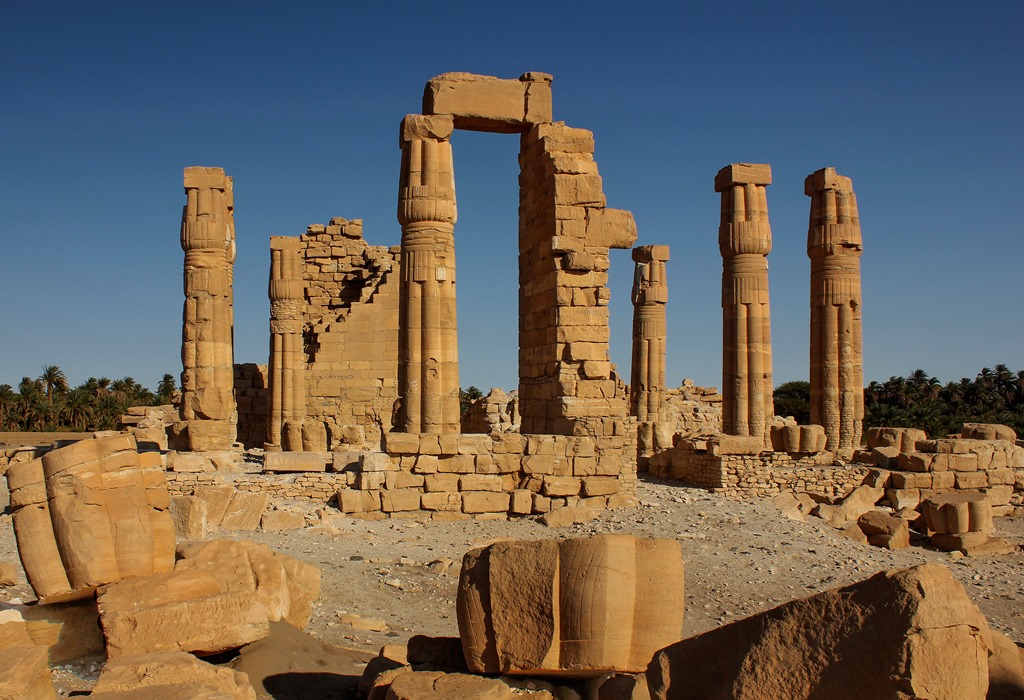
"Shasu of Yhw": the name in Egyptian records
Two Egyptian temple inscriptions, at Soleb in Nubia (Amenhotep III, 14th century BC) and Amarah West (Ramesses II, 13th century BC), list lands of the Shasu, herding peoples east of Egypt. One is "the land of the Shasu, Yhw." Many scholars think this is the earliest written occurrence of the divine name, here as a place or people in the region of Edom and Midian, just where Moses meets God. Others caution that the reading and its link to Yahweh are debated.
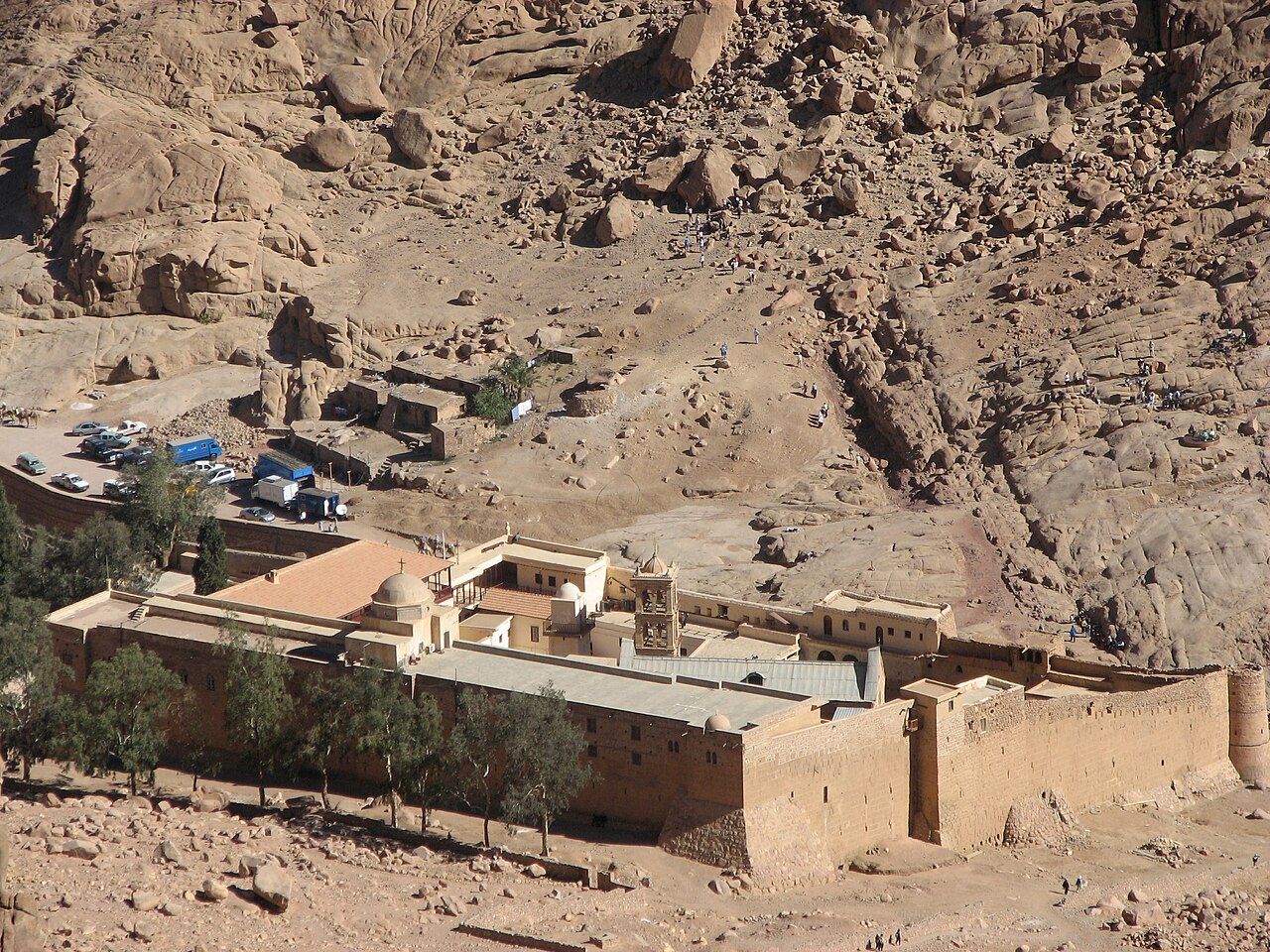
Saint Catherine's Monastery
Since the 4th century AD Christians have venerated a bush at the foot of Jebel Musa in southern Sinai as the burning bush; the Monastery of Saint Catherine, built under Justinian in the 6th century, encloses it. Whether this is the mountain of Exodus is one of the questions in our lesson on Sinai.
The Case for the Biblical Account
Scripture's account
God appears to Moses in a burning bush at Horeb, reveals His name YHWH, and sends him to Pharaoh (Exodus 3–4).
What evidence would we expect?
Evidence for the antiquity of the divine name; a connection between the name and the southern wilderness; a real place called the mountain of God. A divine encounter itself is beyond archaeology.
The discoveries
"Land of the Shasu, Yhw" in Egyptian lists of the 14th and 13th centuries BC; 8th-century BC inscriptions at Kuntillet Ajrud naming "YHWH of Teman" (the south); biblical poems in which the LORD comes from Sinai, Seir and Paran (Deuteronomy 33:2; Judges 5:4–5; Habakkuk 3:3).
Testing the discoveries
The Shasu reading is widely, not universally, accepted as related to the name. It places an early Yhw in the southern deserts, matching Exodus' setting, though it does not mention Moses or Israel.
The strongest reconstruction
Several independent lines of evidence connect the worship of YHWH with the southern wilderness of Midian, Edom and Sinai, which is exactly where Exodus places the revelation of the name.
What remains possible
That God revealed His name to Moses as Exodus says; and, historically, that Israel's worship of YHWH has roots in the south, as several scholars propose (the Midianite or Kenite hypothesis).
The Midianite hypothesis
Because Moses meets God in Midian and is advised by a Midianite priest (Exodus 18), some scholars propose that YHWH was first worshiped among Midianites or Kenites, and that Israel learned the name through Moses. Traditional readers respond that Exodus presents YHWH as the God of Abraham, Isaac and Jacob, revealing His name more fully, not a new god. Both views agree on the striking southern connection.
What the evidence shows
- Egyptian inscriptions of the 14th–13th centuries BC mention "the land of the Shasu, Yhw."Source: D. E. Fleming, Yahweh before Israel: Glimpses of History in a Divine Name (Cambridge, 2020) ↗
- Yhw in these inscriptions is related to the divine name YHWH.Source: D. E. Fleming, Yahweh before Israel: Glimpses of History in a Divine Name (Cambridge, 2020) ↗
- Early Israelite poetry links the LORD with Sinai, Seir and the southern deserts.
- God revealed His name to Moses at the burning bush.
Continue the journey
Connected elsewhere in ScriptureThe Blessing of MosesDeuteronomy 33:2: "The LORD came from Sinai, and rose up from Seir."More from this lesson
Why this matters to the rest of Scripture
- Jesus: "Before Abraham was, I am."
- Jesus cites "how in the bush God spake unto him."
- Stephen retells the burning bush.
- "The LORD came from Sinai, and rose up from Seir."