Era 3 · Egypt and DeliveranceExodus
The Last Warning and the Gods of Egypt
"Against all the gods of Egypt I will execute judgment"
God tells Moses: one more plague, and Pharaoh will not just let Israel go, he will drive them out. The people are to ask their Egyptian neighbors for silver and gold, "and the LORD gave the people favour in the sight of the Egyptians." Moses himself "was very great in the land of Egypt, in the sight of Pharaoh's servants."
Moses announces it to Pharaoh: "About midnight will I go out into the midst of Egypt: and all the firstborn in the land of Egypt shall die, from the firstborn of Pharaoh that sitteth upon his throne, even unto the firstborn of the maidservant that is behind the mill." There will be a great cry in Egypt, "such as there was none like it… but against any of the children of Israel shall not a dog move his tongue."
Moses goes out from Pharaoh "in a great anger." Pharaoh's heart remains hard.
Judgment on the gods
Exodus 12:12 says the plagues were judgment "against all the gods of Egypt." The connections are real in broad terms: the Nile (Hapi), fertility and frogs (Heqet), cattle (Hathor and the Apis bull), the sun (Ra), and Pharaoh himself, considered divine and the guarantor of order. Popular charts that assign one exact god to each plague go beyond the evidence; Exodus names none of them.
The Admonitions of Ipuwer
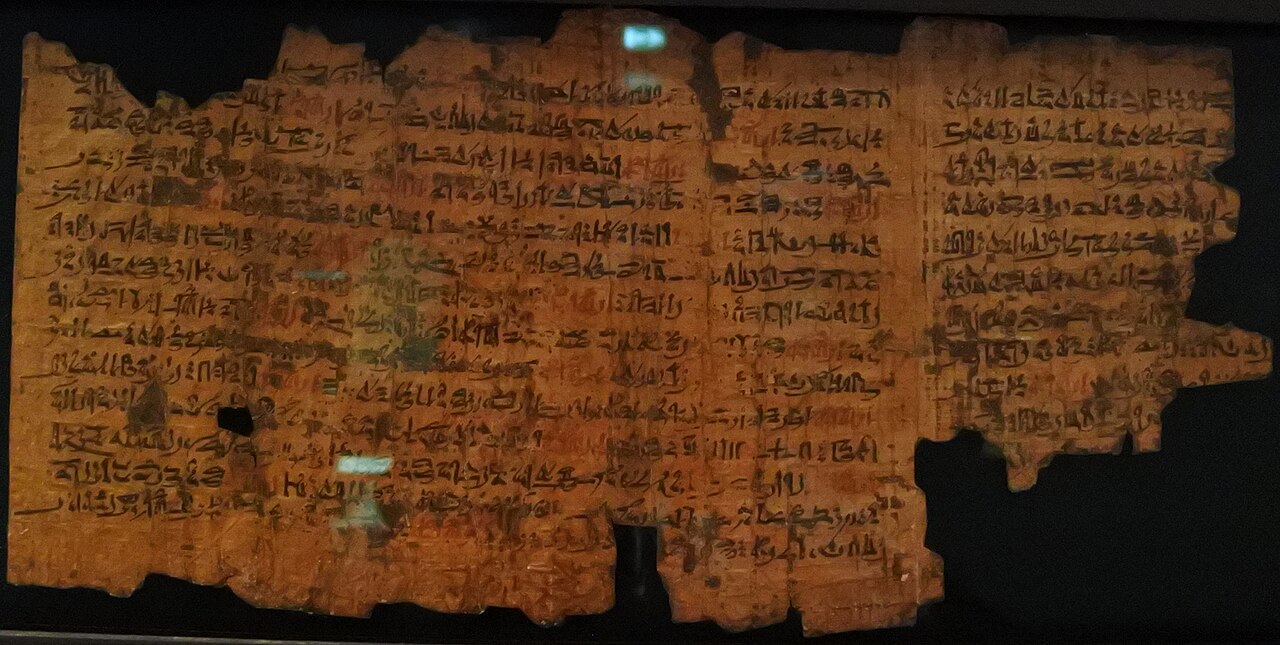
A papyrus in Leiden preserves a long lament by a sage named Ipuwer: "the river is blood," "plague is throughout the land," "gold and lapis lazuli… are hung about the necks of maidservants," "he who poured water on the ground for himself now has a full jar." Some readers see an Egyptian memory of the plagues and of slaves leaving with their masters' wealth. Most Egyptologists date its composition to the Middle Kingdom or earlier and read it as a literary lament about social chaos, a known Egyptian genre, not a record of specific events. The full investigation sets out both views.
Was the next Pharaoh not the firstborn?
Supporters of the early date sometimes point to the Dream Stele of Thutmose IV, which says the god promised him the kingship in a dream, as a hint that he was not the expected heir of Amenhotep II. The stele does not say that an older brother died; this is a suggestion worth investigating, not evidence.
The Case for the Biblical Account
Scripture's account
God announces the death of Egypt's firstborn and judgment on its gods (Exodus 11; 12:12).
What evidence would we expect?
An Egyptian record of mass death, the death of a crown prince, or a memory of the plagues.
The discoveries
The Admonitions of Ipuwer, with imagery resembling the plagues; royal successions where a younger son became king.
Testing the discoveries
Ipuwer's date and genre make it an unlikely eyewitness record. Several Pharaohs were succeeded by younger sons, which proves nothing by itself.
The strongest reconstruction
No Egyptian source records the final plague. Exodus presents it as the decisive act of God against Pharaoh's power.
What remains possible
Egypt's silence is expected for a royal disaster; future discoveries could still illuminate the period.
What the evidence shows
- Egyptian religion honored the Nile, cattle, the sun and Pharaoh as divine or sacred.
- Each plague targeted one specific Egyptian god.Source: Z. Zevit, "Three Ways to Look at the Ten Plagues," Bible Review 6:3 (1990)
- The Ipuwer Papyrus records the Exodus plagues. Most Egyptologists date and read it differently.Source: The Admonitions of Ipuwer, Papyrus Leiden I 344 recto; in M. Lichtheim, Ancient Egyptian Literature I (1973)
- God judged the gods of Egypt.
Continue the journey
Ancient MysteriesThe Ipuwer Papyrus: An Egyptian Record of the Plagues?Does an Egyptian poem that says "the river is blood" remember the Exodus?More from this lesson
Investigations
Optional deep dives: the ancient sources, the physical evidence, and every interpretation side by side, including unconventional ones, each labeled for what it is.
The Ipuwer Papyrus: An Egyptian Record of the Plagues?Papyrus: authentic · Parallels: real · Eyewitness record of the Exodus: unlikely
Does an Egyptian poem that says "the river is blood" remember the Exodus?
Papyrus Leiden I 344 preserves a long Egyptian lament, the Admonitions of Ipuwer, describing a land in chaos: "the river is blood," plague throughout the land, servants wearing their masters' gold. Some writers identify it as an Egyptian account of the plagues. The papyrus is real and the parallels are striking; but its date and its literary genre make a direct identification unlikely.
Open the full investigation →Why this matters to the rest of Scripture
- "Israel is my son, even my firstborn… I will slay thy son, even thy firstborn."
- "Upon their gods also the LORD executed judgments."
- "He smote also all the firstborn… He brought them forth also with silver and gold."