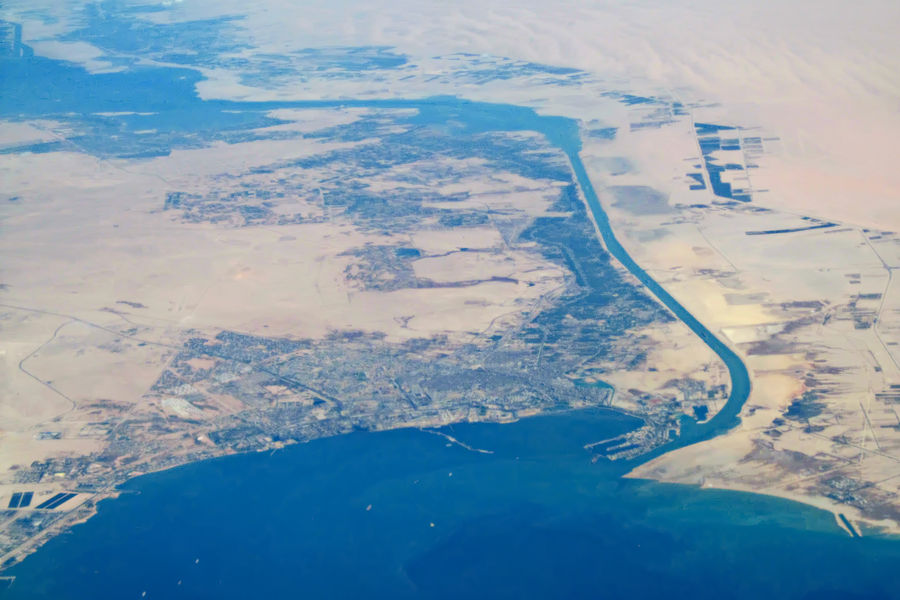
Era 3 · Egypt and DeliveranceExodus
The Crossing of the Sea
"The children of Israel went into the midst of the sea upon the dry ground"
"Wherefore criest thou unto me? speak unto the children of Israel, that they go forward: But lift thou up thy rod, and stretch out thine hand over the sea, and divide it."
The angel of God and the pillar of cloud move from in front of Israel to behind them, standing between the two camps: darkness to the Egyptians, light to Israel, "so that the one came not near the other all the night."
"And Moses stretched out his hand over the sea; and the LORD caused the sea to go back by a strong east wind all that night, and made the sea dry land, and the waters were divided. And the children of Israel went into the midst of the sea upon the dry ground: and the waters were a wall unto them on their right hand, and on their left."
The Egyptians follow them in, all Pharaoh's horses, chariots and horsemen. In the morning watch the LORD looks on the Egyptian army through the pillar of fire and cloud, throws it into confusion, and takes off their chariot wheels "that they drave them heavily." The Egyptians cry, "Let us flee from the face of Israel; for the LORD fighteth for them."
Moses stretches out his hand again, and at daybreak the sea returns to its strength. The waters cover the chariots and the horsemen, "there remained not so much as one of them." "Thus the LORD saved Israel that day… and Israel saw the Egyptians dead upon the sea shore. And… the people feared the LORD, and believed the LORD, and his servant Moses."
Red Sea or Sea of Reeds?
The Hebrew is Yam Suph. Suph means reeds or rushes (it is the word for the reeds where Moses' basket was placed), so many translate "Sea of Reeds." The Greek Septuagint translated it "Red Sea," and so did the Latin and English Bibles after it. Elsewhere the Bible uses Yam Suph for the Gulf of Aqaba (1 Kings 9:26) and the Gulf of Suez (Numbers 33:10–11). Some scholars connect suph with the word for "end," the sea at the end of the world. The term alone does not settle the location.
Three proposed crossing places
The lakes and marshes along Egypt's eastern frontier: Lake Ballah, Lake Timsah, the Bitter Lakes, or lagoons near the coast. Supporters, including James Hoffmeier, point out that this is where the frontier forts, Migdol and the route stations are, and that Israel turned back "between Migdol and the sea." A reedy lake fits "Sea of Reeds."
Challenge: these waters have changed greatly since antiquity, and their exact ancient shorelines are reconstructed. Critics ask whether shallow lakes could drown an army; Exodus describes the return of the waters as overwhelming.
The northern end of the Gulf of Suez, near modern Suez. Many traditional reconstructions, and the Byzantine pilgrims, placed the crossing here, followed by a march down the western Sinai coast to Jebel Musa. It preserves the "Red Sea" of the Greek tradition.
Challenge: the shoreline of the gulf's head has shifted; no route stations have been securely located; and a crossing at the gulf's deeper water requires a very different mechanism from a shallow lake.
At Nuweiba, on the Gulf of Aqaba, a wide beach meets an underwater slope that proponents describe as a natural land bridge to Saudi Arabia. Advocates such as Ron Wyatt and Lennart Möller link it with a Mount Sinai in Midian (northwestern Arabia), where Moses had lived, and report coral-covered chariot parts on the seabed.
Challenge: reaching Nuweiba requires a long journey across Sinai before the crossing, which sits uneasily with Israel being overtaken near Migdol after a few days. The gulf there is several hundred meters deep. The chariot claims have not been authenticated (see the investigation).
Could wind push back the water?
Exodus says the LORD drove the sea back "by a strong east wind all that night." Wind setdown is a real effect: a steady wind over shallow water pushes the water downwind, lowering the level on the upwind side, sometimes by meters. Lake Erie and the Nile Delta have both recorded it. In 1882 a British officer, Major-General Alexander Tulloch, reported watching a strong wind drive the water of Lake Manzala back so far that people walked on the exposed bed.
In 2010 Carl Drews and Weiqing Han of the National Center for Atmospheric Research published a computer model, peer reviewed in PLoS ONE. Using a reconstruction of a lagoon and an old branch of the Nile in the eastern Delta, they found that an east wind of about 28 m/s (63 mph) for 12 hours could expose a land bridge 3–4 km long and 5 km wide for about four hours, with water on both sides. When the wind dropped, the water would rush back within half an hour.
The model shows that a wind-driven crossing is physically possible in that kind of setting. It does not show that the crossing happened there, that the ancient geography has been reconstructed exactly, or how "a wall unto them on their right hand, and on their left" should be pictured. Oceanographers Doron Nof and Nathan Paldor had earlier (1992) calculated a similar effect for the head of the Gulf of Suez.
The chariots under the sea
Since the late 1970s, divers have reported coral formations shaped like chariot wheels and axles on the floor of the Gulf of Aqaba near Nuweiba, and one claimed gilded wheel. These claims deserve a hearing: the Bible does say chariots were lost in the sea. They also face serious unanswered questions. The full investigation sets them out.
The Case for the Biblical Account
Scripture's account
God drives back the sea by a strong east wind all night; Israel crosses on dry ground; the returning waters overwhelm the Egyptian chariots (Exodus 14:15–31).
What evidence would we expect?
A plausible crossing location consistent with the route; a physical mechanism consistent with the text's east wind; perhaps remains of an Egyptian force; an Egyptian record of a military disaster.
The discoveries
Egypt's reconstructed eastern frontier lakes; the Drews–Han wind setdown model; observed setdown events in the Delta; reported but unauthenticated chariot remains in the Gulf of Aqaba.
Testing the discoveries
The physics is sound. The location remains unidentified. The underwater objects lack excavation, sampling, dating and independent publication. Egypt's records, which did not report defeats, are silent.
The strongest reconstruction
A crossing in Egypt's frontier lake region, with a strong wind as the means the text itself names, is physically possible and geographically consistent with the stations. It remains a reconstruction, not a demonstration.
What remains possible
That God used wind and water at a decisive moment; that He acted in a way beyond any natural mechanism; that the site was in the frontier lakes, the Gulf of Suez or the Gulf of Aqaba. New underwater or geological research could narrow the possibilities.
Two ways the Bible tells it
Exodus 14 includes both an east wind that blows all night and makes the sea dry land (14:21), and waters standing as walls on the right and left (14:22, 29). Source critics often assign these to two interwoven accounts. Traditional readers see one event described from two angles: the means God used, and how it appeared to those walking through. The Song of the Sea (15:8) combines them: "with the blast of thy nostrils the waters were gathered together, the floods stood upright as an heap."
Egypt's silence
No Egyptian text records the loss of a Pharaoh's chariot force in the sea. That is not surprising: Egyptian royal inscriptions recorded victories, not defeats, and the archives of the eastern Delta have mostly perished in its damp soil. Exodus does not say Pharaoh himself drowned; Psalm 136:15 says he was "overthrown" in the sea.
What the evidence shows
- A strong, sustained wind can temporarily expose land in shallow water by setdown.Source: C. Drews and W. Han, "Dynamics of Wind Setdown at Suez and the Eastern Nile Delta," PLoS ONE 5(8): e12481 (2010) ↗
- A modeled 28 m/s east wind for 12 hours could expose a land bridge in a reconstructed eastern Delta lagoon.Source: C. Drews and W. Han, "Dynamics of Wind Setdown at Suez and the Eastern Nile Delta," PLoS ONE 5(8): e12481 (2010) ↗
- The crossing took place in Egypt's eastern frontier lakes.Source: J. K. Hoffmeier, Ancient Israel in Sinai (Oxford, 2005)
- The crossing took place at Nuweiba in the Gulf of Aqaba.
- Egyptian chariot remains have been found in the Gulf of Aqaba. See the investigation.
- "The LORD saved Israel that day out of the hand of the Egyptians."
Continue the journey
Ancient MysteriesChariot Wheels Under the Gulf of Aqaba?Do coral-covered objects on the seabed at Nuweiba preserve Pharaoh's chariots?More from this lesson
On the map
Location securely identified Probable identification Proposed or debated location Biblical route (roads schematic) Scholarly proposal
- Exodus proposal: southern Sinai (traditional). Rameses → Succoth → a crossing at the Gulf of Suez (or the nearby lakes) → down the west Sinai coast → Jebel Musa → north to Kadesh-barnea.
- Exodus proposal: northern lakes and Negev. Rameses → Succoth → a crossing in the frontier lakes → across north-central Sinai → a Sinai such as Har Karkom → Kadesh-barnea.
- Exodus proposal: Arabia (Midian). Rameses → across the Sinai peninsula → a crossing at Nuweiba in the Gulf of Aqaba → Jebel al-Lawz in Midian → Kadesh-barnea.
Investigations
Optional deep dives: the ancient sources, the physical evidence, and every interpretation side by side, including unconventional ones, each labeled for what it is.
Chariot Wheels Under the Gulf of Aqaba?Underwater formations: photographed · Identification as Egyptian chariots: not authenticated
Do coral-covered objects on the seabed at Nuweiba preserve Pharaoh's chariots?
Since 1978, explorers led by Ron Wyatt, and later Lennart Möller, have reported coral-encrusted shapes resembling chariot wheels, axles and a gilded wheel on the floor of the Gulf of Aqaba near Nuweiba. If authenticated, such a find would be extraordinary. The objects have never been recovered, sampled, dated, or published by an independent archaeological team.
Open the full investigation →Why this matters to the rest of Scripture
- "Thy way is in the sea, and thy path in the great waters, and thy footsteps are not known."
- "He rebuked the Red sea also, and it was dried up."
- "Which maketh a way in the sea… Behold, I will do a new thing."
- "That hath made the depths of the sea a way for the ransomed to pass over."
- "All passed through the sea; and were all baptized unto Moses."
- "By faith they passed through the Red sea as by dry land."
- The Jordan stops for the next generation.