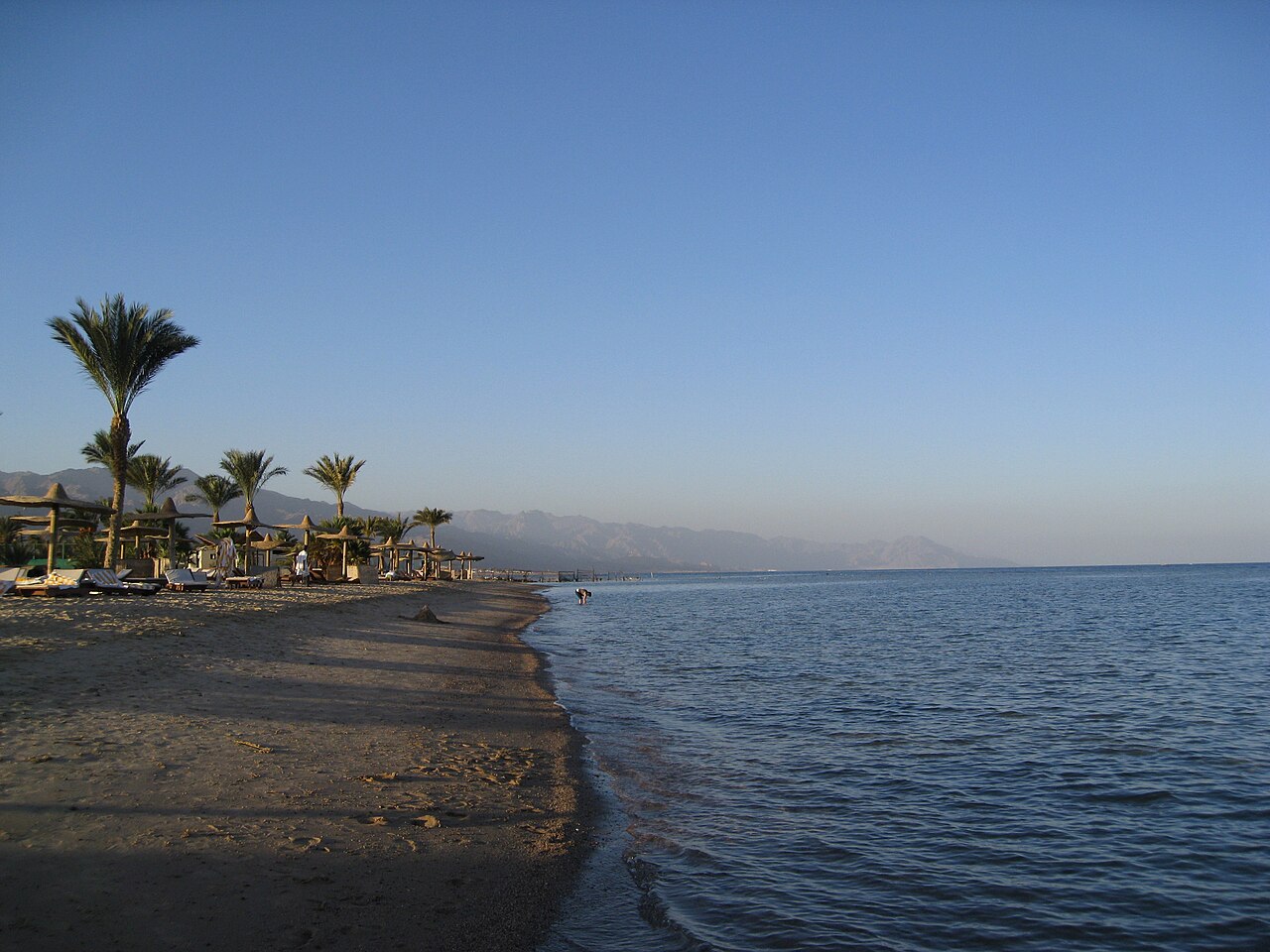
Since 1978, explorers led by Ron Wyatt, and later Lennart Möller, have reported coral-encrusted shapes resembling chariot wheels, axles and a gilded wheel on the floor of the Gulf of Aqaba near Nuweiba. If authenticated, such a find would be extraordinary. The objects have never been recovered, sampled, dated, or published by an independent archaeological team.
Underwater formations: photographed · Identification as Egyptian chariots: not authenticated
Site or place photographNuweiba, on the Sinai coast of the Gulf of Aqaba, the crossing site proposed by Ron Wyatt and Lennart Möller.Image credit
1 What Scripture says
"And the Egyptians pursued, and went in after them to the midst of the sea, even all Pharaoh's horses, his chariots, and his horsemen… And took off their chariot wheels, that they drave them heavily… And the waters returned, and covered the chariots, and the horsemen, and all the host of Pharaoh" (Exodus 14:23–28). "Pharaoh's chariots and his host hath he cast into the sea" (15:4).
2 What evidence we might expect
Recovered objects whose form matches Egyptian chariot construction of the right period.
Material analysis (wood, metal fittings, gold or electrum) and secure dating.
A concentration of related military debris: bits, harness fittings, weapons, bones of horses and men.
Precise location and depth records, and publication open to independent examination.
3 What discoveries exist
What has been reported
1978 onward: Ron Wyatt, an American nurse-anesthetist and amateur explorer, dove at Nuweiba and reported wheel-shaped coral formations, axles and chariot bodies along an underwater slope toward Saudi Arabia.
Wyatt reported finding a gilded four-spoked wheel, and said an Egyptian antiquities official, Nassif Mohammed Hassan, identified it as 18th Dynasty. No written statement from that official has been published, and the wheel was not recovered for study.
Wyatt reported a granite column on the beach at Nuweiba and another on the Saudi shore at the proposed landing, with a Phoenician-style inscription naming Mizraim, Solomon, Edom and Yahweh. No legible photograph of the inscription has been published for specialists to read.
2000s: Lennart Möller, a Swedish professor of environmental medicine, published underwater photographs of wheel-like and box-like coral formations in The Exodus Case and in films.
Site or place photographNuweiba, on the Sinai coast of the Gulf of Aqaba, the crossing site proposed by Ron Wyatt and Lennart Möller.Image credit
Egyptian chariots: what to compare
New Kingdom chariots were light, made mostly of wood (elm, ash, birch bark) and leather, with a few metal fittings. Tutankhamun's six chariots, the best-preserved examples, have six-spoked wheels; four-spoked wheels appear earlier in the 18th Dynasty. In seawater, wood and leather are consumed by shipworms and decay unless buried quickly; coral may grow over objects, but it also grows into wheel-like and branching forms on its own.
The geography
The proposed crossing runs from the Nuweiba beach to the Saudi coast, about 13–18 km depending on the line chosen. Proponents describe a gently sloping underwater ridge; even along that line the seafloor reaches several hundred meters deep, with steep sections. A dry crossing there would require a far larger parting of water than any wind setdown model.
4 How interpretations compare
Alternative explanation
Remains of Pharaoh's army
The objects are Egyptian chariot parts, preserved under coral, along the route where Israel crossed from Sinai to Midian, the location of Mount Sinai in Arabia.
Assessment: Photographs of shapes are not enough to identify manufactured objects. Without recovery, sampling and dating, the identification cannot be tested. The chain of reported confirmations, the gilded wheel's dating and the column inscription, has not been documented in a way others can check.
Source: R. Wyatt, Discovered: Noah's Ark (1989) and his newsletters; Wyatt Archaeological Research materials; L. Möller, The Exodus Case (3rd ed., 2008)
Scholarly reconstruction
Natural coral formations
Coral commonly grows in disk, branching and tubular forms. Wheel-like shapes on a reef are expected without any ancient objects beneath them.
Assessment: This explains the photographs without new assumptions but cannot rule out an object inside a particular formation unless it is examined.
Source: G. Franz, "Is Mount Sinai in Saudi Arabia?" Bible and Spade 13:4 (2000)
Scholarly reconstruction
Modern debris
Nuweiba has been a port and resort, with shipping and tourism; some objects could be modern.
Assessment: Possible for some items; it does not account for all the reported shapes.
Traditional reading
Exodus elsewhere
Most conservative scholars who accept the Exodus place the crossing in Egypt's frontier lakes or the Gulf of Suez, and so do not expect chariots at Nuweiba.
Source: "Is Mt. Sinai in Saudi Arabia?" and related reports, Biblical Archaeology Review / Bible History Daily
5 The strongest supported reconstruction
The underwater formations exist and have been photographed. The claim that they are Egyptian chariots is unproven: no object has been recovered, analyzed, dated, or independently published. The investigation stays open: a properly permitted survey that sampled the formations could settle the question either way.
6 What remains possible or unknown
Whether any formation contains a manufactured object, and if so, what and how old.
What happened to the gilded wheel and the column inscription Wyatt reported.
7 How this material came to us
The claims spread through Wyatt's newsletters and videos (1980s–1990s), Möller's book and films (2000s), and many online videos. Each step should be traced back to the original report and its evidence.
What would settle it
Are the supposed wheels identifiable as manufactured objects (scans or cores)?
Can their material be examined in a laboratory?
Is there reliable location and depth documentation?
Can the objects be securely dated?
Have geological and biological explanations been tested for each one?
Is there a concentration of related military artifacts rather than isolated wheel-like shapes?
Has an independent, permitted archaeological team examined the site?
What the evidence shows
Independently documentedWheel-shaped coral formations have been photographed in the Gulf of Aqaba near Nuweiba.
Source: L. Möller, The Exodus Case (3rd ed., 2008)
Not independently verifiedA gilded 18th-Dynasty chariot wheel was found and identified by an Egyptian official. Reported by Wyatt; no published documentation.
Source: R. Wyatt, Discovered: Noah's Ark (1989) and his newsletters; Wyatt Archaeological Research materials
Not independently verifiedEgyptian chariot remains lie on the seabed at Nuweiba.
Independently documentedEgyptian chariots were built mainly of wood and leather with six-spoked wheels in the later 18th Dynasty.
Source: M. A. Littauer and J. H. Crouwel, Chariots and Related Equipment from the Tomb of Tut'ankhamun (1985); A. J. Veldmeijer and S. Ikram, eds., Chariots in Ancient Egypt (2018)