Exodus begins where Genesis ended: seventy people of Jacob's household in Egypt. Joseph dies, and that whole generation. But "the children of Israel were fruitful, and increased abundantly, and multiplied… and the land was filled with them." The words echo the blessing of creation: be fruitful and multiply.
"Now there arose up a new king over Egypt, which knew not Joseph." He sees a threat: "the people of the children of Israel are more and mightier than we." If war comes, they might join Egypt's enemies and leave. So he sets taskmasters over them "to afflict them with their burdens," and they build the store cities Pithom and Raamses.
The oppression backfires: "the more they afflicted them, the more they multiplied and grew." The Egyptians make their lives bitter "with hard bondage, in morter, and in brick, and in all manner of service in the field."
So Pharaoh turns to murder. He orders the Hebrew midwives, Shiphrah and Puah, to kill every boy at birth. "But the midwives feared God." When Pharaoh demands an explanation, they answer that Hebrew women are "lively" and give birth before the midwife arrives. Genesis named no Pharaoh; Exodus names no Pharaoh either. But it remembers the names of two midwives.
God deals well with the midwives and gives them families of their own. Pharaoh's final command is to all his people: "Every son that is born ye shall cast into the river."
Semitic people living and working in Egypt
Egyptian records leave no doubt that people from Canaan and Syria lived in Egypt, many as servants or forced laborers. The Brooklyn Papyrus (about 1740 BC) lists ninety-five servants of one household, dozens of them described as Asiatics ("Aamu"), many given new Egyptian names. Among the Semitic names is a woman called Shiphrah, the same name as the Hebrew midwife: not the same woman, but proof the name was in use among Semites in Egypt.
Bricks, straw and taskmasters
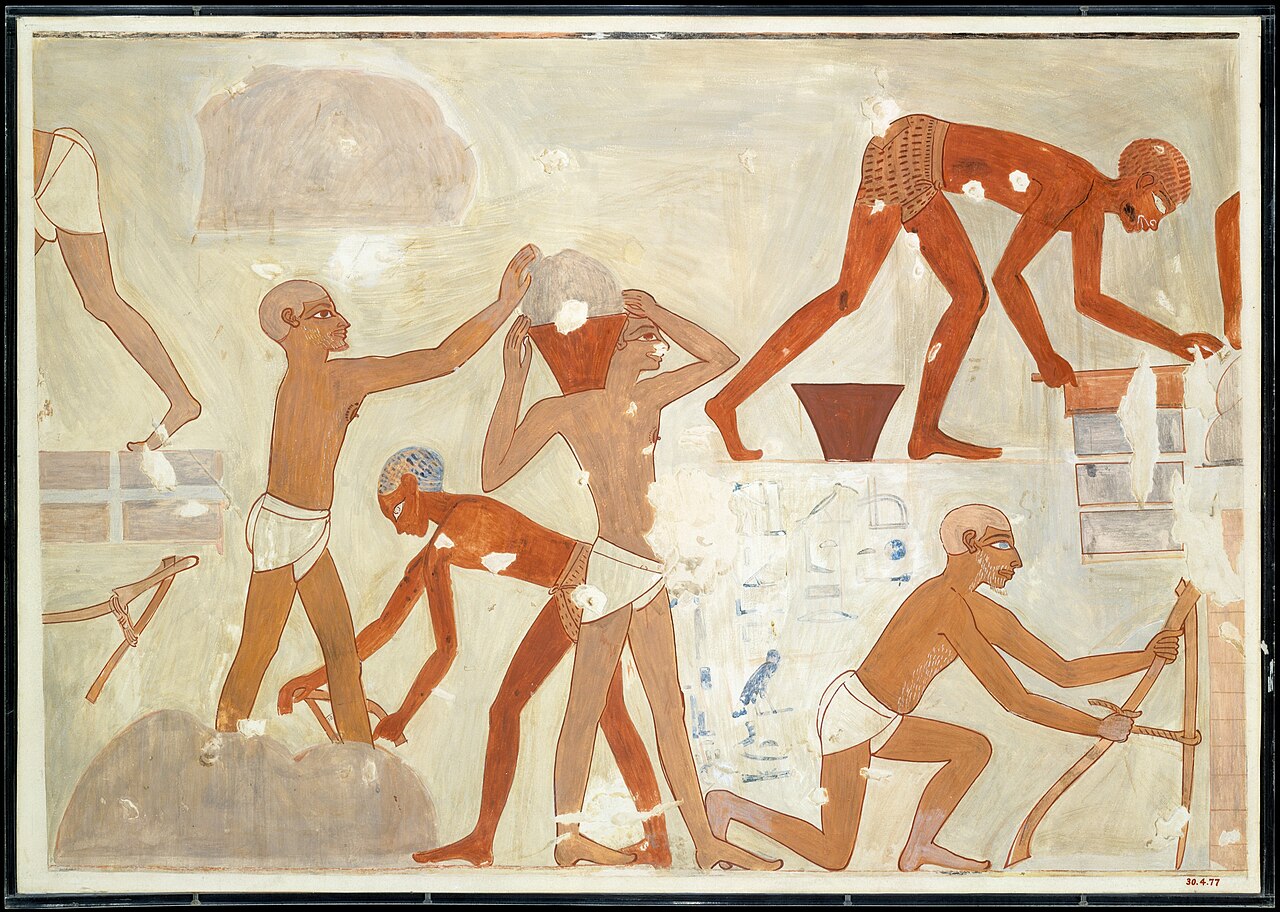
The tomb of Rekhmire, vizier under Thutmose III (about 1450 BC), shows workers fetching water, mixing mud, molding bricks in wooden frames, and carrying them to a building site, under overseers with rods. Some workers are drawn as foreigners. The caption has a taskmaster say, "The rod is in my hand; be not idle." It is not a picture of Israel, but it is a picture of exactly the labor Exodus describes.
Pithom and Raamses
Raamses is almost certainly Pi-Ramesse ("House of Ramesses"), the great Delta capital built by Ramesses II in the 13th century BC at Qantir, right beside the older Levantine city of Avaris. Pithom is Per-Atum, "House of the god Atum," in the Wadi Tumilat; it is identified either with Tell el-Retaba or Tell el-Maskhuta. These real names anchor Exodus in the geography of the eastern Delta, the region where Genesis placed Jacob's family.
The Case for the Biblical Account
Scripture's account
Israel multiplies in Egypt; a new Pharaoh imposes forced labor on them to build Pithom and Raamses, and orders the killing of their sons (Exodus 1).
What evidence would we expect?
Semitic populations in the eastern Delta; Semitic servants and laborers; brick-making by forced labor; real store cities with these names. We would not expect Egyptian royal monuments to record a policy against a group of foreign laborers.
The discoveries
The Levantine community at Avaris from about 1800 BC; Semitic servants in the Brooklyn Papyrus; the Rekhmire brick-making scenes; Pi-Ramesse and Per-Atum as real places in the eastern Delta.
Testing the discoveries
These show the setting is authentic. None names Israel. The name Raamses fits the 13th century BC; supporters of an earlier Exodus regard it as an updated name.
The strongest reconstruction
Exodus 1 describes a world Egyptologists recognize: Semitic people in the eastern Delta, state building projects, and forced labor. The oppression of one people within it has not been independently recorded.
What remains possible
A historical oppression of Israel's ancestors under a 15th- or 13th-century Pharaoh; or the memory of one group's experience, later told as the story of all Israel.
Silence in Egyptian records
No Egyptian text mentions Israel's slavery or departure. That silence is real, and it should not be overstated: Egyptian monuments celebrated victories and rarely recorded embarrassments; most papyri from the Delta, a wet region, have rotted; and a labor force of foreign workers would not usually appear in royal inscriptions. Absence of a record is a limitation of the evidence, not proof that nothing happened. Nor do the surrounding records prove that it did.
What the evidence shows
- People of Levantine origin lived in Egypt's eastern Delta in large numbers in the second millennium BC.Source: M. Bietak, Avaris: The Capital of the Hyksos (British Museum Press, 1996)
- Semitic servants, including a woman named Shiphrah, appear in an Egyptian household list of about 1740 BC.Source: W. C. Hayes, A Papyrus of the Late Middle Kingdom in the Brooklyn Museum (1955); W. F. Albright, "Northwest-Semitic Names in a List of Egyptian Slaves," JAOS 74 (1954)
- Egyptian state projects used forced labor in brick-making, including foreigners.Source: N. de G. Davies, The Tomb of Rekh-mi-Rē' at Thebes (Metropolitan Museum, 1943)
- Raamses is Pi-Ramesse, built by Ramesses II.Source: J. K. Hoffmeier, Israel in Egypt: The Evidence for the Authenticity of the Exodus Tradition (Oxford, 1997)
- The Israelites were enslaved in Egypt. No outside record; the setting is authentic.
- God blessed Israel and protected the midwives.
Continue the journey
Connected elsewhere in ScriptureJoseph Reveals HimselfGenesis 46:27: Seventy souls of Jacob's house went down into Egypt.More from this lesson
Why this matters to the rest of Scripture
- Seventy souls of Jacob's house went down into Egypt.
- Stephen: "another king arose, which knew not Joseph."
- Herod's slaughter of the infants echoes Pharaoh's.
- Moses and the Torah →How the Exodus story became the center of Israel's written Torah.