Era 3 · Egypt and DeliveranceExodus
Moses Is Born
A basket in the reeds and a princess who chose compassion
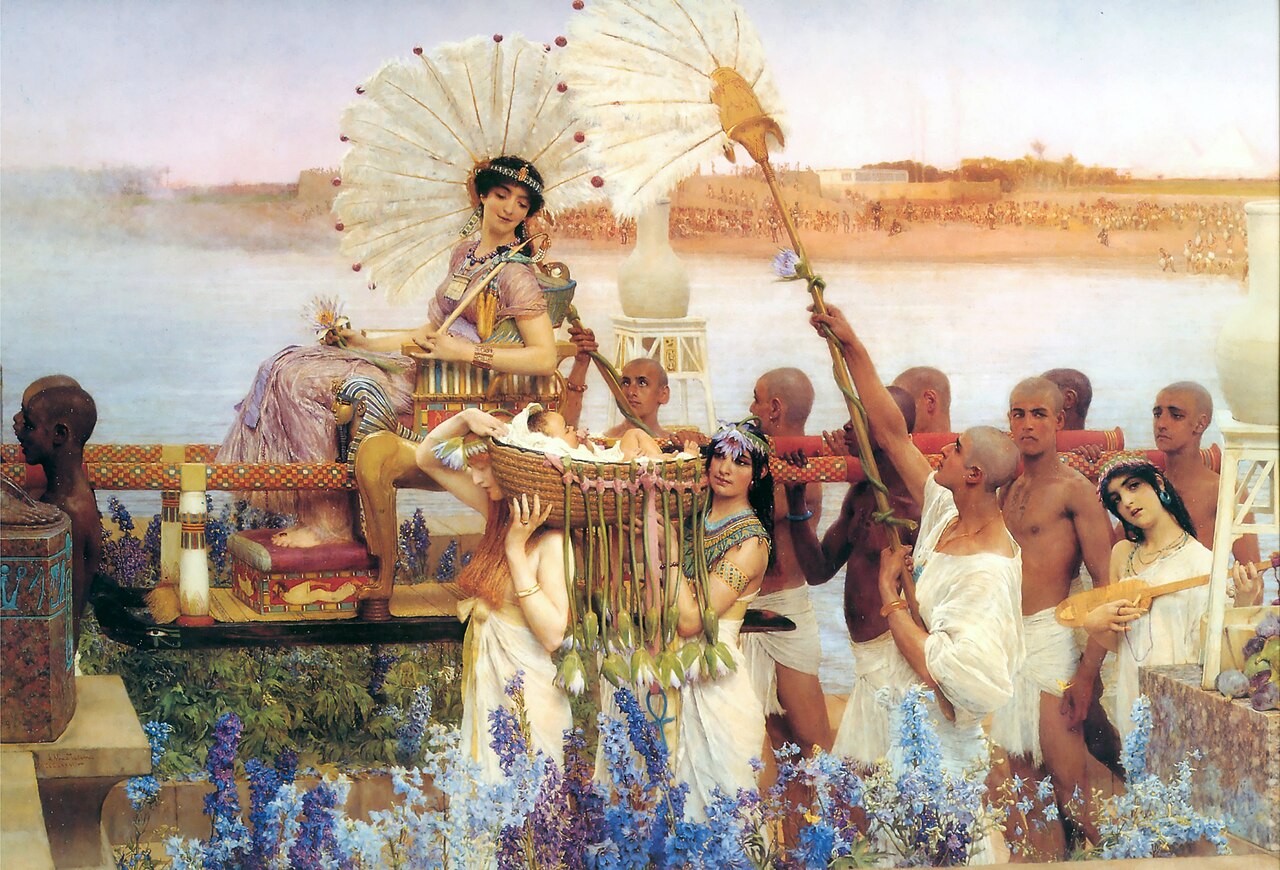
A man and a woman of the tribe of Levi have a son. His mother sees that "he was a goodly child" and hides him for three months. When she can hide him no longer, she makes him an "ark" of papyrus reeds, seals it with bitumen and pitch, places him inside, and sets it among the reeds at the edge of the Nile. His sister stands at a distance to see what will happen.
Pharaoh's daughter comes down to bathe. She sees the basket and sends her maid to fetch it. She opens it: "behold, the babe wept. And she had compassion on him, and said, This is one of the Hebrews' children."
The sister steps forward: "Shall I go and call to thee a nurse of the Hebrew women?" "Go." She calls the child's own mother, and Pharaoh's daughter pays her to nurse him. The baby condemned by Pharaoh is raised at Pharaoh's expense.
When the child grows, his mother brings him to Pharaoh's daughter, "and he became her son. And she called his name Moses: and she said, Because I drew him out of the water."
The same word as Noah's ark
The Hebrew word for Moses' basket, tevah, appears in only two stories in the Bible: here and Noah's ark. Both are sealed with pitch; both carry the future of God's people through waters of death. Genesis' first readers would have heard the echo.
An Egyptian name
Exodus explains Moses (Mosheh) by a Hebrew word, mashah, "to draw out." The name also matches a very common Egyptian element, mose or mes, "born of" or "child," found in royal names like Thutmose ("born of Thoth") and Ahmose. Many scholars think Moses originally had an Egyptian name, which the Hebrew story explains with a fitting wordplay. Both can be true at once: an Egyptian princess would have given an Egyptian name.
Foreign children at the Egyptian court
New Kingdom Egypt raised the sons of foreign rulers at court, in an institution called the kap, where they were educated alongside Egyptian princes and officials. Stephen says Moses "was learned in all the wisdom of the Egyptians" (Acts 7:22). The detail fits how Egypt's court actually worked.

The Case for the Biblical Account
Scripture's account
A Hebrew baby is set adrift in a sealed basket on the Nile and adopted by Pharaoh's daughter, who names him Moses (Exodus 2:1–10).
What evidence would we expect?
Papyrus and bitumen as real materials; an Egyptian-style name; foreign children raised at court.
The discoveries
Papyrus reeds and bitumen were standard Egyptian materials; the mose element is common in Egyptian names; foreign children were raised in the royal kap in the New Kingdom.
Testing the discoveries
A similar birth story is told of King Sargon of Akkad (see Echoes). Some scholars regard Moses' story as modeled on it; others see a common way that ancient people told of a great leader's rescue.
The strongest reconstruction
The details fit Egypt well, and the name is plausibly Egyptian. Moses' own birth is known only from Exodus.
What remains possible
A historical rescue remembered in Israel; a story told in a familiar ancient pattern; or both.
What the evidence shows
- The name Moses resembles a common Egyptian name element meaning "born of" or "child."Source: J. G. Griffiths, "The Egyptian Derivation of the Name Moses," JNES 12 (1953)
- A similar birth story was told of Sargon of Akkad.Source: The Sargon Birth Legend, Neo-Assyrian copies (7th century BC); B. Lewis, The Sargon Legend (ASOR, 1980)
- The Moses story was borrowed from the Sargon legend. The Sargon text is known from 7th-century BC copies; similarities may reflect a common motif.
- Moses was a historical person. No outside record would be expected to name him; that is not evidence against him.
Continue the journey
Echoes Across CivilizationsThe child saved from the watersDid other ancient peoples tell of a future leader set adrift as a baby and rescued?More from this lesson
Echoes Across Civilizations
Optional: how other ancient peoples told similar stories. Open one to compare, then come back to the lesson.
The child saved from the watersAkkad (Mesopotamia) · Egypt · Rome
Did other ancient peoples tell of a future leader set adrift as a baby and rescued?
- Akkad (Mesopotamia): The Sargon Birth Legend Shared literary world
- Egypt: Horus hidden in the marshes of Chemmis Possible historical contact
- Rome: Romulus and Remus Resemblance only
Why this matters to the rest of Scripture
- "By faith Moses, when he was born, was hid three months of his parents."
- Moses "was learned in all the wisdom of the Egyptians."
- Noah's ark: the same Hebrew word, tevah.
- His parents are named: Amram and Jochebed.