Moses is gone a long time. The people gather around Aaron: "Up, make us gods, which shall go before us; for as for this Moses, the man that brought us up out of the land of Egypt, we wot not what is become of him."
Aaron collects their gold earrings, shapes the gold with a tool, and makes a molten calf. They say: "These be thy gods, O Israel, which brought thee up out of the land of Egypt." Aaron builds an altar and proclaims, "To morrow is a feast to the LORD." The people offer sacrifices, eat and drink, "and rose up to play."
God tells Moses: "Let me alone, that my wrath may wax hot against them… and I will make of thee a great nation." Moses pleads: what will the Egyptians say? "Remember Abraham, Isaac, and Israel, thy servants." "And the LORD repented of the evil which he thought to do unto his people."
Moses comes down with the tablets, "the work of God, and the writing was the writing of God." He sees the calf and the dancing, and in anger throws the tablets down and breaks them at the foot of the mountain. He burns the calf, grinds it to powder, scatters it on the water, and makes the people drink it.
"What did this people unto thee, that thou hast brought so great a sin upon them?" Aaron answers: "they gave it me: then I cast it into the fire, and there came out this calf." Moses calls, "Who is on the LORD's side? let him come unto me," and the Levites gather to him and carry out judgment in the camp; about three thousand die.
Moses returns to the LORD: "Oh, this people have sinned a great sin… Yet now, if thou wilt forgive their sin—; and if not, blot me, I pray thee, out of thy book which thou hast written."
Calves and bulls in the ancient Near East
The bull stood for strength and fertility across the ancient world. In Canaan the high god El was called "Bull El," and the storm god Baal was associated with the bull. In Egypt the Apis bull was worshiped at Memphis as the living manifestation of Ptah. Gods were often pictured standing on the back of a bull, so a calf image could be understood as the pedestal of an invisible god as well as a god itself.
The silver calf of Ashkelon
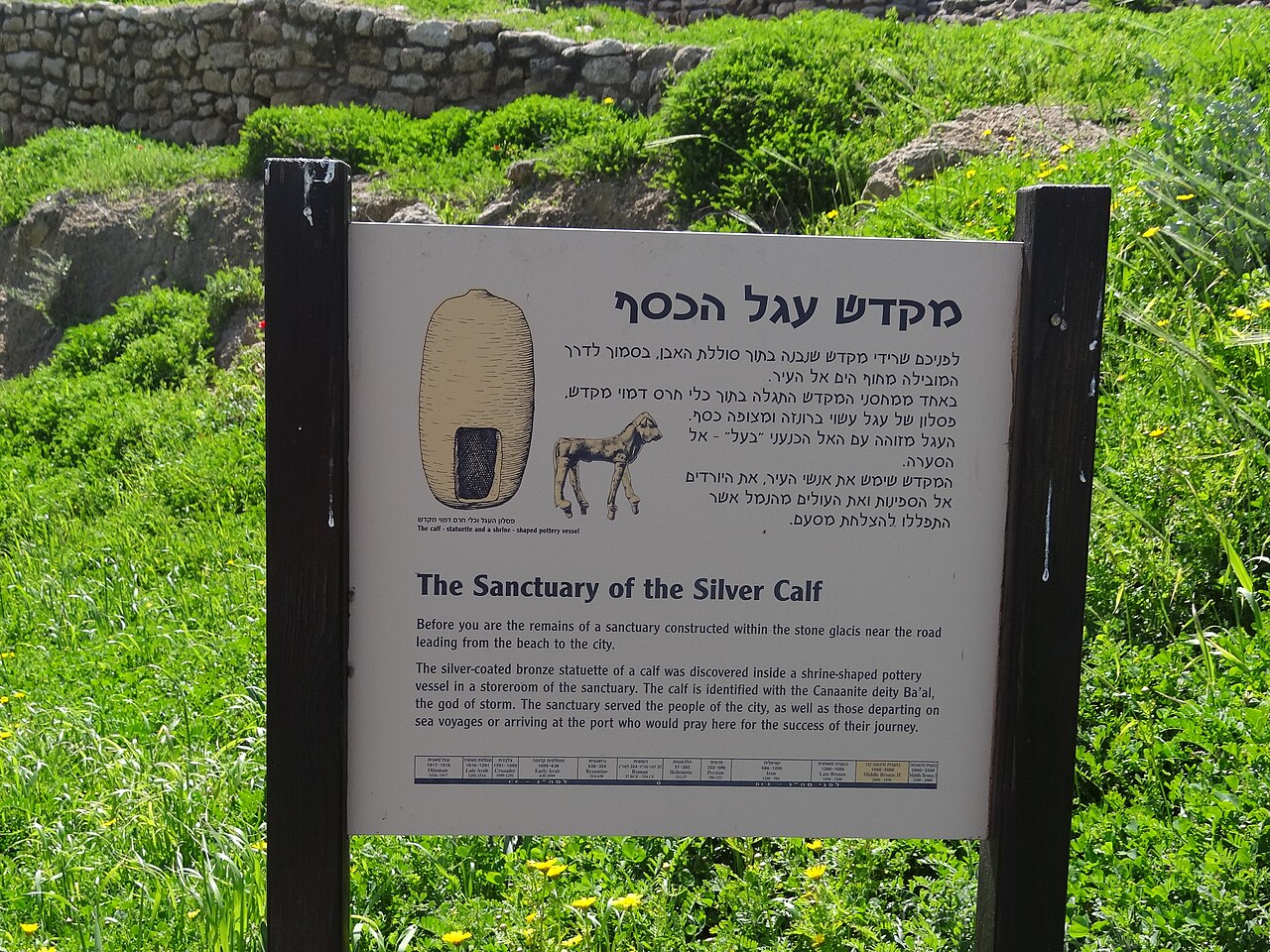
In 1990 Lawrence Stager's team at Ashkelon found a small bronze calf, once covered with silver, inside a pottery model shrine, in the ruins of a Canaanite gate sanctuary of about 1600 BC. It is about 10 cm long. It shows exactly the kind of image Exodus describes: a metal-covered calf, kept in a shrine and worshiped.
At the "Bull Site," an open-air hilltop shrine in the hills of Samaria (12th century BC), Amihai Mazar found a bronze bull figurine about 18 cm long in a stone enclosure, apparently from Israel's earliest settlement period.
Jeroboam's calves
Two centuries after Solomon, Jeroboam I, first king of the northern kingdom, set up golden calves at Bethel and Dan and proclaimed: "Behold thy gods, O Israel, which brought thee up out of the land of Egypt" (1 Kings 12:28), almost exactly Aaron's words. At Tel Dan archaeologists excavated a large cultic platform and altar area from the time of the northern kings.
The Case for the Biblical Account
Scripture's account
Aaron makes a golden calf, the people worship it as the god who brought them out of Egypt, and Moses intercedes (Exodus 32).
What evidence would we expect?
Calf and bull images in Canaanite and early Israelite religion; methods of making metal images; later echoes of the event.
The discoveries
The Ashkelon silver calf (c. 1600 BC); the Bull Site figurine (12th century BC); bull imagery for El and Baal; Jeroboam's calves and the Tel Dan sanctuary.
Testing the discoveries
These show the account is culturally realistic. They cannot date the event or tell us whether Exodus 32 shaped 1 Kings 12, or the reverse.
The strongest reconstruction
Calf worship was a real and recurring temptation in Israel's world. Exodus 32 makes it the archetypal sin: worshiping the true God in a forbidden way.
What remains possible
See the two readings below.
Which came first?
Exodus records a real episode; Jeroboam's calves repeated the ancient sin, and the author of Kings quoted Aaron's words deliberately to condemn him.
Some scholars think Exodus 32 was shaped, or composed, as a polemic against the northern kingdom's calves, which explains the plural "gods" for a single calf and the identical wording.
An older tradition of a wilderness apostasy may have been retold with the northern calves in view. The two are not exclusive.
What the evidence shows
- A silver-plated bronze calf in a model shrine was found at Canaanite Ashkelon, c. 1600 BC.Source: L. E. Stager, "When Canaanites and Philistines Ruled Ashkelon," BAR 17:2 (1991): the silver calf and its shrine
- A bronze bull figurine was found at an early Iron Age hill shrine in Samaria.Source: A. Mazar, "The 'Bull Site': An Iron Age I Open Cult Place," BASOR 247 (1982)
- Jeroboam I set up calf images at Bethel and Dan. 1 Kings 12; a large cultic precinct at Tel Dan fits the account.
- Exodus 32 was written as a polemic against Jeroboam.
- God relented at Moses' intercession.
Continue the journey
Connected elsewhere in ScriptureThe Kingdom Divides1 Kings 12:28–30: Jeroboam's golden calves at Bethel and Dan.More from this lesson
Why this matters to the rest of Scripture
- Jeroboam's golden calves at Bethel and Dan.
- Moses retells the golden calf.
- "They changed their glory into the similitude of an ox."
- Stephen recalls the calf.
- "The people sat down to eat and drink, and rose up to play."
- Paul, like Moses, wishes himself accursed for his people.