
Era 3 · Egypt and DeliveranceExodus
Moses Flees to Midian
A killing, an exile, a well, and a stranger in a strange land
Moses grows up and goes out to his own people and sees their burdens. He sees an Egyptian beating a Hebrew, "one of his brethren." He looks this way and that, sees no one, kills the Egyptian, and hides him in the sand.
The next day two Hebrews are fighting. "Wherefore smitest thou thy fellow?" The answer stings: "Who made thee a prince and a judge over us? intendest thou to kill me, as thou killedst the Egyptian?" Moses realizes it is known. Pharaoh seeks to kill him, and Moses flees to the land of Midian.
He sits down by a well. The seven daughters of the priest of Midian come to water their father's flock, and shepherds drive them away. Moses stands up, defends them, and waters their flock. Their father Reuel (also called Jethro) is surprised they are home so early: "An Egyptian delivered us." "And where is he? why is it that ye have left the man? call him, that he may eat bread."
Moses stays, marries Reuel's daughter Zipporah, and has a son. He names him Gershom: "I have been a stranger in a strange land." The prince of Egypt is now a shepherd in the desert, as his ancestors had been.
Years pass, and the king of Egypt dies. The Israelites groan under their slavery and cry out. "And God heard their groaning, and God remembered his covenant with Abraham, with Isaac, and with Jacob. And God looked upon the children of Israel, and God had respect unto them."
Where was Midian?
Midian lay east of the Gulf of Aqaba, in what is now northwestern Saudi Arabia, though Midianite groups ranged into the Sinai and the Negev. Archaeologists identify a distinctive painted pottery ("Qurayyah ware" or "Midianite ware") from Qurayyah in the Hejaz, dated to around the 13th–12th centuries BC, also found at the copper mines of Timna. At Timna an Egyptian shrine to Hathor was later converted into a tent shrine, apparently by Midianites, with a small copper snake.
An Egyptian who fled
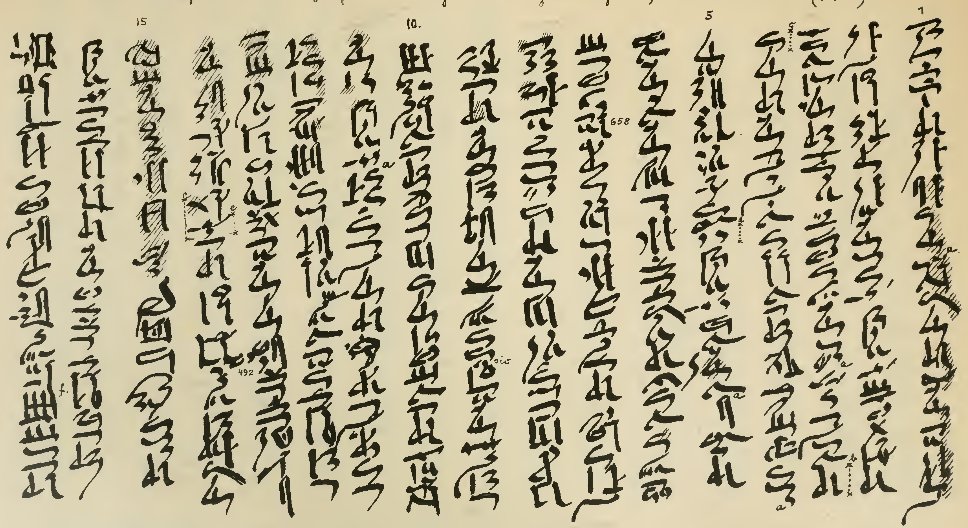
Egypt's most famous story, the Tale of Sinuhe (about 1900 BC), tells of a court official who flees Egypt in fear after a king's death, crosses the eastern frontier nearly dying of thirst, is taken in by a chieftain of Retjenu (Canaan or Syria), marries his eldest daughter, and lives for years as a herdsman before returning home. Egyptians knew this kind of story well. See Echoes.
Wells and marriages
Moses is the third man in the Pentateuch to find a bride at a well: Abraham's servant found Rebekah, Jacob met Rachel, and now Moses meets Zipporah. Each time, a stranger draws water, a woman runs home, and hospitality turns into a marriage.
The Case for the Biblical Account
Scripture's account
Moses kills an Egyptian, flees to Midian, and marries the daughter of a Midianite priest (Exodus 2:11–25).
What evidence would we expect?
A real Midian east of Egypt's frontier; herding peoples with priests and wells; Egyptian awareness of fugitives crossing into Asia.
The discoveries
Midianite pottery and settlements in the Hejaz and at Timna; Egyptian literature about fugitives (Sinuhe); Egyptian frontier records of people crossing in both directions.
Testing the discoveries
The Midianite material is clearest from the 13th–12th centuries BC, which some see as fitting the later Exodus date. The story's details about Moses himself rest on Exodus.
The strongest reconstruction
The flight to Midian fits real geography and a real people who appear repeatedly in Israel's early history.
What remains possible
That Israel's link with Midian (Moses' marriage, Jethro's priesthood) preserves a genuine historical memory, as many scholars, including critical ones, think.
What the evidence shows
- Midianite settlements and pottery are known from northwestern Arabia and Timna.
- Egyptian literature includes the story of an official who fled to Canaan and married a chieftain's daughter.Source: The Story of Sinuhe, Papyrus Berlin P. 3022 and others; in M. Lichtheim, Ancient Egyptian Literature I (1973)
- Moses' marriage into a Midianite priestly family preserves historical memory. A detail later Israel would hardly invent, since Midian became an enemy (Numbers 31).
Continue the journey
Echoes Across CivilizationsExile in the desert and returnAre there ancient stories of a man who flees his homeland, marries into a foreign family, and returns to lead?More from this lesson
Echoes Across Civilizations
Optional: how other ancient peoples told similar stories. Open one to compare, then come back to the lesson.
Exile in the desert and returnEgypt · Alalakh (Syria)
Are there ancient stories of a man who flees his homeland, marries into a foreign family, and returns to lead?
- Egypt: The Story of Sinuhe Possible historical contact
- Alalakh (Syria): The Statue of Idrimi Shared literary world
Why this matters to the rest of Scripture
- Stephen: Moses was forty when he fled; "he supposed his brethren would have understood."
- Moses "refused to be called the son of Pharaoh's daughter."
- Jacob meets Rachel at a well.
- Midian, a son of Abraham and Keturah.