Era 3 · Egypt and DeliveranceExodus
The Way Out of Egypt
"God led them not through the way of the land of the Philistines"
"God led them not through the way of the land of the Philistines, although that was near; for God said, Lest peradventure the people repent when they see war, and they return to Egypt." Instead He leads them by "the way of the wilderness of the Red sea," and they go up out of Egypt armed for the march.
Moses takes the bones of Joseph with him, keeping the oath Joseph made his brothers swear: "God will surely visit you; and ye shall carry up my bones away hence with you."
From Succoth they camp at Etham, "in the edge of the wilderness." "And the LORD went before them by day in a pillar of a cloud, to lead them the way; and by night in a pillar of fire, to give them light." The pillar never leaves them.
Then a strange command: turn back and camp "before Pi-hahiroth, between Migdol and the sea, over against Baal-zephon." Pharaoh will think, "They are entangled in the land, the wilderness hath shut them in." God says: "I will be honoured upon Pharaoh, and upon all his host; that the Egyptians may know that I am the LORD."
The way of the Philistines: Egypt's military highway
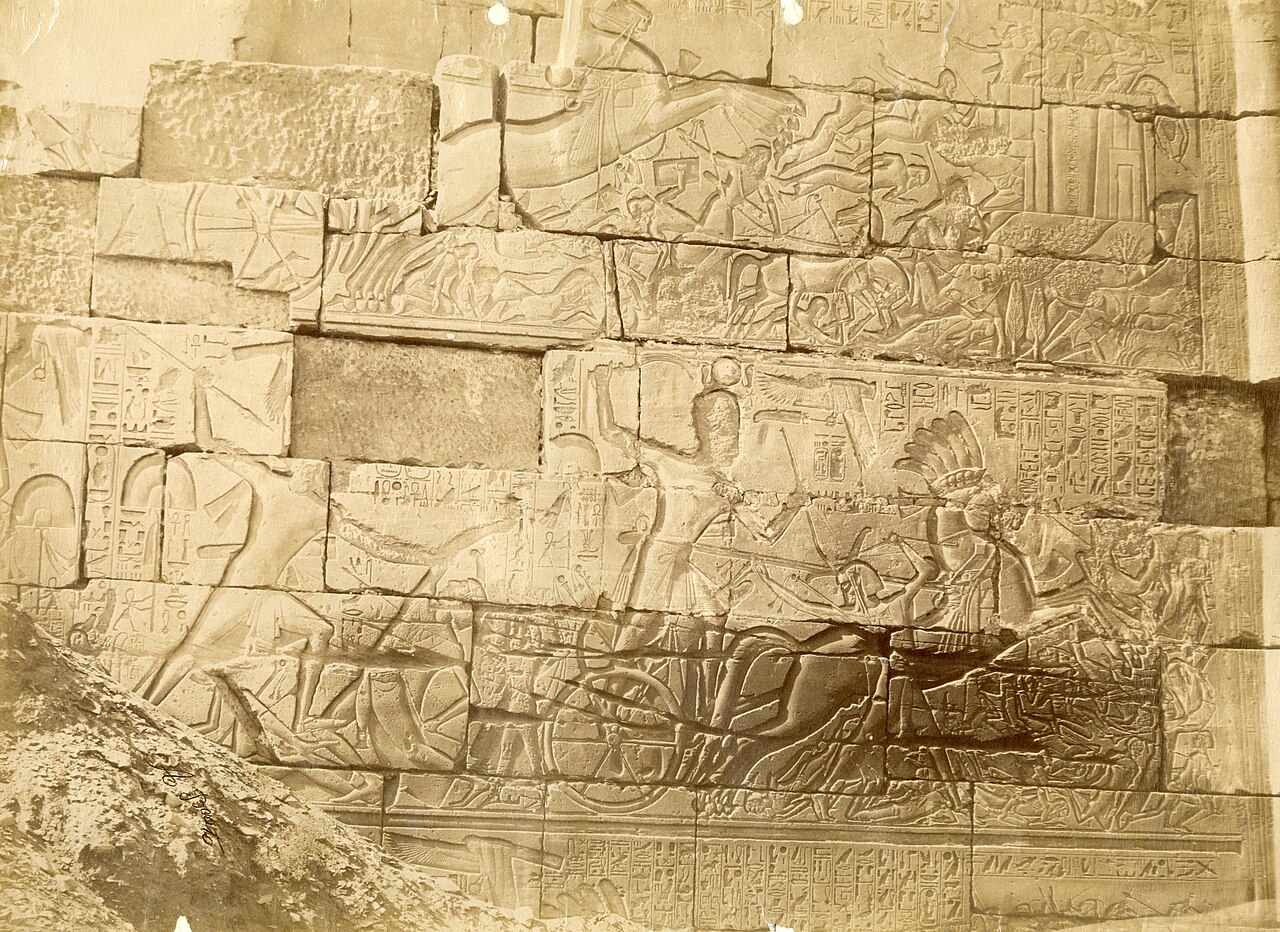
The shortest road from Egypt to Canaan ran along the north Sinai coast. Egyptians called it "the Ways of Horus." Seti I (about 1290 BC) carved a relief at Karnak showing his army returning along it, past a chain of forts and wells, each named, beginning at the frontier fortress of Tjaru and ending at Gaza. Any group leaving Egypt that way would meet Egyptian garrisons almost immediately. "Lest… they see war" fits that road exactly.
The name "way of the Philistines" is a later name: the Philistines settled the southern coast of Canaan in the 12th century BC. A writer naming the road for later readers would naturally call it that.
The frontier forts
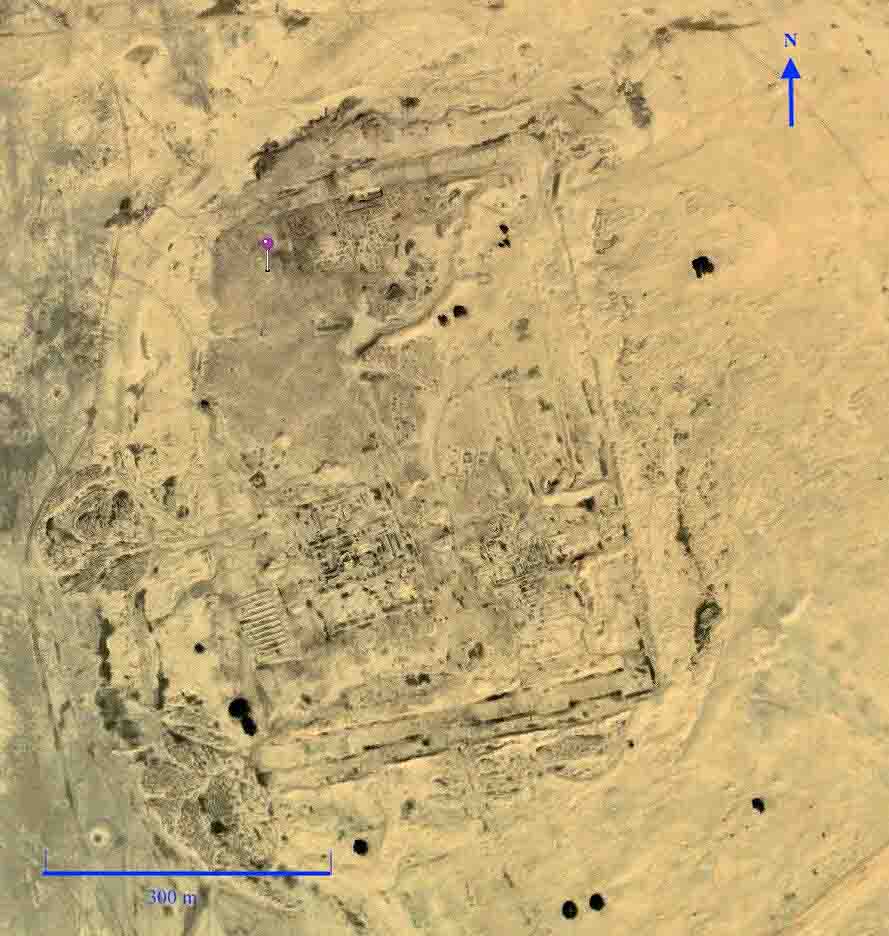
Excavations have found the frontier itself. At Tell Hebua, Egyptian archaeologists uncovered the massive fortress of Tjaru (Sile), the gateway on the Ways of Horus. Nearby at Tell el-Borg, James Hoffmeier's team excavated two New Kingdom forts and traces of an ancient waterway. A canal and lagoons ran along the eastern edge of the Delta, a barrier the Seti relief shows filled with crocodiles and crossed by a bridge.
Migdol and Baal-zephon
"Migdol" is a Semitic word for a tower or fort, used in Egyptian texts for frontier strongholds. A "Migdol of Seti" appears in the Karnak relief. Baal-zephon, "Baal of the North," was a Canaanite god honored at Egyptian ports. Pi-hahiroth remains unidentified. These names place the camp near Egypt's fortified eastern border, not far out in Sinai.
Joseph's bones
Carrying Joseph's bones closes the story that Genesis began: Joseph made his family swear to take him up (Genesis 50:25), and Joshua 24:32 records his burial at Shechem, in the field Jacob bought.
The Case for the Biblical Account
Scripture's account
Israel avoids the coastal road for fear of war, camps at Etham, then turns back to camp between Migdol and the sea (Exodus 13:17–14:4).
What evidence would we expect?
A fortified coastal road; a frontier zone with forts, towers and water barriers; place names that fit Egypt's eastern border.
The discoveries
The Seti I relief of the Ways of Horus; the forts at Tell Hebua (Tjaru) and Tell el-Borg; ancient lagoons and a frontier canal; Egyptian "migdol" forts.
Testing the discoveries
The frontier is archaeologically secure for the New Kingdom. The exact sites of Etham, Pi-hahiroth, Migdol and Baal-zephon are not.
The strongest reconstruction
The route description reflects real knowledge of Egypt's eastern frontier as it was in the New Kingdom, especially the Ramesside period.
What remains possible
That the names preserve an early itinerary, or that a later writer who knew the frontier well shaped the account.
| Station (Exodus) | Proposed identification | Certainty |
|---|---|---|
| Rameses | Pi-Ramesse at Qantir / Tell el-Dab'a | Secure as a city; its link to the Exodus depends on the date |
| Succoth | Egyptian Tjeku, in the Wadi Tumilat | Probable |
| Etham | Perhaps Egyptian khetem, "fortress" | Debated |
| Migdol | One of several frontier forts called Migdol | Debated |
| Pi-hahiroth | Unknown; perhaps "mouth of the canals" | Unidentified |
| Baal-zephon | A shrine of Baal-zephon on the coast or near the lakes | Debated |
What the evidence shows
- Egypt guarded its eastern frontier with a chain of forts along the Ways of Horus.Source: Seti I's battle reliefs, north wall of the hypostyle hall, Karnak: the "Ways of Horus" forts from Tjaru to Gaza; A. H. Gardiner, "The Ancient Military Road between Egypt and Palestine," JEA 6 (1920); M. Abd el-Maksoud, excavations at Tell Hebua (Tjaru), 1986–1999; Hoffmeier and Abd el-Maksoud, "A New Military Site on 'the Ways of Horus'," JEA 89 (2003)
- The Exodus place names reflect authentic knowledge of the eastern Delta frontier.Source: J. K. Hoffmeier, Israel in Egypt: The Evidence for the Authenticity of the Exodus Tradition (Oxford, 1997); J. K. Hoffmeier, Ancient Israel in Sinai (Oxford, 2005)
- The camp at Pi-hahiroth has been located.
- The LORD led Israel by a pillar of cloud and fire.
Continue the journey
Connected elsewhere in ScriptureJoseph's Final DaysGenesis 50:25: Joseph's oath: "ye shall carry up my bones from hence."More from this lesson
On the map
Location securely identified Probable identification Proposed or debated location Biblical route (roads schematic) Scholarly proposal
- Exodus proposal: southern Sinai (traditional). Rameses → Succoth → a crossing at the Gulf of Suez (or the nearby lakes) → down the west Sinai coast → Jebel Musa → north to Kadesh-barnea.
- Exodus proposal: northern lakes and Negev. Rameses → Succoth → a crossing in the frontier lakes → across north-central Sinai → a Sinai such as Har Karkom → Kadesh-barnea.
- Exodus proposal: Arabia (Midian). Rameses → across the Sinai peninsula → a crossing at Nuweiba in the Gulf of Aqaba → Jebel al-Lawz in Midian → Kadesh-barnea.
Why this matters to the rest of Scripture
- Joseph's oath: "ye shall carry up my bones from hence."
- Joseph's bones buried at Shechem.
- The full itinerary of the stations.
- "All our fathers were under the cloud."