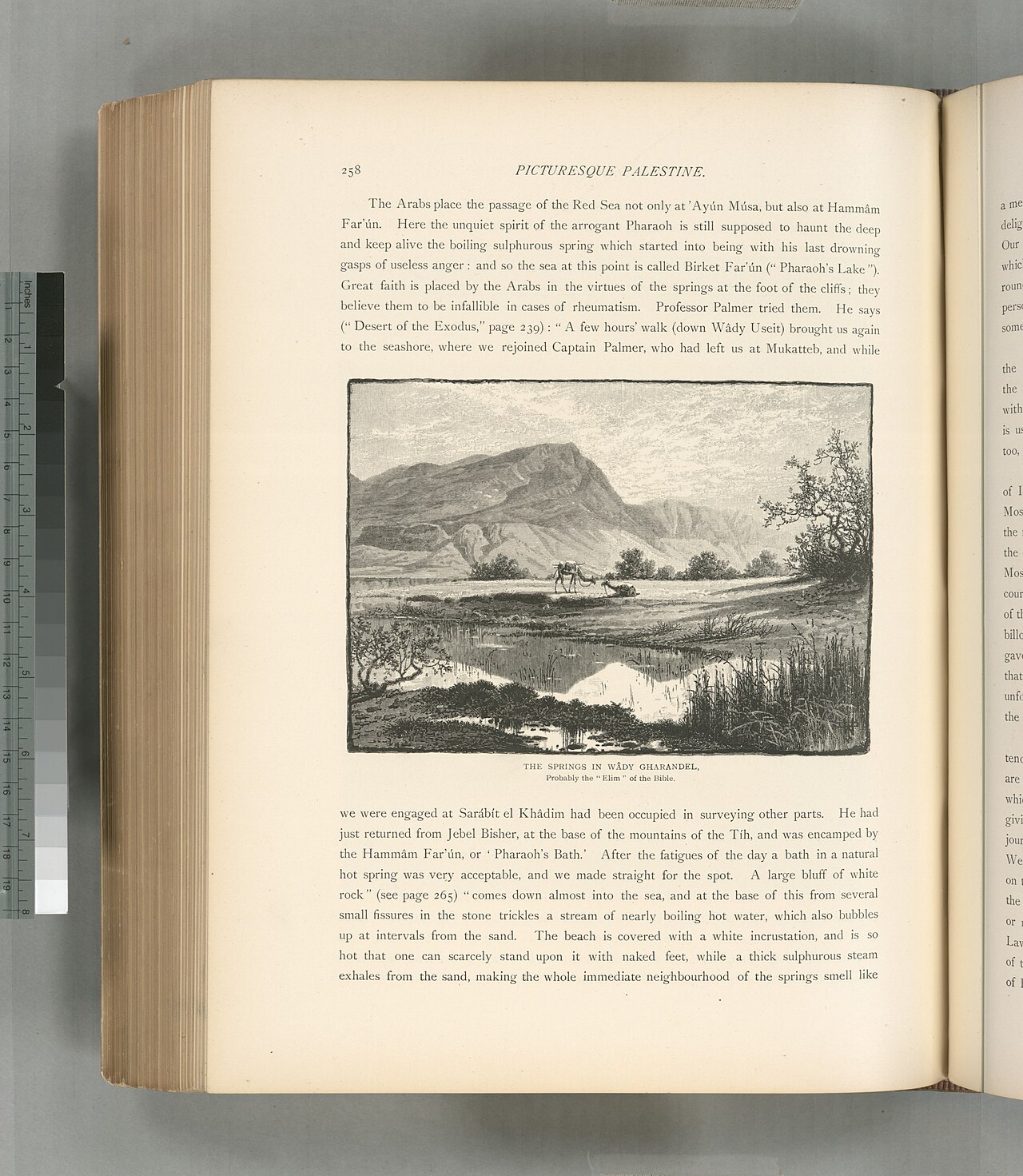
Moses leads Israel from the sea into the wilderness of Shur. For three days they find no water. At Marah there is water, but they cannot drink it, "for they were bitter: therefore the name of it was called Marah" (bitter).
The people murmur: "What shall we drink?" Moses cries to the LORD, "and the LORD shewed him a tree, which when he had cast into the waters, the waters were made sweet."
There God makes a statute and tests them: "If thou wilt diligently hearken to the voice of the LORD thy God… I will put none of these diseases upon thee, which I have brought upon the Egyptians: for I am the LORD that healeth thee."
"And they came to Elim, where were twelve wells of water, and threescore and ten palm trees: and they encamped there by the waters."
Water in the wilderness
The western Sinai has few water sources, and many are brackish or mineral-heavy. Three days without water is about the limit for people walking in desert heat. Wilderness travel depended on knowing where the springs were.
Where were Marah and Elim?
On the traditional southern route, Marah is identified with Ain Hawara (or Bir Marah), a bitter spring south of Suez, and Elim with the oasis of Wadi Gharandel, which has palms, tamarisks and several springs. Ayun Musa ("the Springs of Moses") near Suez is another station on that route. Supporters of other routes propose different sites. None is confirmed.
How might bitter water become sweet?
Some have suggested that certain woods or plant materials can absorb or bind minerals, or that the water was made drinkable by other natural means. Exodus presents it as God showing Moses what to do, and as a sign that He is Israel's healer. A natural explanation of bitter water does not explain the change at Moses' word.
The Case for the Biblical Account
Scripture's account
Bitter water at Marah is made sweet; Israel camps at Elim's twelve springs and seventy palms (Exodus 15:22–27).
What evidence would we expect?
Brackish and fresh springs along a plausible route from the sea toward Sinai.
The discoveries
Bitter springs such as Ain Hawara and the oasis of Wadi Gharandel on the traditional route; brackish water sources common across Sinai.
Testing the discoveries
The identifications are traditional and cannot be confirmed archaeologically; a campsite of nomads leaves little trace.
The strongest reconstruction
The account fits real wilderness conditions: the scarcity of water, bitter springs, and palm oases.
What remains possible
Any of the proposed sites, or others on a different route.
What the evidence shows
- Brackish, mineral-laden springs occur in the Sinai wilderness.
- Marah is Ain Hawara and Elim is Wadi Gharandel. Traditional identifications on the southern route.
- "I am the LORD that healeth thee."
Continue the journey
Connected elsewhere in ScriptureThe Wilderness ItineraryNumbers 33:8–9: Marah and Elim in the itinerary.More from this lesson
On the map
Location securely identified Probable identification Proposed or debated location Biblical route (roads schematic) Scholarly proposal
- Exodus proposal: southern Sinai (traditional). Rameses → Succoth → a crossing at the Gulf of Suez (or the nearby lakes) → down the west Sinai coast → Jebel Musa → north to Kadesh-barnea.
Why this matters to the rest of Scripture
- Marah and Elim in the itinerary.
- Elisha heals the bad waters of Jericho.
- "Who healeth all thy diseases."
- The tree whose leaves are for the healing of the nations.