Era 4 · Covenant and WildernessExodus
The Ten Commandments
"I am the LORD thy God, which have brought thee out of the land of Egypt"
"And God spake all these words, saying, I am the LORD thy God, which have brought thee out of the land of Egypt, out of the house of bondage."
- "Thou shalt have no other gods before me."
- "Thou shalt not make unto thee any graven image… thou shalt not bow down thyself to them."
- "Thou shalt not take the name of the LORD thy God in vain."
- "Remember the sabbath day, to keep it holy… For in six days the LORD made heaven and earth… and rested the seventh day."
- "Honour thy father and thy mother: that thy days may be long upon the land."
- "Thou shalt not kill."
- "Thou shalt not commit adultery."
- "Thou shalt not steal."
- "Thou shalt not bear false witness against thy neighbour."
- "Thou shalt not covet thy neighbour's house… nor any thing that is thy neighbour's."
The people see the thunder, the lightning, the trumpet and the smoking mountain, and they stand far off. "Speak thou with us, and we will hear: but let not God speak with us, lest we die." Moses answers, "Fear not: for God is come to prove you, and that his fear may be before your faces, that ye sin not." Moses draws near to the thick darkness where God is.
Ten words
The Bible itself calls them "the ten words" (Exodus 34:28; Deuteronomy 4:13), from which comes the Greek "Decalogue." It never numbers them, and traditions divide them differently.
| Jewish | Catholic and Lutheran | Orthodox and most Protestants | |
|---|---|---|---|
| 1 | "I am the LORD thy God… out of Egypt" | No other gods (including images) | No other gods |
| 2 | No other gods; no images | God's name | No graven images |
| 3 | God's name | Sabbath | God's name |
| 4 | Sabbath | Parents | Sabbath |
| 5–8 | Parents, murder, adultery, theft | Murder, adultery, theft, false witness | Parents, murder, adultery, theft |
| 9 | False witness | Coveting (wife, or in Lutheran use, house) | False witness |
| 10 | Coveting | Coveting the rest | Coveting |
Exodus 20 and Deuteronomy 5
Deuteronomy repeats the commandments as Moses' speech forty years later, with differences. The biggest is the reason for the Sabbath. Exodus: "For in six days the LORD made heaven and earth… and rested the seventh day." Deuteronomy: "Remember that thou wast a servant in the land of Egypt… therefore the LORD thy God commanded thee to keep the sabbath day." One looks back to creation, the other to the Exodus. Deuteronomy also says "keep" for "remember," and lists the neighbor's wife before his house in the last commandment.
The Nash Papyrus
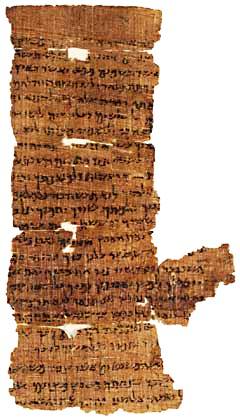
Bought in Egypt in 1902 by W. L. Nash, this small sheet of papyrus, written in the 2nd or 1st century BC, contains the Ten Commandments followed by the Shema ("Hear, O Israel"). Until the Dead Sea Scrolls were found, it was the oldest known manuscript of any part of the Hebrew Bible. It mixes wording from Exodus 20 and Deuteronomy 5, and orders the commandments "adultery, murder, theft," like the Greek Septuagint and the New Testament, not "murder, adultery, theft" as in the standard Hebrew. Follow the passage to see every witness.
Ten words in treaty form
Ancient treaties between a great king and a lesser king typically opened by naming the great king and recalling what he had done for the vassal, then set out exclusive loyalty and obligations, and required copies of the treaty to be deposited in temples. Exodus 20 follows a similar pattern: "I am the LORD… which have brought thee out," then "no other gods," then the stipulations, written later on two tablets kept in the ark. See the Echoes topic on covenant treaties.
The Case for the Biblical Account
Scripture's account
God speaks the Ten Commandments from Sinai, later written on two tablets (Exodus 20; 31:18; Deuteronomy 5).
What evidence would we expect?
Ancient copies of the Decalogue; legal and treaty forms of the period that resemble it; consistent transmission with explainable variations.
The discoveries
The Nash Papyrus; Decalogue texts in Qumran phylacteries and in 4QDeut-n; Hittite treaty structure; ancient law collections.
Testing the discoveries
The copies are late Second Temple, a thousand years after the proposed Sinai event. Treaty parallels show the form was ancient but cannot date the text precisely.
The strongest reconstruction
The Decalogue was central to Jewish life and liturgy long before Jesus, and it was copied with small, traceable differences. Its covenant form fits ancient Near Eastern treaty traditions.
What remains possible
That the Ten Words were given at Sinai as Scripture says; that a core was given at Sinai and expanded; or that they grew within Israel's covenant tradition.
Unique in its world
Ancient law collections, like Hammurabi's, were case law: "If a man does X, then Y." The Decalogue speaks in absolute commands ("Thou shalt not") addressed directly by God to every member of the people, and it forbids worshiping any other god or making any image of God. No other ancient Near Eastern law code demands either.
What the evidence shows
- The Nash Papyrus (2nd–1st century BC) contains the Ten Commandments and the Shema.Source: The Nash Papyrus (Cambridge University Library, MS Or. 233), 2nd–1st century BC
- Exodus 20 and Deuteronomy 5 give different reasons for the Sabbath.
- The Decalogue resembles the structure of Late Bronze Age treaties.Source: G. E. Mendenhall, Law and Covenant in Israel and the Ancient Near East (1955); K. A. Kitchen and P. J. N. Lawrence, Treaty, Law and Covenant in the Ancient Near East, 3 vols. (2012)
- God spoke the Ten Commandments to Israel at Sinai.
Continue the journey
Journey of a PassageExodus 20:8–17: The Ten Commandments: order, Sabbath, and a Samaritan commandmentThe Decalogue is one of the best-attested passages in the Bible, yet its witnesses differ in three ways: the order of "murder, adultery, theft," the reason given for the Sabbath (Exodus 20 versus Deuteronomy 5), and an extra commandment about Mount Gerizim in the Samaritan Pentateuch.More from this lesson
Echoes Across Civilizations
Optional: how other ancient peoples told similar stories. Open one to compare, then come back to the lesson.
Covenants shaped like treatiesHittite · Assyrian
Did ancient kings make treaties in the same shape as God's covenant at Sinai?
- Hittite: Hittite vassal treaties (e.g. Mursili II with Duppi-Teshub of Amurru; Suppiluliuma I with Shattiwaza) Possible historical contact
- Assyrian: The Succession Treaty of Esarhaddon (Vassal Treaties of Esarhaddon) Possible historical contact
Why this matters to the rest of Scripture
- The second giving of the commandments.
- The greatest commandments: love God, love your neighbor.
- Jesus on murder and adultery: "But I say unto you."
- "Love is the fulfilling of the law."
- Jesus lists the commandments to the rich young man.