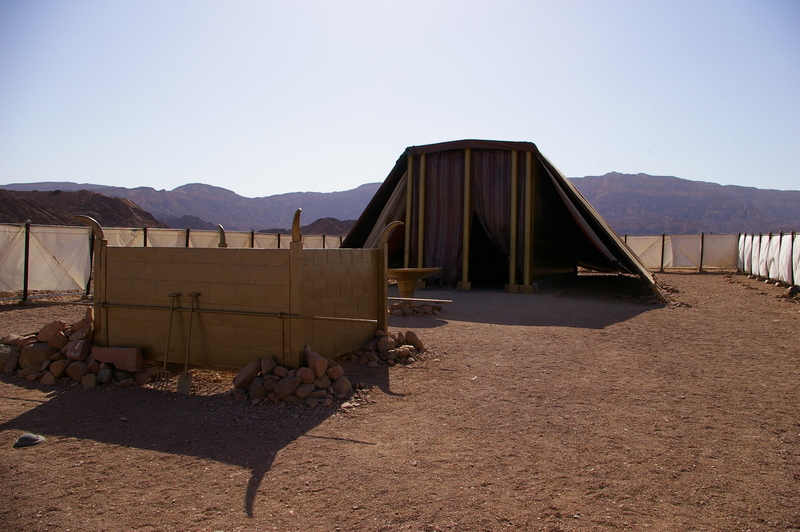
Era 4 · Covenant and WildernessExodus
The Tabernacle and the Ark
"Let them make me a sanctuary; that I may dwell among them"
God tells Moses to receive an offering from everyone "that giveth it willingly with his heart": gold, silver, bronze, blue, purple and scarlet yarn, fine linen, goats' hair, rams' skins, acacia wood, oil, spices and precious stones. "And let them make me a sanctuary; that I may dwell among them. According to all that I shew thee, after the pattern of the tabernacle… even so shall ye make it."
First the ark: a chest of acacia wood, about 1.1 m long, overlaid with pure gold inside and out, carried on poles through gold rings. Inside goes "the testimony," the tablets. On top is the mercy seat, a gold cover, with two cherubim of beaten gold, wings spread over it, facing each other. "And there I will meet with thee, and I will commune with thee from above the mercy seat, from between the two cherubims."
Then a table for the bread of the Presence, always set before the LORD; a lampstand of beaten gold with seven lamps, shaped like an almond tree in blossom; and the tabernacle itself: ten curtains of fine linen woven with cherubim, covered by curtains of goats' hair and coverings of rams' skins dyed red and of fine leather, over a frame of gold-covered acacia boards set in silver sockets.
A veil of blue, purple and scarlet divides the holy place from the most holy place, where the ark stands. Outside is a bronze altar for burnt offerings, and around it all a courtyard of linen hangings, 100 cubits by 50.
Tents fit for a king
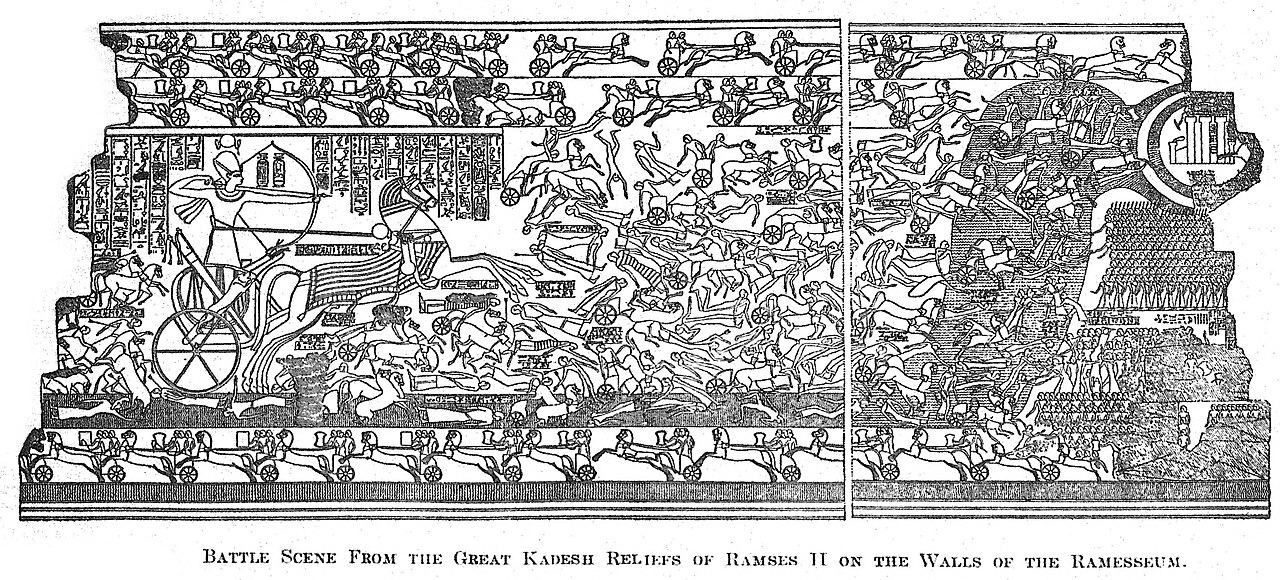
Ramesses II's reliefs of the Battle of Kadesh (about 1274 BC), at Abu Simbel and other temples, show his army camp as a rectangle twice as long as it is wide, with a gateway on the east and the king's tent in the center: an outer reception tent and an inner throne room. Michael Homan and others have noted that the tabernacle courtyard has the same 2:1 proportions and orientation, with God's tent at the center of Israel's camp as the Pharaoh's was at the center of his army. The tabernacle presents Israel's God as the King among His people.
Portable shrines and carrying poles
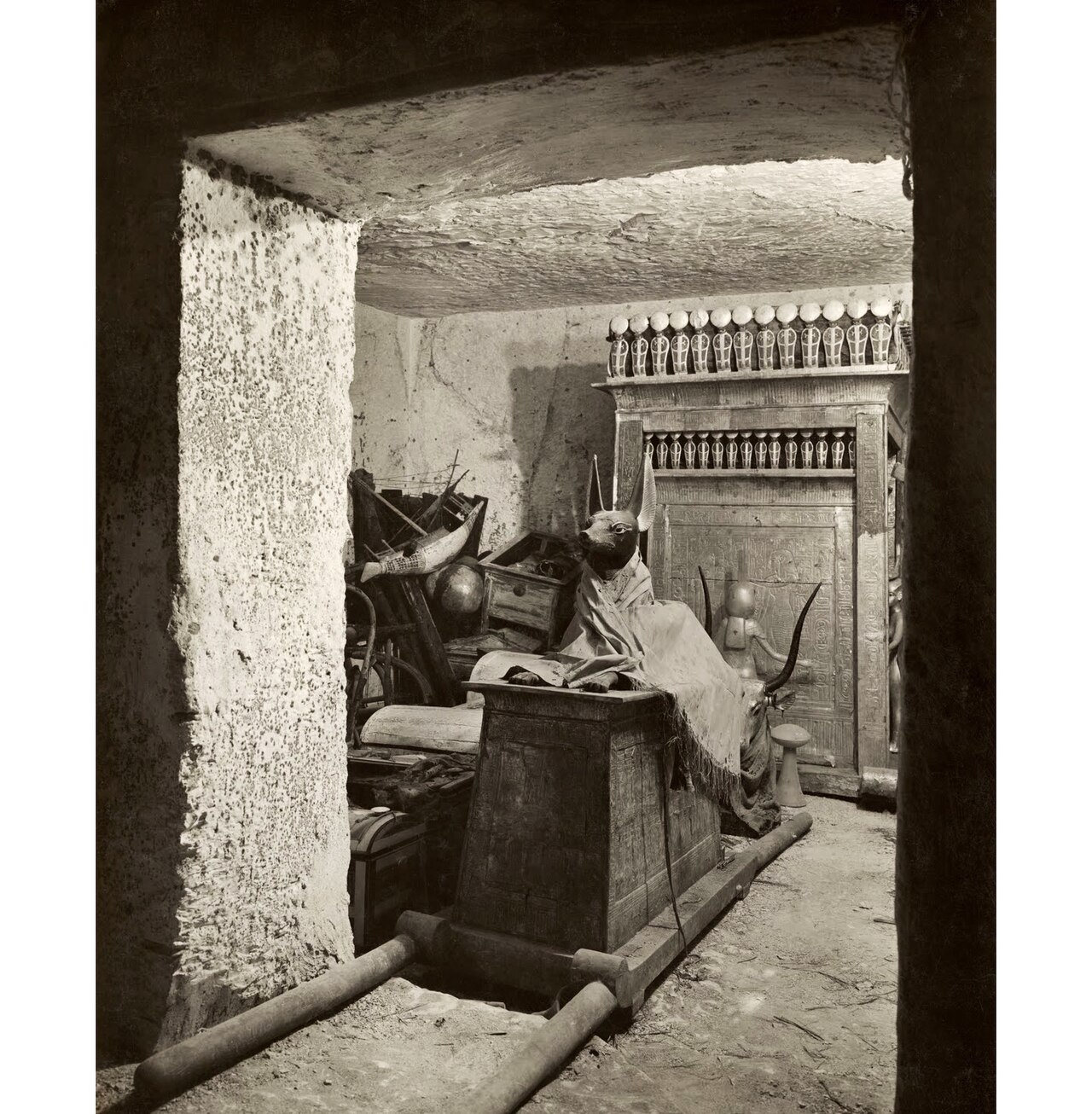
Egyptian sacred objects were carried on poles: the gods' barque shrines in festival processions, and chests such as the gilded Anubis shrine from Tutankhamun's tomb, mounted on carrying poles. Tutankhamun's burial chamber was enclosed in four gilded wooden shrines nested one inside another, built in sections to be assembled, with linen stretched over a frame between them. Kenneth Kitchen pointed to these as evidence that gold-covered wooden sanctuaries designed to be taken apart were real Late Bronze Age technology.
A tent shrine in the desert: Timna
In the Timna valley north of the Gulf of Aqaba, Egyptian copper miners built a small shrine to the goddess Hathor (14th–12th centuries BC). After the Egyptians left, the site was reused, probably by Midianites (their distinctive Qurayyah painted pottery was found there). They defaced the Hathor images, set up standing stones, and covered the shrine with a tent: excavator Beno Rothenberg found heaps of red and yellow woolen cloth with beads along the walls. They also left a copper snake with a gilded head. It is the clearest archaeological example of a desert tent sanctuary from the right region and period.
Cherubim
Cherubim were not chubby infants but composite guardians with wings, like the winged sphinxes that guard thrones in Canaanite and Phoenician art. An ivory plaque from Megiddo (13th–12th century BC) shows a king seated on a throne flanked by winged sphinxes. God "dwelleth between the cherubims" (1 Samuel 4:4): the ark is His footstool and the cherubim His throne.
The Case for the Biblical Account
Scripture's account
God gives Moses the pattern for a portable sanctuary centered on the ark (Exodus 25–27), built in chapters 35–40.
What evidence would we expect?
Portable, gold-covered wooden structures and carrying poles; royal tents at the center of camps; desert tent shrines; cherub iconography of the period.
The discoveries
Ramesses II's Kadesh camp reliefs; Tutankhamun's gilded shrines and Anubis chest; the Timna tent shrine; winged sphinx thrones in Canaanite art.
Testing the discoveries
These show that the tabernacle's design fits Late Bronze Age technology and symbolism, especially Egyptian. The tabernacle itself has not been found, which is unsurprising for a structure of wood, cloth and leather.
The strongest reconstruction
The tabernacle account describes a sanctuary consistent with the world of the 13th century BC, presenting the LORD as the divine King enthroned in Israel's camp.
What remains possible
That it was built as Exodus describes; or, in many critical reconstructions, that later priestly writers modeled it on the Jerusalem temple and projected it back. Its Egyptian features are an important part of this debate.
Built in the wilderness, or drawn from the Temple?
Kitchen, Hoffmeier, Homan and others argue that the tabernacle's technology, materials (acacia grows in Sinai; Egyptians used such dyes and gold leaf) and design parallels are strongest in the Late Bronze Age, and that a later writer imagining the Temple would not invent a tent.
Many critical scholars assign these chapters to the Priestly source (6th–5th century BC) and see the tabernacle as an idealized portable Temple, legitimizing Jerusalem's worship by tracing it to Sinai.
Others think Israel did have an early tent shrine ("the tent of meeting," Exodus 33:7–11, which is simpler and stands outside the camp), and that the detailed account developed from that memory.
What the evidence shows
- Ramesses II's Kadesh reliefs show a 2:1 rectangular camp with the royal tent at its center.Source: M. M. Homan, To Your Tents, O Israel! The Terminology, Function, Form, and Symbolism of Tents in the Hebrew Bible and the Ancient Near East (2002)
- Egyptian craftsmen built gilded wooden shrines in sections and carried sacred chests on poles.Source: K. A. Kitchen, On the Reliability of the Old Testament (2003), ch. 6
- A tent shrine with standing stones was set up at Timna after the Egyptian period.Source: B. Rothenberg, Timna: Valley of the Biblical Copper Mines (1972); The Egyptian Mining Temple at Timna (1988)
- The tabernacle account reflects a Late Bronze Age setting.Source: M. M. Homan, To Your Tents, O Israel! The Terminology, Function, Form, and Symbolism of Tents in the Hebrew Bible and the Ancient Near East (2002); J. Gee, "The Tabernacle and Egyptian Sacred Architecture" (Academy for Temple Studies)
- "There I will meet with thee."
Continue the journey
Ancient MysteriesThe Ark of the CovenantWhat happened to the ark, and have any claims to have found it been verified?More from this lesson
Investigations
Optional deep dives: the ancient sources, the physical evidence, and every interpretation side by side, including unconventional ones, each labeled for what it is.
The Ark of the CovenantBiblical history: traced to Solomon's Temple · Later fate: unknown · Claimed discoveries: unverified
What happened to the ark, and have any claims to have found it been verified?
The ark is the most sacred object in the Old Testament: a gold-covered chest holding the tablets of the covenant, carried across the Jordan, captured by the Philistines, brought to Jerusalem by David and placed in Solomon's Temple. Then the Bible falls silent about it. Traditions place it in a hidden cave, beneath the Temple Mount, in Babylon, or in Ethiopia. None has been verified.
Open the full investigation →Echoes Across Civilizations
Optional: how other ancient peoples told similar stories. Open one to compare, then come back to the lesson.
Portable sanctuaries and royal tentsEgypt · Midianite (probably) · Ugarit (Canaanite)
Did other ancient peoples have portable shrines or tents for their gods and kings like the tabernacle?
- Egypt: Ramesses II's war camp at Kadesh Possible historical contact
- Egypt: Tutankhamun's gilded shrines and Anubis chest Possible historical contact
- Midianite (probably): The Timna tent shrine Possible historical contact
- Ugarit (Canaanite): The tents of the gods Shared literary world
Why this matters to the rest of Scripture
- "The Word was made flesh, and dwelt among us."
- "See… that thou make all things according to the pattern shewed to thee in the mount."
- The tabernacle and its furnishings explained.
- "The ark of the covenant of the LORD of hosts, which dwelleth between the cherubims."
- "Behold, the tabernacle of God is with men."