Era 3 · Egypt and DeliveranceExodus
The Song of the Sea
"The horse and his rider hath he thrown into the sea"
"Then sang Moses and the children of Israel this song unto the LORD… I will sing unto the LORD, for he hath triumphed gloriously: the horse and his rider hath he thrown into the sea. The LORD is my strength and song, and he is become my salvation."
The song retells the night: "With the blast of thy nostrils the waters were gathered together, the floods stood upright as an heap." The enemy boasted, "I will pursue, I will overtake, I will divide the spoil"; "thou didst blow with thy wind, the sea covered them: they sank as lead in the mighty waters."
"Who is like unto thee, O LORD, among the gods? who is like thee, glorious in holiness, fearful in praises, doing wonders?"
Then the song looks forward: the nations of Philistia, Edom, Moab and Canaan will tremble, "till thy people pass over, O LORD," and God will plant them "in the mountain of thine inheritance… the Sanctuary, O Lord, which thy hands have established. The LORD shall reign for ever and ever."
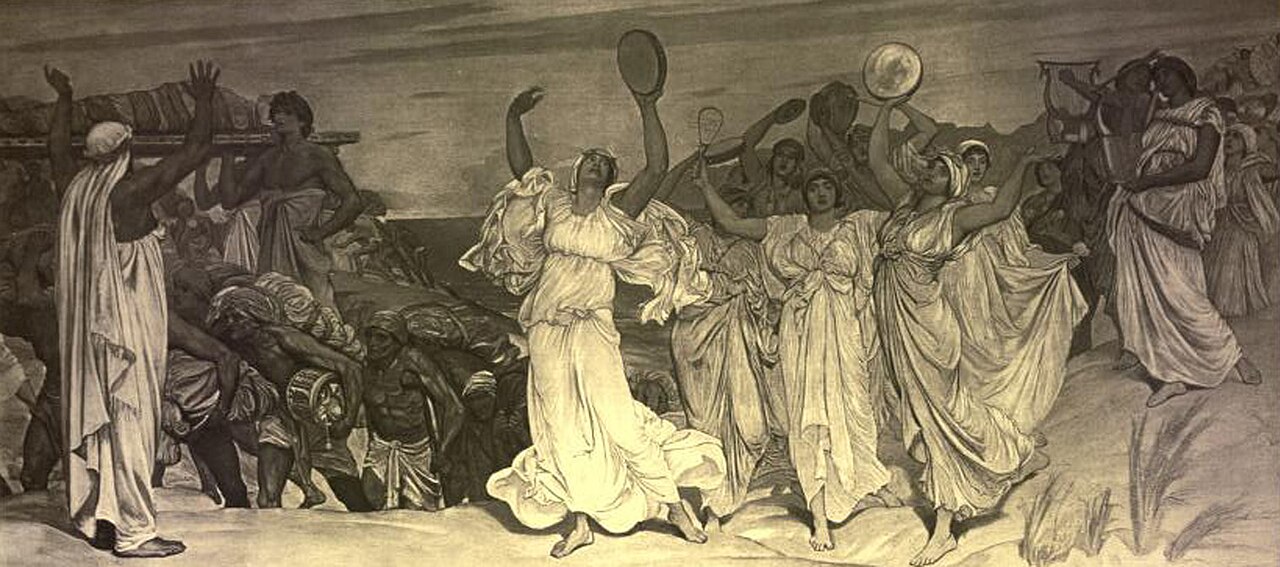
"And Miriam the prophetess, the sister of Aaron, took a timbrel in her hand; and all the women went out after her with timbrels and with dances. And Miriam answered them, Sing ye to the LORD, for he hath triumphed gloriously; the horse and his rider hath he thrown into the sea."
One of the oldest poems in the Bible
Many scholars, including Frank Moore Cross and David Noel Freedman, judged the Song of the Sea to be among the oldest compositions in the Hebrew Bible, perhaps from the 12th or 11th century BC. Its Hebrew uses archaic grammar and spelling found in early poetry, and it closely resembles the Song of Deborah (Judges 5). Others date it later, noting the reference to a sanctuary. Even later dates make it very early Israelite poetry.
Women's victory songs
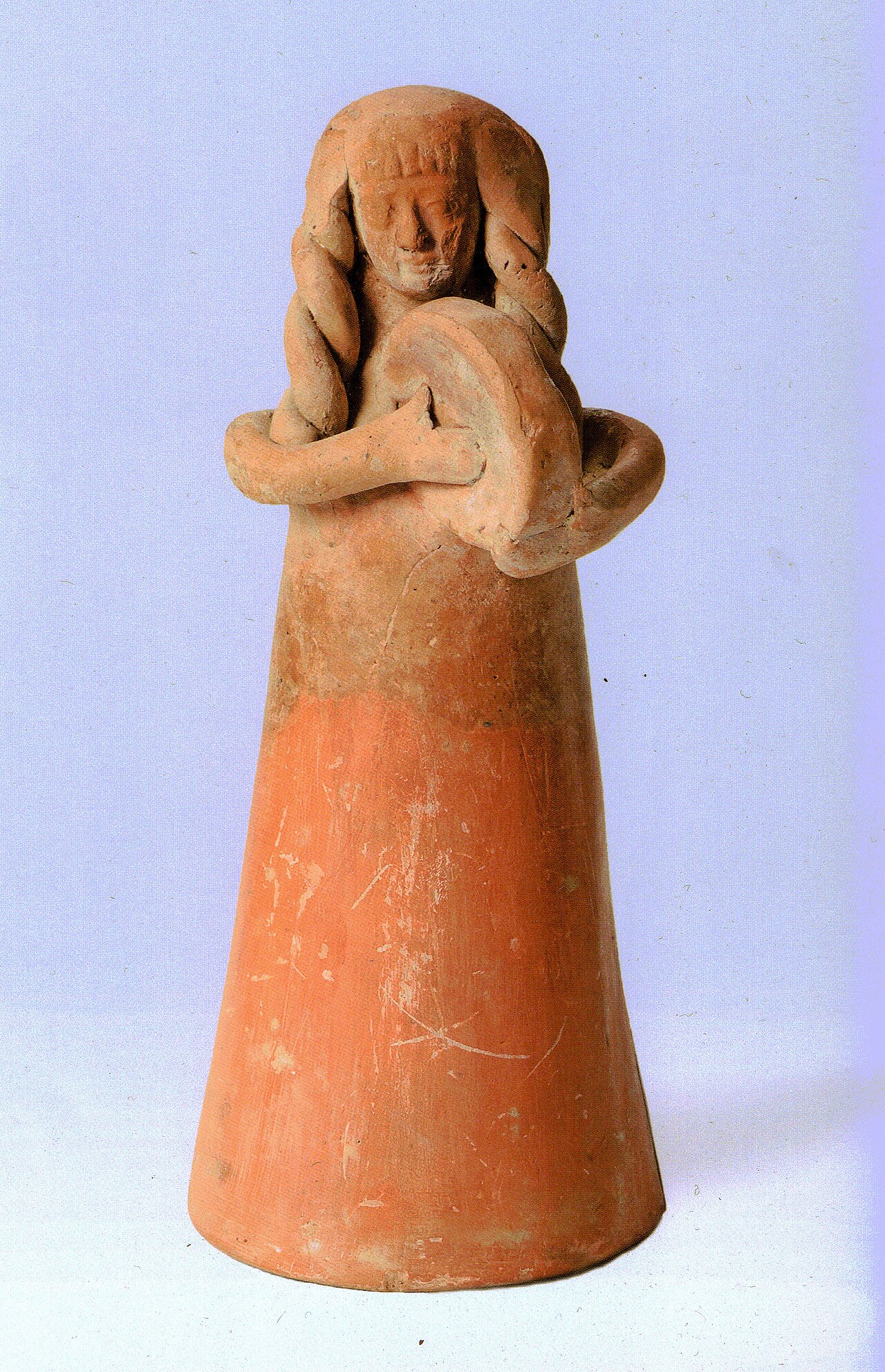
Women greeting a victory with frame drums and dancing is a well-attested custom: Jephthah's daughter (Judges 11:34), the women who sang of Saul and David (1 Samuel 18:6). Clay figurines of women holding frame drums are common finds in Iron Age Israel and Phoenicia. Miriam leads as a prophetess, the first woman given that title in the Bible.
A longer Song of Miriam
Exodus records only one line of Miriam's song. A Dead Sea Scroll known as 4Q365 ("Reworked Pentateuch"), copied around 75–50 BC, inserts several more lines after Exodus 15:21, including "You are great, a deliverer… the hope of the enemy has perished… Extol the one who raises up, who gives triumph." Scholars debate whether this is an ancient tradition or an expansion composed to fill the gap. It shows that Jewish scribes were interested in Miriam's song long before the time of Jesus.
The Case for the Biblical Account
Scripture's account
Moses, Israel and Miriam celebrate the deliverance in song (Exodus 15:1–21).
What evidence would we expect?
Archaic language in the poem; parallels with other early victory songs; evidence of the custom of women's drum songs.
The discoveries
Archaic Hebrew features; the Song of Deborah as a comparable early poem; frame-drum figurines; 4Q365's expanded Song of Miriam.
Testing the discoveries
Linguistic dating of poetry is imprecise, and scholars disagree about how early the song is. The 4Q365 expansion is late Second Temple.
The strongest reconstruction
The Song of the Sea is probably among Israel's earliest surviving poems, celebrating the deliverance at the sea as an act of God the divine warrior and king.
What remains possible
That it was first sung at the event; that it was composed in Israel's earliest centuries in the land; or that it grew in stages.
What the evidence shows
- The Song of the Sea contains archaic Hebrew features shared with the oldest biblical poetry.Source: F. M. Cross and D. N. Freedman, Studies in Ancient Yahwistic Poetry (1975)
- A Dead Sea Scroll preserves additional lines of Miriam's song after Exodus 15:21.Source: 4Q365 (4QReworked Pentateuch-c), fragment 6a ii + 6c: an expanded Song of Miriam; E. Tov and S. White, DJD 13 (1994)
- Women greeted victories with frame drums and dance in ancient Israel.
- "The LORD shall reign for ever and ever."
Continue the journey
Connected elsewhere in ScriptureThe Song of DeborahJudges 5: The Song of Deborah, Israel's other great early victory song.More from this lesson
Why this matters to the rest of Scripture
- The Song of Deborah, Israel's other great early victory song.
- "The LORD is my strength and song, and is become my salvation": quoted from 15:2.
- The same line in Isaiah's song of salvation.
- "They sing the song of Moses the servant of God, and the song of the Lamb."
- "I sent before thee Moses, Aaron, and Miriam."