Era 5 · The Promised LandJudges
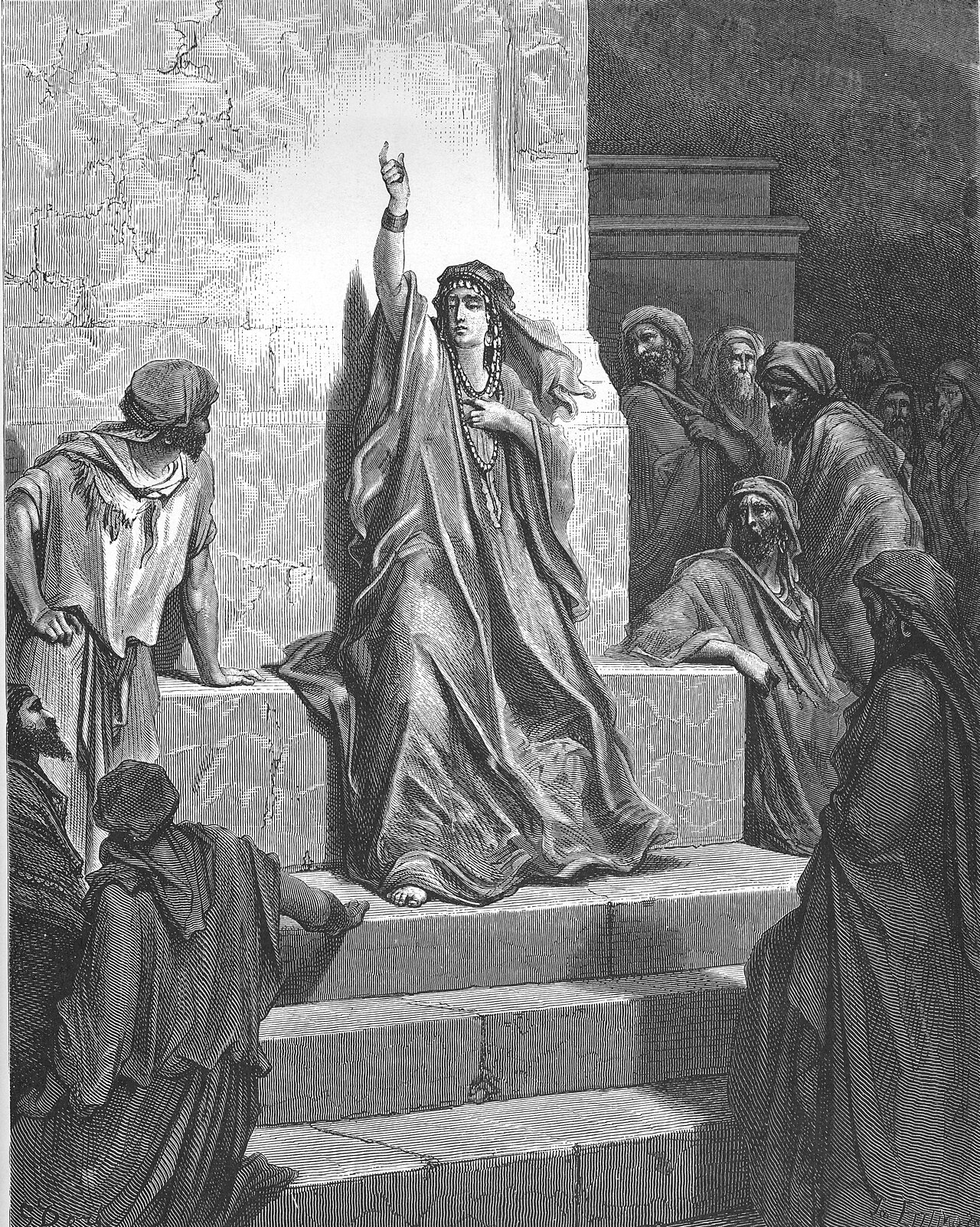
The Song of Deborah
"The stars in their courses fought against Sisera"
"Praise ye the LORD for the avenging of Israel." "LORD, when thou wentest out of Seir, when thou marchedst out of the field of Edom, the earth trembled, and the heavens dropped… The mountains melted from before the LORD." "In the days of Shamgar… the highways were unoccupied… until that I Deborah arose, that I arose a mother in Israel."
Ephraim, Benjamin, Machir, Zebulun, Issachar and Naphtali come. Reuben stays "among the sheepfolds," Gilead beyond Jordan, Dan "in ships," Asher "on the sea shore." "They fought from heaven; the stars in their courses fought against Sisera. The river of Kishon swept them away." "Curse ye Meroz… because they came not to the help of the LORD."
"Blessed above women shall Jael the wife of Heber the Kenite be… She put her hand to the nail, and her right hand to the workmen's hammer." "The mother of Sisera looked out at a window… Why is his chariot so long in coming?" Her wise ladies answer: they are dividing the spoil, "a damsel or two" for every man. "So let all thine enemies perish, O LORD: but let them that love him be as the sun when he goeth forth in his might. And the land had rest forty years."
Prose and poem
| Judges 4 (prose) | Judges 5 (poem) | |
|---|---|---|
| Enemy king | Jabin of Hazor | "Kings of Canaan"; Jabin not named |
| Tribes | Naphtali and Zebulun | Six tribes come; four stay away; Meroz cursed |
| The rout | God "discomfited" Sisera | Stars fight; the Kishon floods |
| Jael | Sisera asleep, peg through his temple | Sisera struck while drinking, falls at her feet |
These are two compositions, not two manuscripts of the same text. Many readers think the prose drew on the poem; others see two traditions of the same event.
How old is the song?
Many scholars, following William F. Albright and Frank Cross, have dated the song to the 12th century BC because of its archaic grammar and spelling, making it a candidate for the oldest long poem in the Bible. Serge Frolov (2011) and others argue it is a later composition imitating old style; Jacob Wright reads it as a "poetic war monument" shaped to commemorate and shame the tribes. The site does not declare it the oldest poem.
Stars that fight
Heavenly bodies fighting for God's people is divine-warrior language found also in Joshua 10 and Habakkuk 3, and storm imagery at Ugarit. The verse may describe a storm that flooded the Kishon. Modern claims of a sky battle or of craft are speculation with no evidence; the text is poetry.
God from Seir
Like Deuteronomy 33:2 and Habakkuk 3:3, the poem has God coming from the south: Seir, Edom. Kuntillet Ajrud inscriptions mention "YHWH of Teman." Many scholars see an old memory of Israel's God associated with the southern deserts.
The Case for the Biblical Account
Scripture's account
The Song of Deborah (Judges 5).
What evidence would we expect?
Archaic Hebrew; parallels with ancient divine-warrior poetry; a tribal world before kings.
The discoveries
Archaic grammatical features; parallels with Exodus 15, Deuteronomy 33, Psalm 68 and Habakkuk 3; Ugaritic storm-god imagery; "YHWH of Teman" at Kuntillet Ajrud.
Testing the discoveries
Linguistic dating is contested. The poem's tribal list and lack of Judah fit an early setting but could be literary.
The strongest reconstruction
The song preserves an old tradition of a tribal victory, perhaps in very old poetry.
What remains possible
A 12th-century composition; later composition in archaic style.
What the evidence shows
- The Song of Deborah is the oldest poem in the Bible.Source: S. Frolov, "How Old Is the Song of Deborah?" JSOT 36 (2011) ↗; J. L. Wright, "A Poetic War Monument," in War, Memory, and National Identity in the Hebrew Bible (2020) ↗; Oxford Bibliographies: Deborah ↗
- Judges 4 and 5 differ in details of the battle and Sisera's death.
- The stars fighting describes an unusual sky phenomenon. Poetic divine-warrior language.
- "So let all thine enemies perish, O LORD."
Continue the journey
Journey of a PassageJudges 4–5: One battle, a story and a songJudges 4 tells the victory over Sisera in prose; Judges 5 sings it as poetry.More from this lesson
On the map
Location securely identified Probable identification Proposed or debated location Biblical route (roads schematic) Scholarly proposal
- Deborah and Barak against Sisera. Illustrative only. Jabin reigns in Hazor; Barak gathers at Tabor and descends to the Kishon. Harosheth-hagoyim, Sisera's base, and the battlefield are not located.
Investigations
Optional deep dives: the ancient sources, the physical evidence, and every interpretation side by side, including unconventional ones, each labeled for what it is.
Did the Stars Fight for Deborah?Text: stable across witnesses checked · Event: unattested outside Judges · Space-battle readings: speculative
What does "the stars in their courses fought against Sisera" describe?
The Song of Deborah says the stars fought from heaven and the Kishon swept the enemy away. It belongs to a family of ancient poems in which God marches out as a warrior and creation fights on His side. Many readers see a storm that flooded the valley. Modern readings of a sky battle or visiting craft have no ancient or archaeological support.
Open the full investigation →Was Shamgar a Son of the Goddess Anat?Anat: documented · Shamgar: attested only in Judges · Meaning: disputed
What does "Shamgar son of Anath" mean?
Anat was a fierce warrior goddess in the Ugaritic texts, sister of Baal. An Israelite deliverer called "son of Anath" is a puzzle. The phrase may name his father or mother, his town (Beth-anath), or a warrior title; it does not have to mean he worshiped the goddess. The library's Greek reads "son of Dinach."
Open the full investigation →Echoes Across Civilizations
Optional: how other ancient peoples told similar stories. Open one to compare, then come back to the lesson.
The God who marches out to battleCanaanite (Ugarit) · Assyrian · Israelite
Did other ancient peoples sing of a god who comes from his mountain in storm, shaking the earth, with heaven fighting for his people?
- Canaanite (Ugarit): Baal the storm god Shared literary world
- Assyrian: Royal inscriptions of the storm god Adad Resemblance only
- Israelite: "YHWH of Teman" Possible historical contact
Also covered: A battle in the sky?, clearly labeled as a modern theory.
Compare side by side →Why this matters to the rest of Scripture
- The Song of the Sea.
- "The LORD came from Sinai, and rose up from Seir."
- "When thou wentest forth… the earth shook."
- God from Teman; sun and moon stand still.
- "Blessed art thou among women."