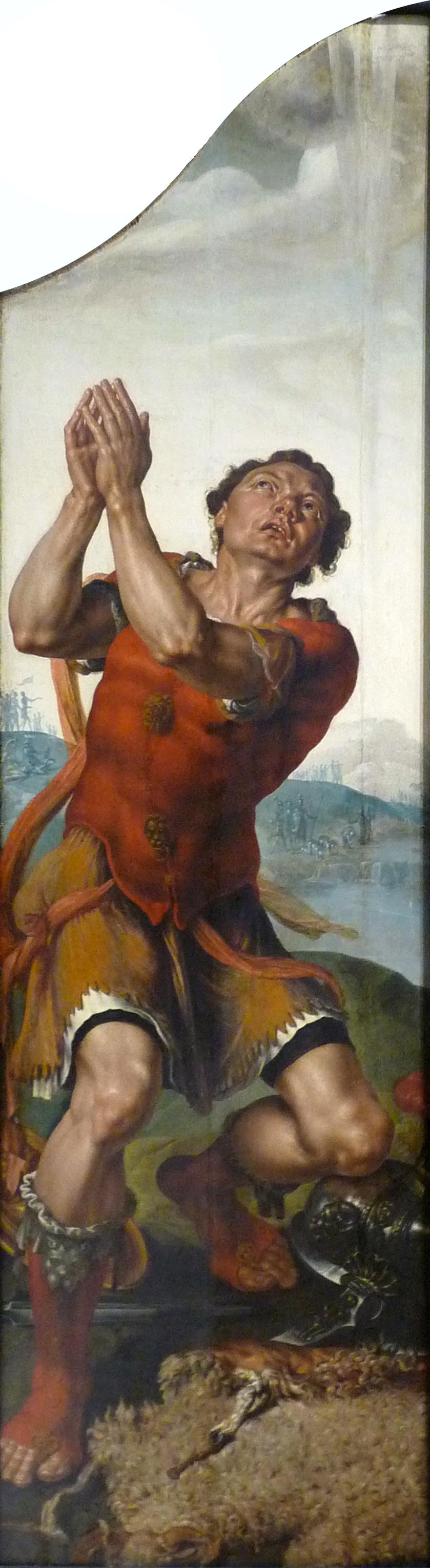
Era 5 · The Promised LandJudges
Gideon's Victory and Compromises
"I will not rule over you… the LORD shall rule over you"
Ephraim complains they were not called; Gideon answers gently: "Is not the gleaning of the grapes of Ephraim better than the vintage of Abiezer?" At Succoth and Penuel the leaders refuse bread to his exhausted men. After capturing Zebah and Zalmunna, Gideon returns, teaches the elders of Succoth "with thorns of the wilderness and briers," breaks the tower of Penuel and kills its men.
He kills Zebah and Zalmunna, who had killed his brothers at Tabor. "Then the men of Israel said unto Gideon, Rule thou over us, both thou, and thy son, and thy son's son." "I will not rule over you, neither shall my son rule over you: the LORD shall rule over you."
He asks for the gold earrings from the spoil: 1,700 shekels. "And Gideon made an ephod thereof, and put it in his city, even in Ophrah: and all Israel went thither a whoring after it: which thing became a snare unto Gideon, and to his house." He has many wives and seventy sons, and a concubine in Shechem bears him a son he names Abimelech, "my father is king." After his death Israel returns to Baal-berith.
What was the ephod?
An ephod is usually the high priest's vest (Exodus 28), but elsewhere it seems to be an object used to inquire of God (1 Samuel 23:9; Judges 17–18). Gideon's gold ephod may have been a cult image or oracle object. The text does not describe it, and no reconstruction should be taken as its appearance.
1,700 shekels
About 19–20 kg of gold, using an approximate shekel of 11.4 grams. Shekel standards varied, so the figure is a rough conversion.
Succoth and Penuel
Both are east of the Jordan near the Jabbok, linked with Jacob's story (Genesis 32–33). Succoth is often placed at Tell Deir Alla (proposed; another candidate is Tell el-Ekhsas); Penuel at Tulul edh-Dhahab. The identifications are debated.
The Case for the Biblical Account
Scripture's account
Gideon's pursuit, revenge, refusal of kingship and ephod (Judges 8).
What evidence would we expect?
Towns east of the Jordan; cultic objects of gold; early ideas about kingship.
The discoveries
Jabbok-valley sites proposed for Succoth and Penuel; gold jewelry in Late Bronze–Iron I contexts.
Testing the discoveries
The places are debated; the events are known only from Judges.
The strongest reconstruction
Judges 8 begins the book's critique of kingship through Gideon's mixed legacy.
What remains possible
What the ephod was.
What the evidence shows
- Gideon refused hereditary rule in words.
- Succoth is Tell Deir Alla.
- 1,700 shekels is about 19–20 kg of gold. Approximate conversion.
Continue the journey
Connected elsewhere in ScriptureWrestling with GodGenesis 32:30–31; 33:17: Penuel and Succoth in Jacob's story.More from this lesson
On the map
Location securely identified Probable identification Proposed or debated location Biblical route (roads schematic) Scholarly proposal
- Gideon pursues Midian. Harod → the Midianite camp by Moreh → across the Jordan to Succoth (Tell Deir Alla, proposed) and Penuel. Lines are schematic; Ophrah is not located.
Why this matters to the rest of Scripture
- Genesis 32:30–31; 33:17Penuel and Succoth in Jacob's story.
- "They have rejected me, that I should not reign over them."
- The king must not multiply wives or gold.
- "A soft answer turneth away wrath."