Era 5 · The Promised LandJudges
Samson and the Riddle
"Out of the eater came forth meat, and out of the strong came forth sweetness"
"Samson went down to Timnath, and saw a woman in Timnath of the daughters of the Philistines." "Get her for me; for she pleaseth me well." His parents object, "but his father and his mother knew not that it was of the LORD, that he sought an occasion against the Philistines."
In the vineyards of Timnah "a young lion roared against him. And the Spirit of the LORD came mightily upon him, and he rent him as he would have rent a kid." Later he finds "a swarm of bees and honey in the carcase of the lion," eats it, and gives some to his parents without telling them where it came from.
At the seven-day feast he poses a riddle to thirty companions for thirty linen garments: "Out of the eater came forth meat, and out of the strong came forth sweetness." On the seventh day they threaten to burn his wife and her father's house. She weeps until he tells her; they answer, "What is sweeter than honey? and what is stronger than a lion?" "If ye had not plowed with my heifer, ye had not found out my riddle." He goes down to Ashkelon, kills thirty men, takes their garments, and leaves in anger. His wife is given to his companion.
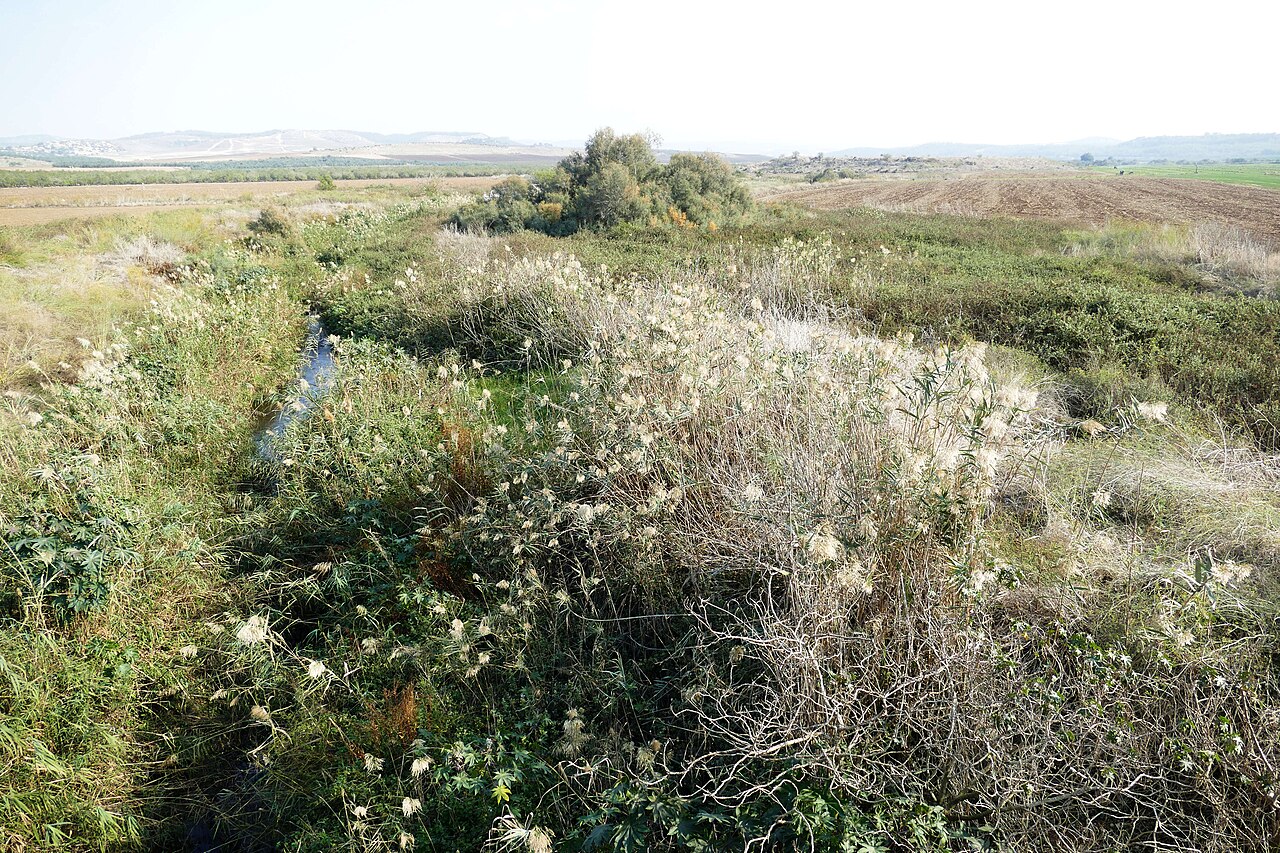
Timnah and Tel Batash
Tel Batash in the Sorek valley is the generally accepted location of Timnah. Excavations by George Kelm and Amihai Mazar (1977–1989) found a Late Bronze Canaanite town followed by an Iron I settlement with Philistine-style pottery, a frontier where Philistine and local cultures met. It fits the story's world well; it does not attest Samson or his wife.
The riddle
Riddles were a form of wedding entertainment and wit in the ancient world. Samson's cannot be solved without knowing his secret, so it is unfair. The answer comes as a riddle in return; some scholars suggest an underlying folk riddle about love ("What is sweeter than honey… stronger than a lion?"). Both Greek and Latin render the Hebrew closely here.
The lion and the corpse
Lions lived in the Levant until the Middle Ages. Taking honey from a carcass meant contact with a dead body, which defiled a Nazirite (Numbers 6:6). Bees nesting in a dried carcass appears also in Greek and Roman tradition (the bugonia legend).
The Case for the Biblical Account
Scripture's account
Samson at Timnah (Judges 14).
What evidence would we expect?
A Philistine presence at Timnah; contact between Philistines and Israelites; lions in the region.
The discoveries
Tel Batash's Iron I strata with Philistine pottery; lion bones and lion imagery from the Bronze and Iron Ages.
Testing the discoveries
The setting is strongly grounded; the episodes are unattested outside Judges.
The strongest reconstruction
A borderland hero story told against a real Philistine frontier.
What remains possible
How the Samson stories developed; recent study links them closely with the Tel Batash setting.
What the evidence shows
- Tel Batash is Timnah.Source: G. L. Kelm and A. Mazar, "Excavating in Samson Country: Philistines and Israelites at Tel Batash," BAR (1989) ↗
- Iron I Timnah shows Philistine material culture.Source: G. L. Kelm and A. Mazar, "Excavating in Samson Country: Philistines and Israelites at Tel Batash," BAR (1989) ↗
- The Samson stories reflect the Tel Batash setting.Source: Samson and Tel Batash, Vetus Testamentum (2025, advance article) ↗
- "It was of the LORD."
Continue the journey
Journey of a PassageJudges 14:14: Samson's riddleThe riddle is stable across the witnesses checked.More from this lesson
On the map
Location securely identified Probable identification Proposed or debated location Biblical route (roads schematic) Scholarly proposal
- Samson's world. Zorah → Timnah → Ashkelon (thirty men) → Gaza, whose gates he carries toward Hebron. Lehi, Etam and the valley of Sorek home of Delilah are not precisely located.
Investigations
Optional deep dives: the ancient sources, the physical evidence, and every interpretation side by side, including unconventional ones, each labeled for what it is.
Samson's Strength and the House of DagonSetting: well attested · Samson: not attested outside the Bible · Temple: not identified
Is there evidence for Samson, and could a man bring down a Philistine temple?
Samson is known only from Judges. His world is well attested: Timnah (Tel Batash), the Sorek valley, the Philistine cities and their temples. Excavated Philistine temples at Tell Qasile and Ekron had roofs resting on wooden pillars set on stone bases close together. That shows how the story's final scene was architecturally imaginable; it does not identify the building or prove the event.
Open the full investigation →Echoes Across Civilizations
Optional: how other ancient peoples told similar stories. Open one to compare, then come back to the lesson.
Strongmen who fight lionsGreek · Mesopotamian · Israelite
Do other ancient traditions have heroes of superhuman strength who kill lions with their bare hands?
- Greek: Heracles and the Nemean lion Resemblance only
- Mesopotamian: Gilgamesh and the master of animals Shared literary world
- Israelite: David and Benaiah Possible historical contact
Why this matters to the rest of Scripture
- Marriage with outsiders and violence.
- David and the lion.
- "The honour of kings is to search out a matter."