Era 5 · The Promised LandJudges
Historical Investigation: Women, Violence and Ethical Interpretation
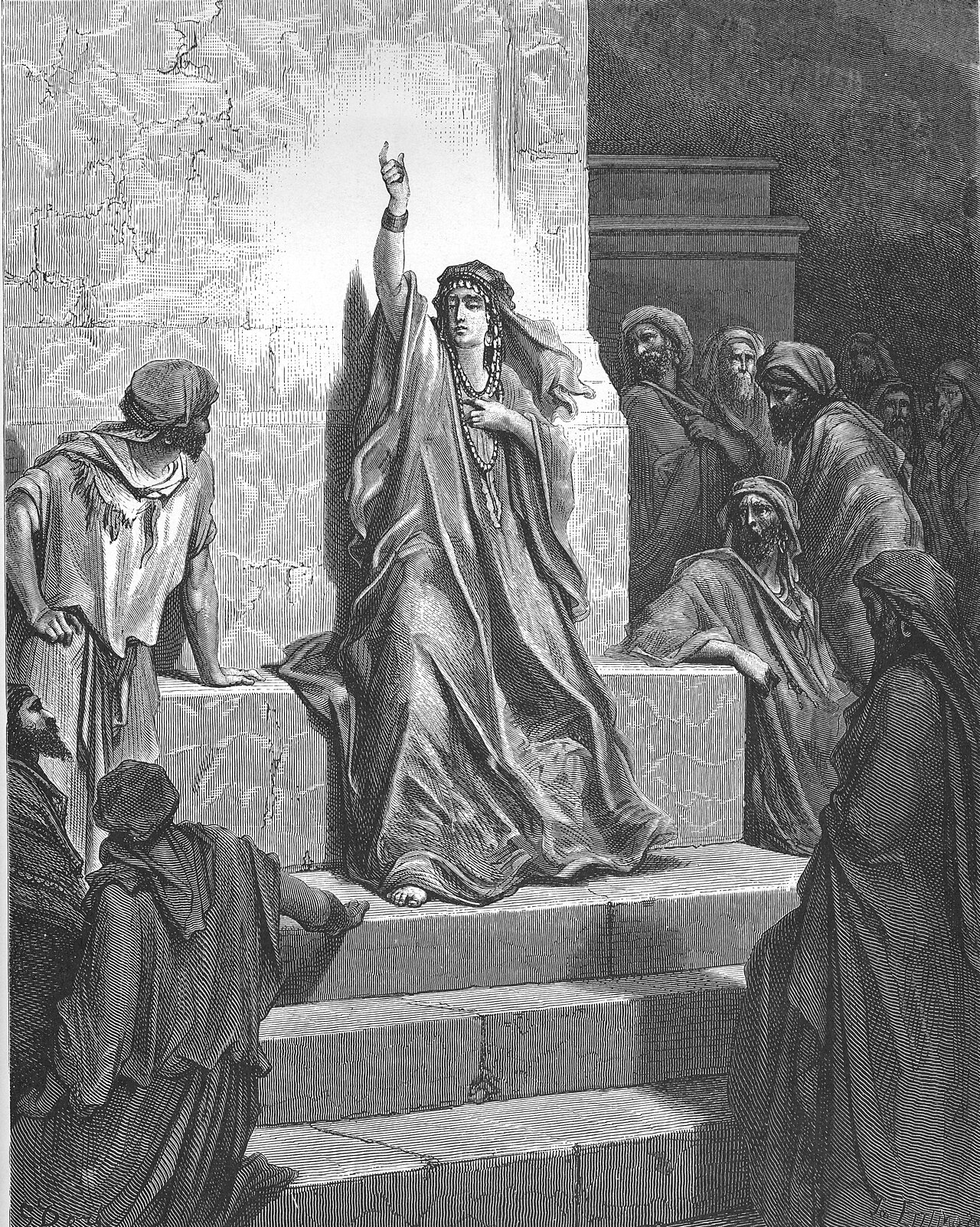
Women in Judges, from Achsah's springs to the dancers of Shiloh
Many readers have noticed that the fortunes of women in Judges mirror the book's decline. Early on, women act with initiative and are honored. By the end, they are nameless, silenced, killed and seized. The book does not need to state the lesson; it shows it.
| Woman | Chapter | What happens |
|---|---|---|
| Achsah | 1:12–15 | Given in marriage as a prize; asks her father for springs and receives them |
| Deborah | 4–5 | Prophet and judge; summons Barak; "a mother in Israel" |
| Jael | 4–5 | Kills Sisera; "blessed above women" |
| Sisera's mother | 5:28–30 | Waits in vain at her window |
| Woman of Thebez | 9:53 | Kills Abimelech with a millstone |
| Jephthah's daughter | 11 | Unnamed; victim of her father's vow; remembered yearly |
| Samson's mother | 13 | Receives the angel; wiser than her husband |
| The woman of Timnah | 14–15 | Threatened, then burned with her father |
| Delilah | 16 | Paid to betray Samson |
| Micah's mother | 17 | Dedicates silver to make an idol |
| The Levite's concubine | 19 | Unnamed; raped and killed; dismembered |
| Women of Jabesh-gilead | 21 | 400 taken captive after their families are killed |
| Daughters of Shiloh | 21 | Seized while dancing at a festival |
Reading difficult texts
Phyllis Trible called Jephthah's daughter and the Levite's concubine "texts of terror." Others emphasize that the narrator clearly condemns: the refrain "every man did that which was right in his own eyes" is a verdict, and the outrage of 19:30 is shared by all Israel. Describing an act is not approving it.
The book shows what happens when God's people forget Him: the vulnerable suffer first. God's silence in chapters 19–21 is itself a judgment. The answer the canon offers is not merely a king, but a faithful king and ultimately God's own rule.
The appendices may have been shaped to discredit Benjamin and Saul's town Gibeah in favor of David's Judah (Bethlehem frames chapters 17 and 19). The women's stories also preserve fragments of women's memory, such as the annual lament for Jephthah's daughter.
These readings recover the perspective of women silenced in the text, note who speaks and who does not, and ask readers not to repeat the narrators' and characters' silences.
Violence in Judges
Judges contains assassination, mutilation, mass killing, revenge cycles, human sacrifice, rape and civil war. It does not offer these as models. Hebrews 11 praises the faith of Gideon, Barak, Samson and Jephthah without endorsing all they did.
The Case for the Biblical Account
Scripture's account
Women throughout Judges.
What evidence would we expect?
Women's roles in ancient Near Eastern society; textual signals of the narrator's stance.
The discoveries
Women as prophets, musicians and mourners in ancient texts; literary patterns in Judges.
Testing the discoveries
The decline pattern is widely recognized; its purpose is debated.
The strongest reconstruction
Judges uses women's experience as a measure of Israel's faithfulness.
What remains possible
Different emphases among readers of faith, historians and ethicists.
What the evidence shows
- Women's experiences in Judges decline as the book progresses.Source: P. Trible, Texts of Terror: Literary-Feminist Readings of Biblical Narratives (1984)
- The narrator approves of the violence in Judges 19–21. The closing refrain and 19:30 frame it as moral collapse.
- The appendices were shaped against Saul's Gibeah.
Continue the journey
Ancient MysteriesWas Jephthah's Daughter Actually Killed?Did Jephthah sacrifice his daughter, or dedicate her to a life of celibacy?More from this lesson
Investigations
Optional deep dives: the ancient sources, the physical evidence, and every interpretation side by side, including unconventional ones, each labeled for what it is.
Was Jephthah's Daughter Actually Killed?Text: stable · Sacrifice reading: majority · Dedication reading: minority · God's approval: not stated
Did Jephthah sacrifice his daughter, or dedicate her to a life of celibacy?
Jephthah vowed a burnt offering of whatever came out of his door; his only daughter came out. The text says he did to her as he had vowed. Most ancient and modern readers conclude that he killed her. A medieval Jewish reading, followed by some Christian interpreters, holds that she was dedicated to lifelong virginity. The Torah forbids human sacrifice, and God never commands the vow.
Open the full investigation →Echoes Across Civilizations
Optional: how other ancient peoples told similar stories. Open one to compare, then come back to the lesson.
Women who save and women who sufferJewish (Hellenistic) · Egyptian and Ugaritic · Greek
How do other ancient traditions portray women as deliverers and as victims of war?
- Jewish (Hellenistic): Judith Shared literary world
- Egyptian and Ugaritic: Warrior goddesses Anat and Astarte Resemblance only
- Greek: Trojan Women Similar human experience
Why this matters to the rest of Scripture
- Achsah.
- The daughters of Zelophehad.
- "In the days when the judges ruled."
- Faith in the days of the judges.