Era 5 · The Promised LandJudges
Historical Investigation: Philistines, Canaanites and the Changing Iron Age
Sea Peoples, ancient DNA and a 7th-century king of Ekron
In Judges the Philistines appear first with Shamgar (3:31) and dominate the Samson stories, ruling over Judah (15:11). They are called "uncircumcised" outsiders. The Bible says they came from Caphtor (Amos 9:7; Jeremiah 47:4), usually identified with Crete.
The Sea Peoples
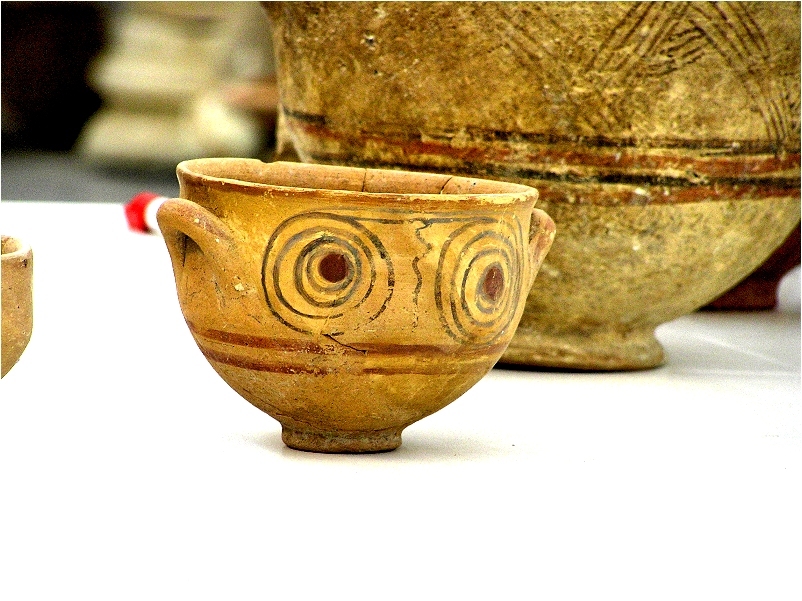
Reliefs of Ramesses III at Medinet Habu (about 1177 BC) show battles against peoples from the sea, including the Peleset, generally equated with the Philistines. Around the same time cities across the eastern Mediterranean fell. Soon after, at Ashdod, Ashkelon, Ekron and Gath, a new culture appears: locally made Mycenaean-style pottery, later the painted "bichrome" ware; hearths; loom weights of Aegean type; and a diet with pork and dog.
Ancient DNA from Ashkelon
In 2019, Michal Feldman and colleagues published DNA from ten individuals buried at Ashkelon across the Bronze and Iron Ages. Those from the early Iron Age (12th century BC) had a European-related ancestry component not found in the Bronze Age individuals; within two centuries it had largely disappeared into the local gene pool. The study supports a real migration that contributed to Philistine origins. It is based on a small sample, cannot identify the exact homeland, and does not mean all Philistines were "European." It says nothing about any individual in the Bible.
The Ekron inscription
In 1996, excavators of Tel Miqne found a limestone inscription in Temple Complex 650: "The temple which Achish son of Padi… ruler of Ekron, built for Ptgyh his lady." Achish (Ikausu) and Padi are known from Assyrian records of the 7th century BC, confirming Tel Miqne as Ekron. The inscription is real and important, but it is about four centuries later than the setting of Samson and does not corroborate his story.
The five cities
| City | Site | Certainty |
|---|---|---|
| Gaza | Tell Harube / modern Gaza | City secure; ancient remains largely beneath the modern city |
| Ashkelon | Tel Ashkelon | Secure |
| Ashdod | Tel Ashdod | Secure |
| Ekron | Tel Miqne | Secure (inscription) |
| Gath | Tell es-Safi | Strongly supported |
Canaanites
Canaanite cities in the lowlands, such as Megiddo and Beth-shean, continued into the 12th century and beyond; Egyptian garrisons stayed at Beth-shean until about 1130 BC. Canaanite religion is known from Ugarit: El, Baal, Anat, Asherah and Astarte.
The Case for the Biblical Account
Scripture's account
Philistines from Caphtor rule over Israel (Judges 13–16).
What evidence would we expect?
A foreign culture appearing on the coast; Egyptian records; links to the Aegean.
The discoveries
Medinet Habu reliefs; Aegean-style pottery and practices; Ashkelon DNA; the Ekron inscription naming later kings.
Testing the discoveries
Philistine origins in a migration with Aegean connections are strongly supported; details of homeland and numbers are debated.
The strongest reconstruction
The Bible's Philistines match a real Iron Age people with migrant origins.
What remains possible
Crete, Cyprus, western Anatolia or several origins.
What the evidence shows
- Early Iron Age individuals at Ashkelon carried a European-related ancestry component.Source: M. Feldman et al., "Ancient DNA sheds light on the genetic origins of early Iron Age Philistines," Science Advances 5 (2019) ↗
- All Philistines were European. The study shows mixing and dilution.
- The Ekron inscription names Achish son of Padi in the 7th century BC.Source: S. Gitin, T. Dothan and J. Naveh, "A Royal Dedicatory Inscription from Ekron," IEJ 47 (1997); Harvard HMANE summary ↗
- The Ekron inscription confirms Samson. About four centuries later.
- Caphtor is Crete.
Continue the journey
Ancient MysteriesWas There a Real Philistine Migration?Where did the Philistines come from, and what does ancient DNA show?More from this lesson
Investigations
Optional deep dives: the ancient sources, the physical evidence, and every interpretation side by side, including unconventional ones, each labeled for what it is.
Was There a Real Philistine Migration?Migration: strongly supported · Exact homeland: debated · DNA sample: small
Where did the Philistines come from, and what does ancient DNA show?
The Bible says the Philistines came from Caphtor. Egyptian reliefs show the Peleset among the Sea Peoples about 1177 BC. Philistine cities show Aegean-style pottery, hearths and food. A 2019 ancient-DNA study found a European-related ancestry component in early Iron Age burials at Ashkelon that soon faded. The evidence supports a real migration that mixed with local people.
Open the full investigation →Why this matters to the rest of Scripture
- "The Philistines from Caphtor."
- Philistines in the Table of Nations.
- The ark among the Philistines.
- Achish king of Gath.