Era 5 · The Promised LandJudges
Delilah, Gaza and the Final Collapse
"He wist not that the LORD was departed from him"
At Gaza Samson spends the night with a prostitute; the Gazites wait at the gate to kill him at dawn. At midnight he rises, takes "the doors of the gate of the city, and the two posts," and carries them "to the top of an hill that is before Hebron."
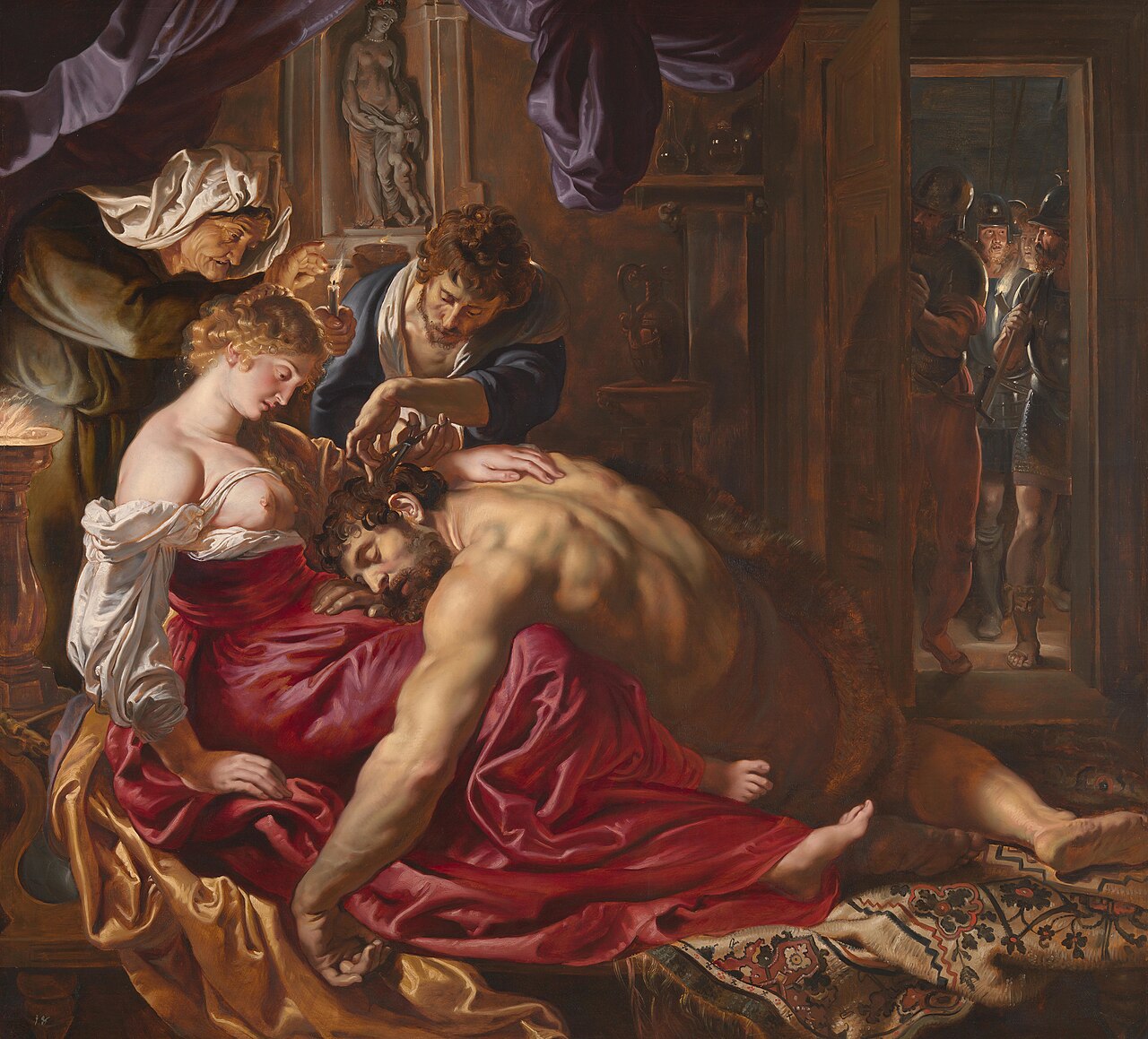
"He loved a woman in the valley of Sorek, whose name was Delilah." Each Philistine lord offers her 1,100 pieces of silver. Samson tells her seven fresh bowstrings, then new ropes, then weaving his seven locks into the loom; each time she calls "The Philistines be upon thee, Samson," and he breaks free. "How canst thou say, I love thee, when thine heart is not with me?" When "his soul was vexed unto death," he tells her: "There hath not come a razor upon mine head; for I have been a Nazarite unto God."
She has his head shaved while he sleeps. "I will go out as at other times before, and shake myself. And he wist not that the LORD was departed from him." The Philistines put out his eyes, bind him with bronze fetters, and set him to grind in the prison at Gaza. "Howbeit the hair of his head began to grow again."
The lords gather for a great sacrifice to Dagon: "Our god hath delivered Samson our enemy into our hand." They bring Samson out to entertain them, about 3,000 on the roof. He asks the boy leading him to let him feel the pillars. "O Lord GOD, remember me, I pray thee, and strengthen me, I pray thee, only this once." He grasps the two middle pillars: "Let me die with the Philistines," and bows with all his might. "So the dead which he slew at his death were more than they which he slew in his life."
The loom
In the Hebrew of 16:13–14 Samson says to weave his seven locks with the web; she does so and fastens it with the pin. The Greek and Latin preserve a longer text in which Samson explains that if the web is fastened with a pin into the wall he will be weak, and she does so. Many scholars think the Hebrew lost words by a scribe's eye skipping between similar phrases. This is a real ancient textual difference; see the passage page.
Pillars and the house of Dagon
Philistine temples excavated at Tell Qasile (near Tel Aviv) and Ekron had roofs supported by wooden pillars on stone bases, set close together; at Tell Qasile two central pillar bases stand about 2 m apart. The architecture shows how a man could reach two central supports. No excavated building has been identified as the temple of Judges 16, and none has been excavated at ancient Gaza.
Dagon
Dagan was an old, widely worshiped god of Syria and Mesopotamia (at Ebla, Mari and Ugarit), linked to grain (Hebrew dagan, "grain"). The Philistines apparently adopted him after settling in Canaan. The popular idea that Dagon was a fish god comes from medieval interpretation of the Hebrew dag ("fish") and is not securely supported by ancient evidence.
Who was Delilah?
The text does not say she was a Philistine, though she works with Philistine lords. Her name may be related to "night" (laylah), a wordplay, or to a Semitic root meaning "flirtatious" or "small." She is never called his wife.
The Case for the Biblical Account
Scripture's account
Gaza, Delilah, capture and death in Dagon's house (Judges 16).
What evidence would we expect?
Philistine cities and lords; Dagon worship; pillared Philistine temples.
The discoveries
Five Philistine cities (Gaza, Ashkelon, Ashdod, Ekron, Gath); pillared temples at Tell Qasile and Ekron; Dagan in Syrian texts; ancient DNA from Ashkelon.
Testing the discoveries
The Philistine world is richly attested; Samson, Delilah and the temple collapse are not.
The strongest reconstruction
The climax of a hero tradition set in a well-attested Philistine world.
What remains possible
Which temple and where; the original wording of 16:13–14.
What the evidence shows
- Philistine temples had wooden roof pillars on stone bases set close together.Source: "Philistine cult and religion" (review), Religions 10:2 (2019) ↗
- An excavated building is the temple Samson destroyed.
- Dagon was a fish god. A medieval interpretation; ancient sources link Dagan with grain.
- The Greek and Latin preserve a longer 16:13–14. Checked in Giguet's French and the Vulgate; Greek A and B not checked separately.
- "The LORD was departed from him."
Continue the journey
Journey of a PassageJudges 16:13–14: Delilah's loom: a shorter Hebrew textIn the Hebrew, Samson says only "If you weave the seven locks of my head with the web," and the story continues.More from this lesson
On the map
Location securely identified Probable identification Proposed or debated location Biblical route (roads schematic) Scholarly proposal
- Samson's world. Zorah → Timnah → Ashkelon (thirty men) → Gaza, whose gates he carries toward Hebron. Lehi, Etam and the valley of Sorek home of Delilah are not precisely located.
Investigations
Optional deep dives: the ancient sources, the physical evidence, and every interpretation side by side, including unconventional ones, each labeled for what it is.
Samson's Strength and the House of DagonSetting: well attested · Samson: not attested outside the Bible · Temple: not identified
Is there evidence for Samson, and could a man bring down a Philistine temple?
Samson is known only from Judges. His world is well attested: Timnah (Tel Batash), the Sorek valley, the Philistine cities and their temples. Excavated Philistine temples at Tell Qasile and Ekron had roofs resting on wooden pillars set on stone bases close together. That shows how the story's final scene was architecturally imaginable; it does not identify the building or prove the event.
Open the full investigation →Was There a Real Philistine Migration?Migration: strongly supported · Exact homeland: debated · DNA sample: small
Where did the Philistines come from, and what does ancient DNA show?
The Bible says the Philistines came from Caphtor. Egyptian reliefs show the Peleset among the Sea Peoples about 1177 BC. Philistine cities show Aegean-style pottery, hearths and food. A 2019 ancient-DNA study found a European-related ancestry component in early Iron Age burials at Ashkelon that soon faded. The evidence supports a real migration that mixed with local people.
Open the full investigation →Echoes Across Civilizations
Optional: how other ancient peoples told similar stories. Open one to compare, then come back to the lesson.
Strongmen who fight lionsGreek · Mesopotamian · Israelite
Do other ancient traditions have heroes of superhuman strength who kill lions with their bare hands?
- Greek: Heracles and the Nemean lion Resemblance only
- Mesopotamian: Gilgamesh and the master of animals Shared literary world
- Israelite: David and Benaiah Possible historical contact
Why this matters to the rest of Scripture
- The ark in the house of Dagon.
- "There shall no razor come upon his head."
- "Out of weakness were made strong."
- A warning against the seductive woman.