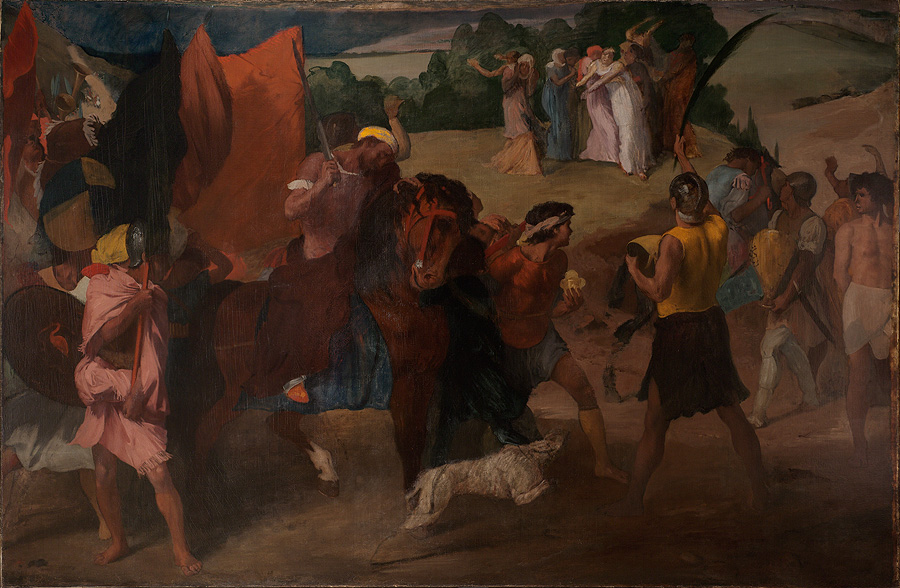
Era 5 · The Promised LandJudges
Jephthah and His Daughter
"I have opened my mouth unto the LORD, and I cannot go back"
"Now Jephthah the Gileadite was a mighty man of valour, and he was the son of an harlot." His half-brothers drive him out: "Thou shalt not inherit in our father's house." He gathers "vain men" in the land of Tob. When Ammon attacks, the elders of Gilead come to him; he agrees to lead them if he becomes their head. At Mizpah he speaks "all his words before the LORD."
He sends messengers to the king of Ammon and recounts the history: Israel did not take Moab's or Ammon's land; it took the land of Sihon the Amorite; "Wilt not thou possess that which Chemosh thy god giveth thee to possess?" Israel has lived there 300 years. "The LORD the Judge be judge this day between the children of Israel and the children of Ammon." The king does not listen.
"Then the Spirit of the LORD came upon Jephthah." He vows: "If thou shalt without fail deliver the children of Ammon into mine hands, then it shall be, that whatsoever cometh forth of the doors of my house to meet me, when I return in peace… shall surely be the LORD's, and I will offer it up for a burnt offering." He defeats Ammon.
"And, behold, his daughter came out to meet him with timbrels and with dances: and she was his only child." He tears his clothes: "Alas, my daughter! thou hast brought me very low… for I have opened my mouth unto the LORD, and I cannot go back." She answers: "do to me according to that which hath proceeded out of thy mouth," and asks two months to go upon the mountains with her friends "and bewail my virginity." "At the end of two months… he did with her according to his vow which he had vowed: and she knew no man. And it was a custom in Israel, that the daughters of Israel went yearly to lament the daughter of Jephthah the Gileadite four days in a year."
What did Jephthah vow?
The Hebrew "whatever (or whoever) comes out of the doors of my house to meet me" uses a form that can refer to a person. Houses often sheltered animals, so some think he expected an animal; but "comes out… to meet me" is the language of people, and women traditionally met returning warriors with dances (Exodus 15:20; 1 Samuel 18:6). "Burnt offering" (ʿolah) everywhere else means a sacrifice burned whole.
Two readings
Most ancient Jewish and Christian readers, and most modern scholars, read the text plainly: Jephthah killed his daughter as a burnt offering. Josephus, the rabbis (who condemn Jephthah and say the vow could have been annulled), and early church writers took it this way. The narrator's restraint, "he did with her according to his vow," is read as refusing to describe the horror.
From the Middle Ages, some readers (notably David Kimchi) proposed that she was dedicated to lifelong celibate service: the Hebrew "and" in "shall be the LORD's, and I will offer it" could be read "or," and the stress on her virginity ("she knew no man") would fit a life without marriage or children. Critics reply that the text gives no clear support for a sanctuary vocation for women and that 11:39 most naturally follows a death.
The Law and human sacrifice
The Torah forbids child sacrifice as an abomination (Leviticus 18:21; Deuteronomy 12:31; 18:10). In Genesis 22 God stops Abraham. In 1 Samuel 14 the people rescue Jonathan from his father's rash oath. In 2 Kings 3:27 the king of Moab sacrifices his son on the wall. Jephthah, who quotes Israel's history so well, acts as if he did not know its law, which may be part of the point.
Chemosh or Milcom?
Jephthah calls Chemosh the god of the Ammonites. Elsewhere Chemosh is Moab's god (Numbers 21:29; Mesha Stele) and Milcom Ammon's (1 Kings 11:5, 33). His speech is largely about Moabite territory (the Arnon), so he may be addressing a Moabite-Ammonite claim, or the tradition may have merged them. It is a real historical problem, not proof of error either way.
The Case for the Biblical Account
Scripture's account
Jephthah's rise, diplomacy, vow and daughter (Judges 11).
What evidence would we expect?
Ammonite and Moabite kingdoms with national gods; ancient practices of vows and human sacrifice.
The discoveries
Chemosh in the Mesha Stele (9th century BC); Milcom in Ammonite inscriptions; ancient references to child sacrifice in crisis (2 Kings 3:27; Phoenician texts).
Testing the discoveries
The gods and kingdoms are real; Jephthah and his daughter are known only from Judges and its later readers.
The strongest reconstruction
The plain reading is sacrifice; the story functions as a warning against rash vows and pagan practice.
What remains possible
The dedication reading; the composition date of the story and its annual-lament tradition.
What the evidence shows
- Jephthah's daughter was offered as a burnt offering. The majority reading of ancient and modern interpreters.Source: J. Stiebert, Fathers and Daughters in the Hebrew Bible (2013), ch. 2 ↗; T. Römer, "Why Would the Deuteronomists Tell About the Sacrifice of Jephthah's Daughter?" JSOT 77 (1998) ↗; D. Janzen, "Why the Deuteronomist Told About the Sacrifice of Jephthah's Daughter," JSOT 29 (2005) ↗; B. P. Robinson, "The Story of Jephthah and His Daughter: Then and Now," Biblica 85 (2004) ↗
- She was dedicated to lifelong celibate service instead.Source: David Kimchi (Radak), commentary on Judges 11:31 (medieval Jewish dedication reading); B. P. Robinson, "The Story of Jephthah and His Daughter: Then and Now," Biblica 85 (2004) ↗
- The Torah forbids human sacrifice.
- Chemosh was Moab's god in the Mesha Stele.
- God commanded or approved the vow. The text never says so, and the Law forbids such sacrifices.
Then and Later
Jephthah's daughter, then and later
- JudgesAn annual lament Israel's daughters mourn her four days each year.
- 1st centuryJosephus and Pseudo-Philo Josephus condemns the sacrifice as neither lawful nor pleasing to God; Pseudo-Philo gives the daughter a name, Seila, and a lament.
- RabbisA vow that should have been annulled Rabbinic tradition faults Jephthah and the high priest Phinehas for not releasing the vow.
- New TestamentFaith, not the vow Hebrews names Jephthah among the faithful without endorsing his vow.
- Middle AgesThe dedication reading Kimchi and others propose she lived in seclusion.
Continue the journey
Journey of a PassageJudges 11:30–40: Jephthah's vow: whatever or whoever?All the witnesses checked agree that Jephthah vowed a burnt offering and "did with her according to his vow." The debate turns on the Hebrew: "whatever" or "whoever" comes out, and whether "and" in "shall be the LORD's, and I will offer it" could mean "or."More from this lesson
Investigations
Optional deep dives: the ancient sources, the physical evidence, and every interpretation side by side, including unconventional ones, each labeled for what it is.
Was Jephthah's Daughter Actually Killed?Text: stable · Sacrifice reading: majority · Dedication reading: minority · God's approval: not stated
Did Jephthah sacrifice his daughter, or dedicate her to a life of celibacy?
Jephthah vowed a burnt offering of whatever came out of his door; his only daughter came out. The text says he did to her as he had vowed. Most ancient and modern readers conclude that he killed her. A medieval Jewish reading, followed by some Christian interpreters, holds that she was dedicated to lifelong virginity. The Torah forbids human sacrifice, and God never commands the vow.
Open the full investigation →Echoes Across Civilizations
Optional: how other ancient peoples told similar stories. Open one to compare, then come back to the lesson.
Vows that cost a childGreek · Moabite
Do other ancient stories tell of a leader who must sacrifice a daughter or son because of a vow or a war?
- Greek: Agamemnon and Iphigenia Resemblance only
- Greek: Idomeneus Resemblance only
- Moabite: The king of Moab on the wall Possible historical contact
Women who save and women who sufferJewish (Hellenistic) · Egyptian and Ugaritic · Greek
How do other ancient traditions portray women as deliverers and as victims of war?
- Jewish (Hellenistic): Judith Shared literary world
- Egyptian and Ugaritic: Warrior goddesses Anat and Astarte Resemblance only
- Greek: Trojan Women Similar human experience
Why this matters to the rest of Scripture
- God stops Abraham.
- Vowed persons can be redeemed with money.
- Burning sons and daughters is an abomination.
- Saul's rash oath; the people save Jonathan.
- The king of Moab sacrifices his son.
- "Better is it that thou shouldest not vow."