Josephus, Antiquities 5.263–266
- Language
- Greek
- Composed
- c. AD 93
- Oldest surviving copy
- Medieval manuscripts
- Status
- Not scripture
Says Jephthah sacrificed her, "neither lawful nor pleasing to God."
Ancient Mysteries & Interpretations
Jephthah vowed a burnt offering of whatever came out of his door; his only daughter came out. The text says he did to her as he had vowed. Most ancient and modern readers conclude that he killed her. A medieval Jewish reading, followed by some Christian interpreters, holds that she was dedicated to lifelong virginity. The Torah forbids human sacrifice, and God never commands the vow.
Text: stable · Sacrifice reading: majority · Dedication reading: minority · God's approval: not stated
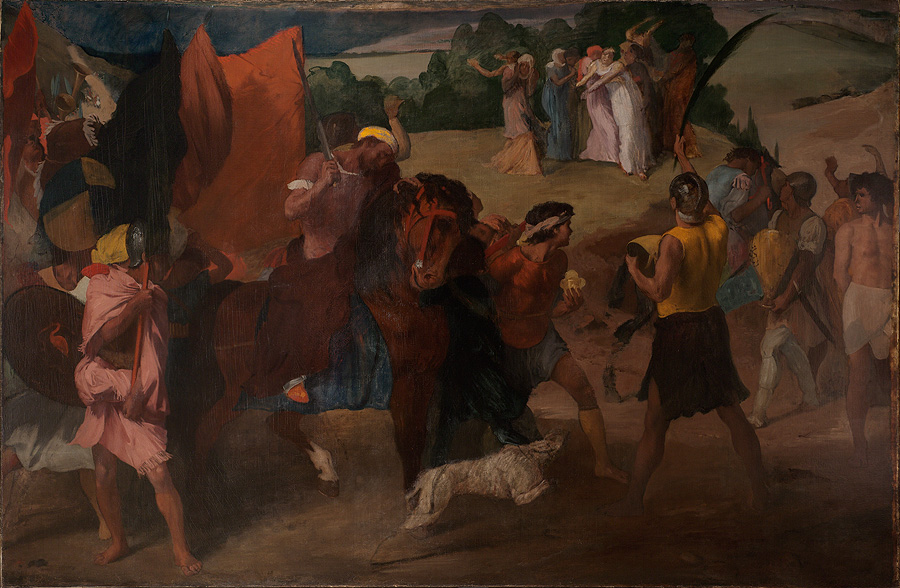
"And it came to pass at the end of two months, that she returned unto her father, who did with her according to his vow which he had vowed: and she knew no man" (11:39).
Says Jephthah sacrificed her, "neither lawful nor pleasing to God."
Names her Seila and gives her lament.
2 Kings 3:27 and the Mesha Stele world show that sacrifice of a child in war crisis was known in Moab. Phoenician and Punic sites (such as the tophet at Carthage) are debated evidence for child sacrifice in the wider Levantine world. None of this concerns Jephthah directly.
Traditional reading
The plain reading, held by Josephus, the rabbis, early church writers and most modern scholars. The story condemns the vow by its outcome.
Source: T. Römer, "Why Would the Deuteronomists Tell About the Sacrifice of Jephthah's Daughter?" JSOT 77 (1998) ↗; D. Janzen, "Why the Deuteronomist Told About the Sacrifice of Jephthah's Daughter," JSOT 29 (2005) ↗; J. Stiebert, Fathers and Daughters in the Hebrew Bible (2013), ch. 2 ↗
Alternative explanation
"Shall be the LORD's, or I will offer it": she was devoted to the LORD and lived unmarried.
Assessment: Has a long reception history, but lacks clear support in the text.
Source: David Kimchi (Radak), commentary on Judges 11:31 (medieval Jewish dedication reading); B. P. Robinson, "The Story of Jephthah and His Daughter: Then and Now," Biblica 85 (2004) ↗
Scholarly reconstruction
The story explains an annual women's lament (11:40).
The text most naturally describes a sacrifice, told with restraint and without approval. The daughter's memory was kept by Israel's women.
The Greek and Latin use personal forms ("the first who," "whoever") in 11:31. See the passage page.
What the evidence shows
Source: T. Römer, "Why Would the Deuteronomists Tell About the Sacrifice of Jephthah's Daughter?" JSOT 77 (1998) ↗; D. Janzen, "Why the Deuteronomist Told About the Sacrifice of Jephthah's Daughter," JSOT 29 (2005) ↗
Source: B. P. Robinson, "The Story of Jephthah and His Daughter: Then and Now," Biblica 85 (2004) ↗