Era 5 · The Promised LandJudges
Abimelech, Shechem and Jotham's Fable
"The trees went forth on a time to anoint a king over them"
Abimelech persuades his mother's relatives in Shechem: "Whether is better for you, either that all the sons of Jerubbaal… reign over you, or that one reign over you?" They give him seventy pieces of silver from the house of Baal-berith; he hires "vain and light persons" and kills his brothers "upon one stone." Jotham the youngest hides. The men of Shechem make Abimelech king "by the plain of the pillar."
From the top of Mount Gerizim Jotham calls: "The trees went forth on a time to anoint a king over them." The olive, the fig and the vine refuse, unwilling to give up their fruit to "be promoted over the trees." The bramble answers: "come and put your trust in my shadow: and if not, let fire come out of the bramble, and devour the cedars of Lebanon." Jotham flees.
After three years "God sent an evil spirit between Abimelech and the men of Shechem." Gaal son of Ebed leads a revolt; Abimelech destroys the city and sows it with salt. The leaders of the tower of Shechem take refuge in "an hold of the house of the god Berith"; Abimelech piles branches against it and burns it, and about a thousand men and women die. At Thebez, as he approaches another tower door to burn it, "a certain woman cast a piece of a millstone upon Abimelech's head, and all to brake his skull." He asks his armor-bearer to kill him, "that men say not of me, A woman slew him."
The fortress-temple at Shechem
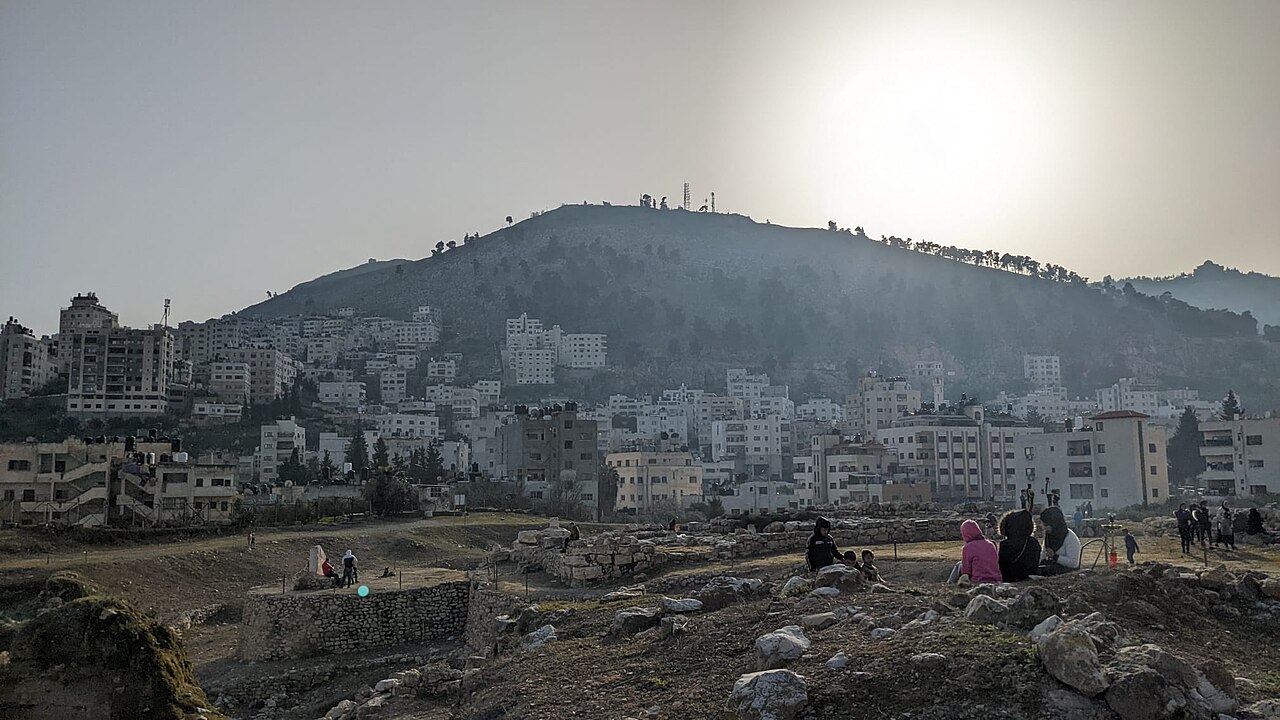
At Tell Balata, Ernst Sellin and later G. Ernest Wright's expedition excavated a massive Middle Bronze Age fortress-temple (migdal) with walls about 5 m thick, beside a large standing stone. Wright suggested it was the "house of El-berith/Baal-berith" and the "tower of Shechem" of Judges 9, and that a destruction around 1100 BC matched Abimelech's attack. The building is real and its comparison with Judges 9 is attractive, but the identification and the dating of its later phases and destruction are debated; it is not proven to be the building Abimelech burned.
Fables
Plant fables appear in Mesopotamian disputation texts (such as the tamarisk and the palm), and 2 Kings 14:9 has a thistle and cedar fable. Jotham's fable is one of the earliest political fables in the Bible.
The woman of Thebez
Household grinding stones (the upper stone could be carried) are found at every Iron Age site. 2 Samuel 11:21 recalls this death as a warning to soldiers: "Who smote Abimelech…? did not a woman cast a piece of a millstone upon him?"
The Case for the Biblical Account
Scripture's account
Abimelech's kingship at Shechem and its violent end (Judges 9).
What evidence would we expect?
A temple and tower at Shechem; a destruction in the Iron I period.
The discoveries
The fortress-temple and standing stone at Tell Balata; evidence of destruction in the site's sequence.
Testing the discoveries
The building is real and dated to the Middle Bronze Age with later use; whether it survived into Abimelech's period and how it was destroyed is debated.
The strongest reconstruction
Judges 9 is set in a real Canaanite cult center with a famous temple, and tells a story of failed local kingship.
What remains possible
That the tower of Judges 9 is the excavated temple; or another structure.
What the evidence shows
- Tell Balata has a massive fortress-temple and standing stone.Source: "What's a Bamah? How Sacred Space Functioned in Ancient Israel," BAR (Shechem fortress temple) ↗
- The excavated temple is the house of El-berith burned by Abimelech.Source: "What's a Bamah? How Sacred Space Functioned in Ancient Israel," BAR (Shechem fortress temple) ↗; Associates for Biblical Research, "Abimelech at Shechem" (confessional perspective) ↗
- Jotham's fable is a political satire on kingship.
Continue the journey
Ancient MysteriesAbimelech and the Temple at ShechemIs the fortress-temple at Tell Balata the house of El-berith that Abimelech burned?More from this lesson
Investigations
Optional deep dives: the ancient sources, the physical evidence, and every interpretation side by side, including unconventional ones, each labeled for what it is.
Abimelech and the Temple at ShechemBuilding: documented · Identification with Judges 9: disputed
Is the fortress-temple at Tell Balata the house of El-berith that Abimelech burned?
At Tell Balata, ancient Shechem, excavators uncovered a massive fortress-temple with walls about 5 meters thick and a great standing stone. G. Ernest Wright identified it with the "tower of Shechem" and "house of El-berith" of Judges 9 and connected a destruction with Abimelech. The comparison is attractive, but the building's later phases and the date of its destruction are debated.
Open the full investigation →Why this matters to the rest of Scripture
- The covenant stone at Shechem.
- The thistle and the cedar.
- "Did not a woman cast a piece of a millstone?"
- "Whatsoever a man soweth."