
"And take thou unto thee Aaron thy brother, and his sons with him… that he may minister unto me in the priest's office." Their holy garments are to be made "for glory and for beauty."
The ephod is woven of gold, blue, purple and scarlet, with two onyx stones on the shoulders engraved with the names of the twelve tribes. The breastplate of judgment carries twelve stones in four rows, each engraved with a tribe's name, "and Aaron shall bear the names of the children of Israel… upon his heart, when he goeth in unto the holy place." In it go the Urim and Thummim.
The robe is blue, with pomegranates and golden bells around the hem, "and his sound shall be heard when he goeth in unto the holy place." On the turban is a plate of pure gold engraved "HOLINESS TO THE LORD."
Seven days of consecration follow, with sacrifices and anointing. Then come the incense altar, the bronze basin, the anointing oil and the incense. God names the craftsman: "I have called by name Bezaleel… and I have filled him with the spirit of God, in wisdom, and in understanding, and in knowledge, and in all manner of workmanship," with Aholiab as his helper.
Finally, the Sabbath: "It is a sign between me and the children of Israel for ever." And God gives Moses "two tables of testimony, tables of stone, written with the finger of God."
Twelve stones
The Hebrew names of the breastplate stones are difficult to translate; ancient translations (Greek, Latin, Josephus) already differ. Some can be identified with confidence (emerald or green feldspar, lapis lazuli, carnelian, agate), others not. Josephus says the stones were still worn by the high priest in his day.
Urim and Thummim
The Urim and Thummim (perhaps "lights and perfections") were used to learn God's will in decisions, apparently giving yes-or-no answers (1 Samuel 14:41 in the Greek text). How they worked is unknown. By the return from exile they were no longer available (Ezra 2:63).
Priestly blessing on silver
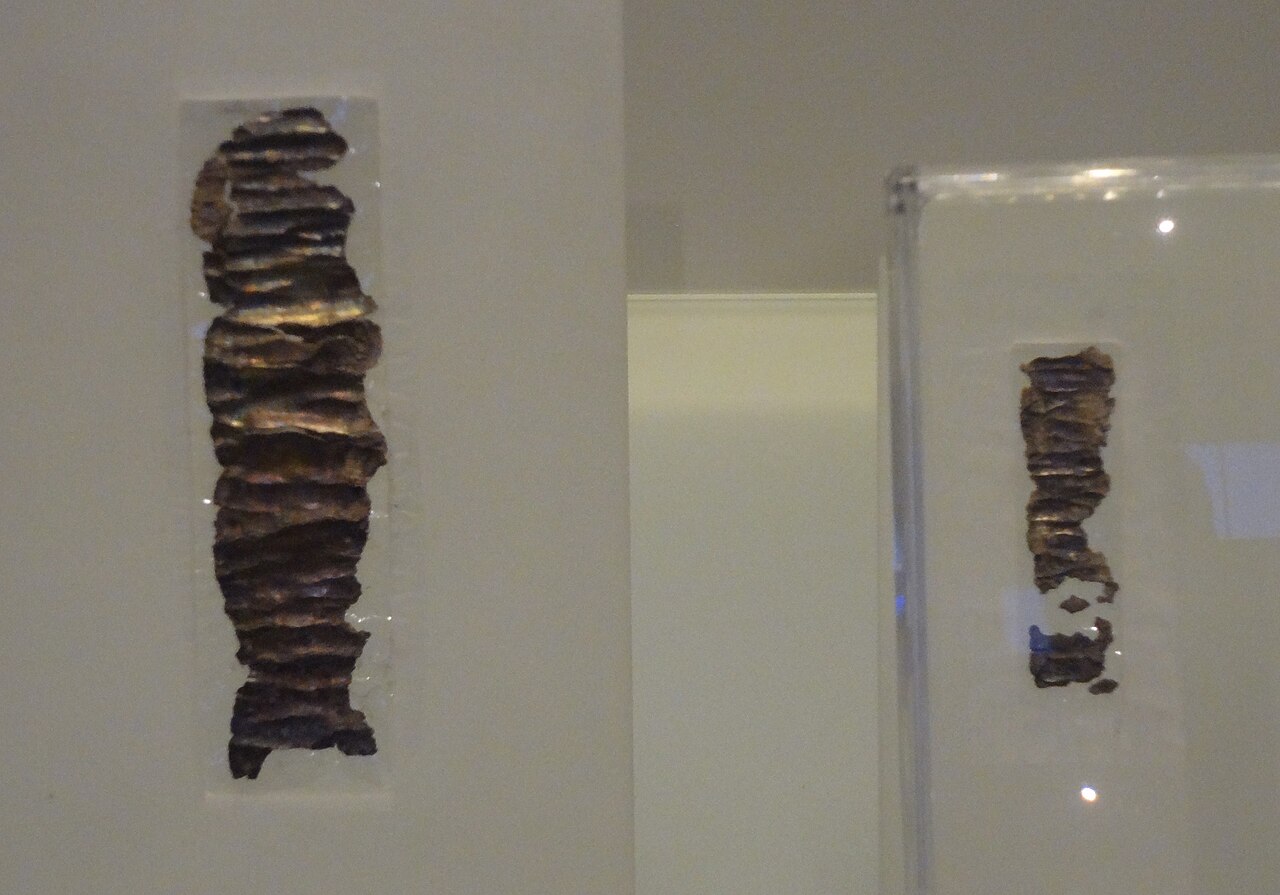
Two tiny silver scrolls from a burial cave at Ketef Hinnom in Jerusalem, from about 600 BC, contain the priestly blessing of Numbers 6:24–26, "The LORD bless thee, and keep thee." They are the oldest known texts of any passage in the Bible. They will be investigated in full with Numbers.
The ivory pomegranate
A thumb-sized ivory pomegranate inscribed "belonging to the house of [the LORD], holy to the priests" was once celebrated as the only surviving object from Solomon's Temple. In 2004 an Israel Antiquities Authority committee concluded that the ivory itself is Late Bronze Age but the inscription is a modern forgery; some epigraphers disagreed. We list it as an example of why authentication matters, not as evidence.
The Case for the Biblical Account
Scripture's account
Aaron's family is consecrated as priests in sacred garments; Bezalel is filled with God's Spirit to make the sanctuary (Exodus 28–31).
What evidence would we expect?
Ancient priestly dress with gold, colored textiles and gems; craft techniques of the period; early evidence of Israel's priestly tradition.
The discoveries
Egyptian and Near Eastern priestly and royal garments in art and tombs; gold-thread weaving; the Ketef Hinnom silver scrolls; the debated pomegranate.
Testing the discoveries
The garments fit ancient practice generally; specific identifications of the stones and the Urim and Thummim are uncertain. The pomegranate inscription is probably forged.
The strongest reconstruction
Israel's priesthood and its dress belong to an ancient, widespread pattern, transformed by the conviction that the priest represents the whole people before the holy God.
What remains possible
As with the tabernacle, scholars debate whether these chapters reflect the wilderness or the later Temple.
What the evidence shows
- Silver amulets from Ketef Hinnom (c. 600 BC) contain the priestly blessing of Numbers 6:24–26.
- The ivory pomegranate's inscription is ancient. Judged a forgery by an IAA committee; contested by some scholars.Source: Israel Antiquities Authority, Final Report of the Committee on the Ivory Pomegranate (2004–2005); A. Lemaire's dissent in BAR
- The meaning of all twelve breastplate stones is known.
- God filled Bezalel with His Spirit.
Continue the journey
Connected elsewhere in ScripturePurification, Vows, and the Written BlessingNumbers 6:22–27: The priestly blessing, found engraved on silver from about 600 BC.More from this lesson
Why this matters to the rest of Scripture
- The priestly blessing, found engraved on silver from about 600 BC.
- The ordination carried out.
- Jesus the great high priest.
- "A royal priesthood."
- Twelve precious stones in the foundations of the new Jerusalem.
- "Holiness unto the LORD" written even on the bells of the horses.
- The priestly blessing.