Era 4 · Covenant and WildernessNumbers
Purification, Vows, and the Written Blessing
"The LORD bless thee, and keep thee"
Chapter 5 begins with three laws. Anyone with a skin disease, a discharge, or contact with a dead body is to be put outside the camp, "that they defile not their camps, in the midst whereof I dwell." Anyone who wrongs another person "shall confess their sin" and repay in full, "and add unto it the fifth part thereof"; if the wronged person has died and has no kin, the payment goes to the priest.
The third law concerns a husband overcome by "the spirit of jealousy" who suspects his wife of adultery when there is no witness. He brings her to the priest with an offering. The priest takes holy water in a clay vessel, adds dust from the tabernacle floor, loosens her hair, and puts her under an oath. He writes the curses on a scroll, washes the ink into the "bitter water," and she drinks it. If she is guilty, "her belly shall swell, and her thigh shall rot"; if she is innocent, "she shall be free, and shall conceive seed." "Then shall the man be guiltless from iniquity, and this woman shall bear her iniquity."
"When either man or woman shall separate themselves to vow a vow of a Nazarite, to separate themselves unto the LORD: He shall separate himself from wine and strong drink… All the days of the vow of his separation there shall no razor come upon his head… He shall come at no dead body." At the end of the vow, the Nazirite brings offerings and shaves the consecrated hair, burning it on the altar.
Then God tells Moses: "Speak unto Aaron and unto his sons, saying, On this wise ye shall bless the children of Israel, saying unto them,"
"And they shall put my name upon the children of Israel; and I will bless them."
The silver scrolls of Ketef Hinnom
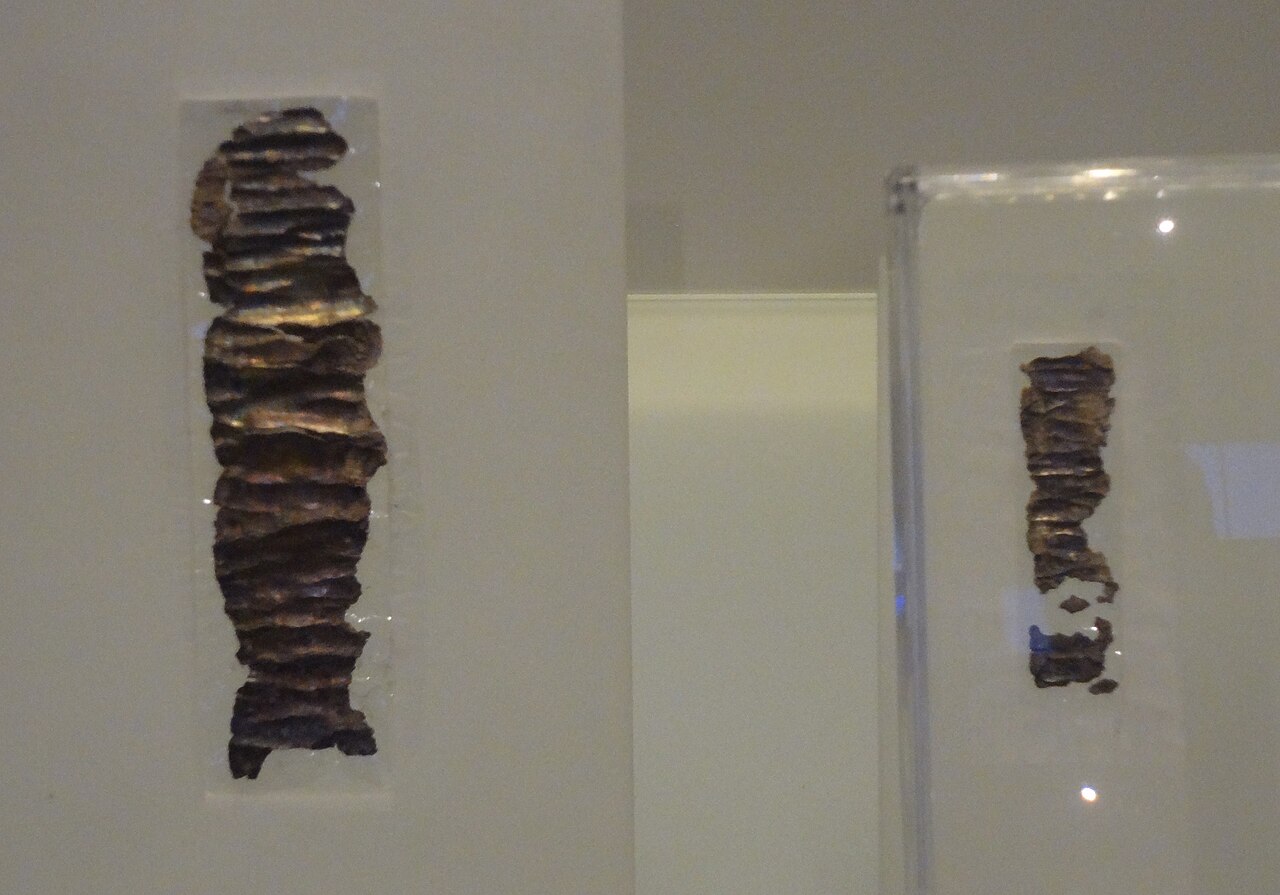
In 1979 Gabriel Barkay was excavating burial caves on the slope of Ketef Hinnom, across the Hinnom Valley from Jerusalem's Old City. A young volunteer, Nathan Zelikovitch, was cleaning Cave 24 when he found that a collapsed ceiling had sealed a repository (chamber 25) full of objects: pottery, arrowheads, jewelry, over a thousand items. Among them were two tiny rolled-up strips of silver, amulets meant to be worn on a cord.
Unrolling them took three years. The larger (KH1) is 27 by 97 mm; the smaller (KH2) 11 by 39 mm. Both are engraved in paleo-Hebrew letters. KH1 contains phrases close to Deuteronomy 7:9 ("the great God who keeps the covenant and the lovingkindness for those who love him and keep his commandments") and a form of the priestly blessing. KH2 has a shorter blessing: "May YHWH bless you and keep you; may YHWH make his face shine upon you and give you peace."
Dating and reading the amulets is careful work. In 2004 Barkay and a team from the University of Southern California's West Semitic Research Project re-photographed the scrolls with advanced imaging and argued for a date just before the Babylonian destruction of Jerusalem in 586 BC. In 2011 Nadav Na'aman proposed a later date, in the late 6th or early 5th century BC (the early Second Temple period), based on the script and on the use of the burial cave. The pre-exilic date remains the more widely held, but the question is debated. The amulets are in the Israel Museum.
The larger amulet (KH1) is badly damaged; its blessing must be partly restored, and it includes other protective and covenant language, so it should not be read as a complete copy of Numbers 6:24–26. The smaller (KH2) preserves a shorter blessing without "be gracious unto thee" and "lift up his countenance upon thee." Jeremy Smoak argues that writing blessings on objects was itself part of Judahite religious practice, and helps explain how this blessing came to be written in Scripture.
What they show, and what they don't
They are the oldest known texts that also appear in the Hebrew Bible, about four centuries older than the Dead Sea Scrolls. They show that the priestly blessing, worded almost as in Numbers, was in use in Jerusalem before the exile, and that the divine name YHWH was invoked for protection. They do not by themselves show that the book of Numbers, or the whole Torah, existed in its present form at that time.
Nazirites in Scripture
Samson was a Nazirite from birth (Judges 13:5), and Hannah vowed that no razor would touch Samuel (1 Samuel 1:11). Paul cut his hair at the end of a vow (Acts 18:18) and paid for four men completing Nazirite vows in the Temple (Acts 21:23–26). The Mishnah devotes a whole tractate, Nazir, to the vow.
The ordeal of the suspected wife (sotah)
Ordeals that let a god decide a case without witnesses were common in the ancient Near East. Hammurabi's laws (§§ 131–132) send a wife accused of adultery to "the divine River": she jumps in, and if she survives she is innocent. Numbers' ritual is different: it takes place at the sanctuary, the drink is not physically dangerous, and the outcome is left to God. It also protected the wife from her husband's or the community's direct punishment on suspicion alone. At the same time, it is one-sided: there is no ordeal for a suspected husband, and the woman bears the humiliation of a public ritual created by her husband's jealousy.
The physical effects are described in obscure Hebrew. "Her belly shall swell, and her thigh shall rot (fall)" has been read as a disease, as infertility, as a prolapsed womb, and by some modern interpreters as a miscarriage; none of these readings is certain. One scholar has even proposed that the "dust" was copper ore; this is a speculative proposal, not an established reading. The Mishnah devotes a tractate, Sotah, to the rite and says Rabban Yohanan ben Zakkai abolished it in the 1st century AD, "when adulterers multiplied."
There is no ancient record showing how often the rite was performed or what happened to the women who drank. We present the text without softening it.
The Case for the Biblical Account
Scripture's account
Laws for the Nazirite vow and the words of the priestly blessing (Numbers 6).
What evidence would we expect?
Early written forms of the blessing; amulets invoking God's protection; evidence of the Nazirite vow in practice.
The discoveries
The Ketef Hinnom silver scrolls (c. 600 BC) with the blessing; similar blessing formulas at Kuntillet Ajrud (c. 800 BC, "may he bless you and keep you"); Nazirite vows in Acts, Josephus and the Mishnah.
Testing the discoveries
The Ketef Hinnom dating was challenged and reaffirmed by the 2004 imaging study. The scrolls show the blessing, not the whole book.
The strongest reconstruction
The priestly blessing was a living text in Jerusalem before the exile, probably centuries older than its earliest surviving copy.
What remains possible
That the blessing goes back to Aaron, as Numbers says; that it grew in Temple worship and was included in Numbers; or both.
Then and Later
The priestly blessing, then and later
- SinaiNumbers 6:24–26. Aaron and his sons bless Israel.
- c. 800 BCKuntillet Ajrud. A desert way station's inscriptions bless "by YHWH… may he bless you and keep you."
- c. 600 BC (debated)Ketef Hinnom. The blessing engraved on silver amulets in a Jerusalem tomb; some date them a century later.Journey of the passage →
- c. 190 BCSimon the high priest. Lifts his hands to pronounce the blessing in the Temple.
- c. AD 30The Ascension. Jesus "lifted up his hands, and blessed them."
- RabbinicBirkat Kohanim. Jews descended from Aaron (kohanim) bless the synagogue with lifted hands.
- TodayChurch and synagogue. The blessing closes countless Christian services and is spoken by Jewish parents over their children on Sabbath eve.
What the evidence shows
- Two silver amulets from Ketef Hinnom contain forms of the priestly blessing.Source: G. Barkay, M. J. Lundberg, A. G. Vaughn and B. Zuckerman, "The Amulets from Ketef Hinnom: A New Edition and Evaluation," BASOR 334 (2004); "Ketef Hinnom scrolls" (overview with bibliography) ↗
- The amulets date to about 600 BC. Barkay et al. (2004); Na'aman (2011) proposes the late 6th–early 5th century BC.Source: G. Barkay, M. J. Lundberg, A. G. Vaughn and B. Zuckerman, "The Amulets from Ketef Hinnom: A New Edition and Evaluation," BASOR 334 (2004); N. Na'aman, "A New Appraisal of the Silver Amulets from Ketef Hinnom," Israel Exploration Journal 61 (2011) ↗
- Hammurabi's laws send a wife accused of adultery to a river ordeal.Source: Laws of Hammurabi §§ 131–132; M. T. Roth, Law Collections (1997)
- The sotah ritual caused a specific physical outcome such as miscarriage.
- They are the oldest known texts that also appear in the Hebrew Bible.Source: G. Barkay, M. J. Lundberg, A. G. Vaughn and B. Zuckerman, "The Amulets from Ketef Hinnom: A New Edition and Evaluation," BASOR 334 (2004); J. D. Smoak, The Priestly Blessing in Inscription and Scripture (Oxford, 2015) ↗
- They prove the book of Numbers existed before the exile. They show the blessing existed; the book's date is a separate question.
- "The LORD bless thee, and keep thee."
Continue the journey
Journey of a PassageNumbers 6:24–26: The priestly blessing: from silver to scroll to synagogueThe oldest known writing of words that also appear in the Bible: two silver amulets, usually dated about 600 BC, carry the priestly blessing in a shorter form.More from this lesson
Investigations
Optional deep dives: the ancient sources, the physical evidence, and every interpretation side by side, including unconventional ones, each labeled for what it is.
The Silver Scrolls of Ketef HinnomAmulets: authentic and excavated · Date: c. 600 BC (supported, debated) · A copy of Numbers: no · Proof of the whole Torah: no
Are two tiny silver amulets from a Jerusalem tomb really the oldest known writing of words found in the Bible?
Found in 1979 in a burial cave across from Jerusalem's Old City, two rolled silver amulets carry the priestly blessing of Numbers 6 and words close to Deuteronomy 7:9. Usually dated about 600 BC, a date supported by a 2004 imaging study but challenged by Nadav Na'aman in 2011, they are the oldest known texts that also appear in the Hebrew Bible.
Open the full investigation →Why this matters to the rest of Scripture
- Restitution plus a fifth.
- Jesus and the woman accused of adultery.
- Samson, a Nazirite from the womb: a lifelong, not temporary, vow.
- Hannah's vow for Samuel.
- "God be merciful unto us, and bless us; and cause his face to shine upon us."
- John the Baptist "shall drink neither wine nor strong drink."
- Paul pays for men completing vows; Acts 18:18 may describe a different kind of vow.
- Paul's threefold blessing.