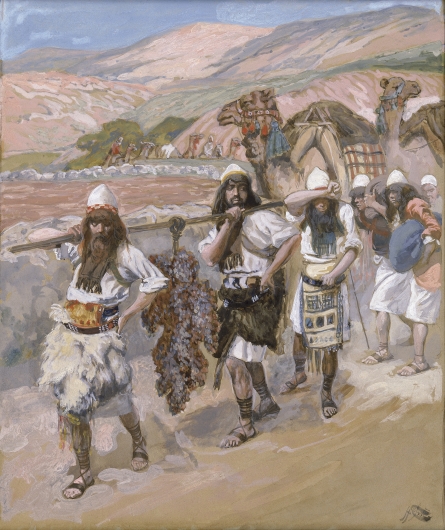
Moses sends a leader from each tribe from the wilderness of Paran: "see the land, what it is; and the people that dwelleth therein, whether they be strong or weak… whether it be fat or lean." They go through the Negev to Hebron, where the sons of Anak live. "(Now Hebron was built seven years before Zoan in Egypt.)" At the valley of Eshcol they cut a single cluster of grapes and carry it on a pole between two men.
After forty days they report: "surely it floweth with milk and honey; and this is the fruit of it. Nevertheless the people be strong… and the cities are walled, and very great: and moreover we saw the children of Anak there." Caleb says, "Let us go up at once… for we are well able to overcome it." The others: "there we saw the giants [Nephilim]… and we were in our own sight as grasshoppers, and so we were in their sight."
Moses had renamed one of them: "Moses called Oshea [Hoshea] the son of Nun Jehoshua [Joshua]." Hoshea means "he saves"; Joshua, "the LORD saves," the name that in Greek becomes Iesous, Jesus.
"Built seven years before Zoan"
Zoan is Tanis in the Delta, which became a royal capital about 1070 BC. Hebron was already a large walled city in the Middle Bronze Age (c. 1800–1550 BC), with massive walls still visible at Tel Rumeida. The reference may point to the earlier Delta capital at Avaris, which later writers sometimes identified with Zoan, or to a local tradition about the two cities. The note shows the writer cared about Egypt's chronology.
Giants in the land
The Anakim appear in Joshua and Deuteronomy as tall inhabitants of Hebron and the hills. Some scholars connect them with names in the Egyptian Execration Texts (19th–18th centuries BC), which curse rulers of a people called Iy-ʿanaq, a reading that is debated. The spies call them Nephilim, the name of the mighty beings of Genesis 6:4, which the Story connects with the Watchers. Most readers take the spies' words as exaggeration born of fear: the narrator calls it "an evil report."
The grapes of Eshcol
The hills around Hebron are still famous for grapes. The image of two spies carrying a huge cluster on a pole became the logo of Israel's Ministry of Tourism.
The same story, told twice
Deuteronomy 1 has Moses retell the scouting forty years later. The two accounts agree on the outline but differ in emphasis.
| Numbers 13–14 | Deuteronomy 1:19–46 | |
|---|---|---|
| Who proposes the scouting? | God commands it (13:1–2) | The people ask; Moses agrees (1:22–23) |
| The scouts' names | All twelve listed (13:4–16) | Not named |
| The report | Good land, but strong people; ten give "an evil report" | "It is a good land" (1:25); the fear is the people's |
| Who is spared | Caleb and Joshua (14:30) | Caleb (1:36); Joshua as Moses' successor (1:38) |
| Moses' own fate | Not mentioned here | "The LORD was angry with me for your sakes" (1:37) |
Readers have explained the differences as two perspectives on one event (the people asked, God approved), as Moses' preaching emphasis, or as separate sources. The Samaritan Pentateuch, as the Research section shows, adds Deuteronomy's wording into Numbers so the two match.
The Case for the Biblical Account
Scripture's account
Twelve tribal leaders explore Canaan for forty days and return with fruit and a divided report (Numbers 13).
What evidence would we expect?
Fortified cities in Canaan, especially Hebron; references to tall inhabitants; the agricultural richness described.
The discoveries
Massive Middle Bronze walls at Hebron (Tel Rumeida); fortified Canaanite cities; Execration Texts naming Canaanite rulers; Egyptian accounts of Canaan's produce (Sinuhe's "figs and grapes… more wine than water").
Testing the discoveries
Many Canaanite cities were less fortified in the Late Bronze Age than in the Middle Bronze, which affects how these descriptions fit different dates. The Anakim link to the Execration Texts is uncertain.
The strongest reconstruction
The spies' report fits Canaan's real fertility and impressive old fortifications, especially Hebron's.
What remains possible
That the cities' walls reflect the Middle Bronze Age or memory of it; that the giants are real tall people, Rephaim traditions, or fear-driven exaggeration.
A longer text in the Samaritan Pentateuch
The Samaritan Pentateuch inserts passages from Deuteronomy 1 into Numbers 12–13, so that Moses' later retelling and the original story match. Follow the passage page for Numbers 13:33.
What the evidence shows
- Hebron was a large fortified city in the Middle Bronze Age.
- Zoan (Tanis) became a royal city around 1070 BC.
- The Anakim are named in the Egyptian Execration Texts.
- The spies saw literal Nephilim. The narrator calls their report evil.
- Numbers 13 and Deuteronomy 1 differ on who proposed the scouting.
- God sent the spies and promised Israel the land.
Continue the journey
Journey of a PassageNumbers 13:33: The spies' report, expanded from DeuteronomyIn the Samaritan Pentateuch, Numbers 13:33 continues with Moses' later speech from Deuteronomy 1:27–33, so that the story and the retelling match.More from this lesson
Echoes Across Civilizations
Optional: how other ancient peoples told similar stories. Open one to compare, then come back to the lesson.
Giants, Watchers, and heavenly beingsJewish (Second Temple) · Mesopotamia · Greece
What did other cultures say about beings between heaven and earth?
- Jewish (Second Temple): 1 Enoch, the Book of the Watchers Shared literary world
- Mesopotamia: The Apkallu (the seven sages) Shared literary world
- Greece: Titans, Giants, and demigod heroes Resemblance only
Also covered: Ancient-astronaut interpretations, clearly labeled as a modern theory.
Compare side by side →Why this matters to the rest of Scripture
- Moses retells the spies.
- Caleb, at eighty-five, claims Hebron.
- The Nephilim.
- Joshua sends two spies of his own, to Jericho.
- "Thou shalt call his name Jesus" (Joshua): "for he shall save his people."