Era 4 · Covenant and WildernessNumbers
Sihon and Og
"Come into Heshbon, let the city of Sihon be built"
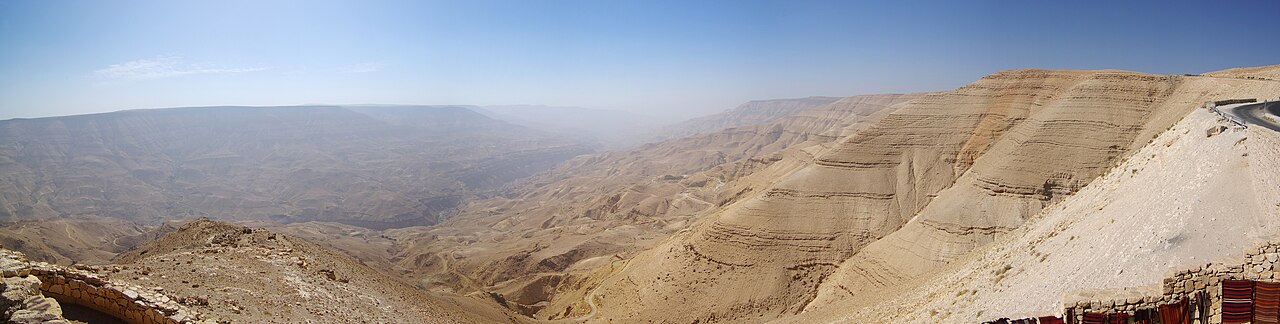
Israel asks Sihon, king of the Amorites, for passage. He attacks and is defeated at Jahaz; Israel takes his land from the Arnon to the Jabbok, including Heshbon, Sihon's city, which he had taken from Moab. A taunt song is quoted: "Come into Heshbon, let the city of Sihon be built… For there is a fire gone out of Heshbon… it hath consumed Ar of Moab… Woe to thee, Moab! thou art undone, O people of Chemosh."
Then Og king of Bashan comes out to fight at Edrei and is defeated, and Israel takes his land.
The Song of Heshbon
"Wherefore they that speak in proverbs say": the taunt song over Heshbon (21:27–30) is introduced as the work of the moshlim, ballad singers. It celebrates that Sihon had taken Heshbon from Moab, then that fire went out from Heshbon and consumed Moab. Its Hebrew is among the hardest in the Torah, with words whose meaning is unsure. Jeremiah reuses it nearly word for word against Moab centuries later (48:45–46), showing it was a known song.
Heshbon and Dibon: the archaeological problem
Excavations at Tell Hesban (Heshbon), by Andrews University from 1968, and at Dhiban (Dibon) found no Late Bronze Age city at either place. If these are the biblical towns, they did not exist as cities when Israel arrived by either Exodus date. Proposals: biblical Heshbon was another site (such as Tell Jalul); the place names in the story reflect later times; or a tent-and-village population left little trace.
Charles Krahmalkov (1994) noted that Egyptian topographical lists of Thutmose III, Amenhotep III and Ramesses II include a route through Transjordan with names matching Numbers 33's stations (Iyyim, Dibon, Abel), and that Ramesses II's reliefs at Luxor name Dibon in Moab. He argued that a road and its stations existed in the Late Bronze Age even if a city mound is empty. Other scholars dispute some of his identifications.
Og, Ashtaroth and Edrei
Deuteronomy 1:4 says Og "dwelt at Ashtaroth in Edrei" and was one of the last of the Rephaim. A Ugaritic text (KTU 1.108, 13th century BC) speaks of Rapiʾu, "the eternal king," a figure linked with the Rephaim, who sits in ʿAshtaroth and rules in Edreʿi: the same two towns in the same pairing. It is a remarkable connection between Ugaritic myth and the biblical memory of Og.
Og's bed
Deuteronomy 3:11 adds: "only Og king of Bashan remained of the remnant of giants [Rephaim]; behold, his bedstead was a bedstead of iron; is it not in Rabbath of the children of Ammon? nine cubits was the length thereof, and four cubits the breadth of it", about 4 by 1.8 meters. Some scholars think "iron" describes black basalt and that the "bed" was a burial slab or one of the great stone dolmens that dot the Golan and northern Jordan, which local tradition associated with giants. Others take it as a royal bed displayed as a trophy. The verse presents it as something a reader could still go and see. The Rephaim are traced through the Bible and Ugarit in a separate investigation.
What the Samaritan Pentateuch adds
Here the Samaritan Pentateuch has its longest run of additions in Numbers, drawn from Deuteronomy 2. Before Israel sends messengers (21:21), God says "Rise ye up, take your journey, and pass over the river Arnon: behold, I have given into thine hand Sihon" (Deuteronomy 2:24–25). Israel's message adds the offer to buy food and water "as the children of Esau… and the Moabites" did (2:27–29). And after Sihon refuses (21:23), God says "Behold, I have begun to give Sihon and his land before thee" (2:31). The library's Samaritan text marks gaps in parts of 21:21–22, so the exact wording there awaits collation with a critical edition.
The Case for the Biblical Account
Scripture's account
Israel's march north of Moab, the defeat of Sihon and Og (Numbers 21:10–35).
What evidence would we expect?
Cities at Heshbon and Dibon; Transjordanian routes in Egyptian records; traditions of Og and the Rephaim.
The discoveries
No Late Bronze city at Tell Hesban or Dhiban; Egyptian lists naming Transjordanian places; Ramesses II's mention of Dibon; Ugaritic KTU 1.108 pairing Ashtaroth and Edrei.
Testing the discoveries
The absence at Hesban and Dhiban is a genuine difficulty. The Egyptian and Ugaritic evidence shows the region's names and traditions were older than the Iron Age.
The strongest reconstruction
Numbers 21 preserves very old poetry and place names; its fit with Late Bronze archaeology is incomplete.
What remains possible
Different site identifications; later naming; or occupation that has not been found.
What the evidence shows
- Tell Hesban had no Late Bronze Age city.Source: Andrews University Heshbon Expedition (Tell Hesban), 1968–1978; Ø. LaBianca et al.
- Egyptian lists name a Late Bronze Transjordanian route including Dibon.Source: C. R. Krahmalkov, "Exodus Itinerary Confirmed by Egyptian Evidence," BAR 20:5 (1994) ↗
- A Ugaritic text pairs ʿAshtaroth and Edreʿi as seats of a Rephaite king.Source: KTU 1.108 (Ugarit, 13th century BC): Rapiʾu, "king of eternity," who dwells in ʿAshtaroth and Edreʿi
- Jeremiah 48:45–46 reuses the Song of Heshbon.
- Og's "bed of iron" was a basalt dolmen or sarcophagus.
- The Samaritan Pentateuch adds Deuteronomy 2:24–25, 2:27–29 and 2:31 at 21:21–23. Read in the site's Samaritan text, which has gaps at 21:21–22.
- The LORD gave Sihon and Og into Israel's hand.
Continue the journey
Echoes Across CivilizationsGiants, Watchers, and heavenly beingsWhat did other cultures say about beings between heaven and earth?More from this lesson
On the map
Location securely identified Probable identification Proposed or debated location Biblical route (roads schematic) Scholarly proposal
- Proposal: from Kadesh to the plains of Moab. An illustrative proposal, not a confirmed route. Kadesh → Mount Hor on Edom's border → around Edom through the Arabah (Punon) → north along Moab → Dibon → the plains of Moab opposite Jericho. Punon, Dibon and the plains of Moab are securely located; Kadesh is probable; Mount Hor is debated. Most of the stations of Numbers 33 cannot be placed on a map (see the itinerary lesson); lines between stops are schematic.
Echoes Across Civilizations
Optional: how other ancient peoples told similar stories. Open one to compare, then come back to the lesson.
Giants, Watchers, and heavenly beingsJewish (Second Temple) · Mesopotamia · Greece
What did other cultures say about beings between heaven and earth?
- Jewish (Second Temple): 1 Enoch, the Book of the Watchers Shared literary world
- Mesopotamia: The Apkallu (the seven sages) Shared literary world
- Greece: Titans, Giants, and demigod heroes Resemblance only
Also covered: Ancient-astronaut interpretations, clearly labeled as a modern theory.
Compare side by side →Why this matters to the rest of Scripture
- Sihon and Og retold; Og's iron bed.
- The Heshbon song applied to Moab's fall.
- "Sihon king of the Amorites… and Og the king of Bashan."
- Rahab has heard about Sihon and Og.
- "The Amorite… whose height was like the height of the cedars."