Era 4 · Covenant and WildernessNumbers
Reuben, Gad, and the Lands East of the Jordan
"Be sure your sin will find you out"
The tribes of Reuben and Gad have "a very great multitude of cattle," and the land of Jazer and Gilead is good for cattle. "Let this land be given unto thy servants for a possession, and bring us not over Jordan."
Moses is alarmed: "Shall your brethren go to war, and shall ye sit here?" It would be the spies all over again. They answer: we will build sheepfolds and towns for our families here, but our armed men will go ahead of Israel until every tribe has its inheritance. Moses agrees: "But if ye will not do so, behold, ye have sinned against the LORD: and be sure your sin will find you out."
"And the children of Gad built Dibon, and Ataroth, and Aroer"; Reuben built Heshbon, Elealeh, Kiriathaim, Nebo and Baal-meon. Half of Manasseh takes Gilead.
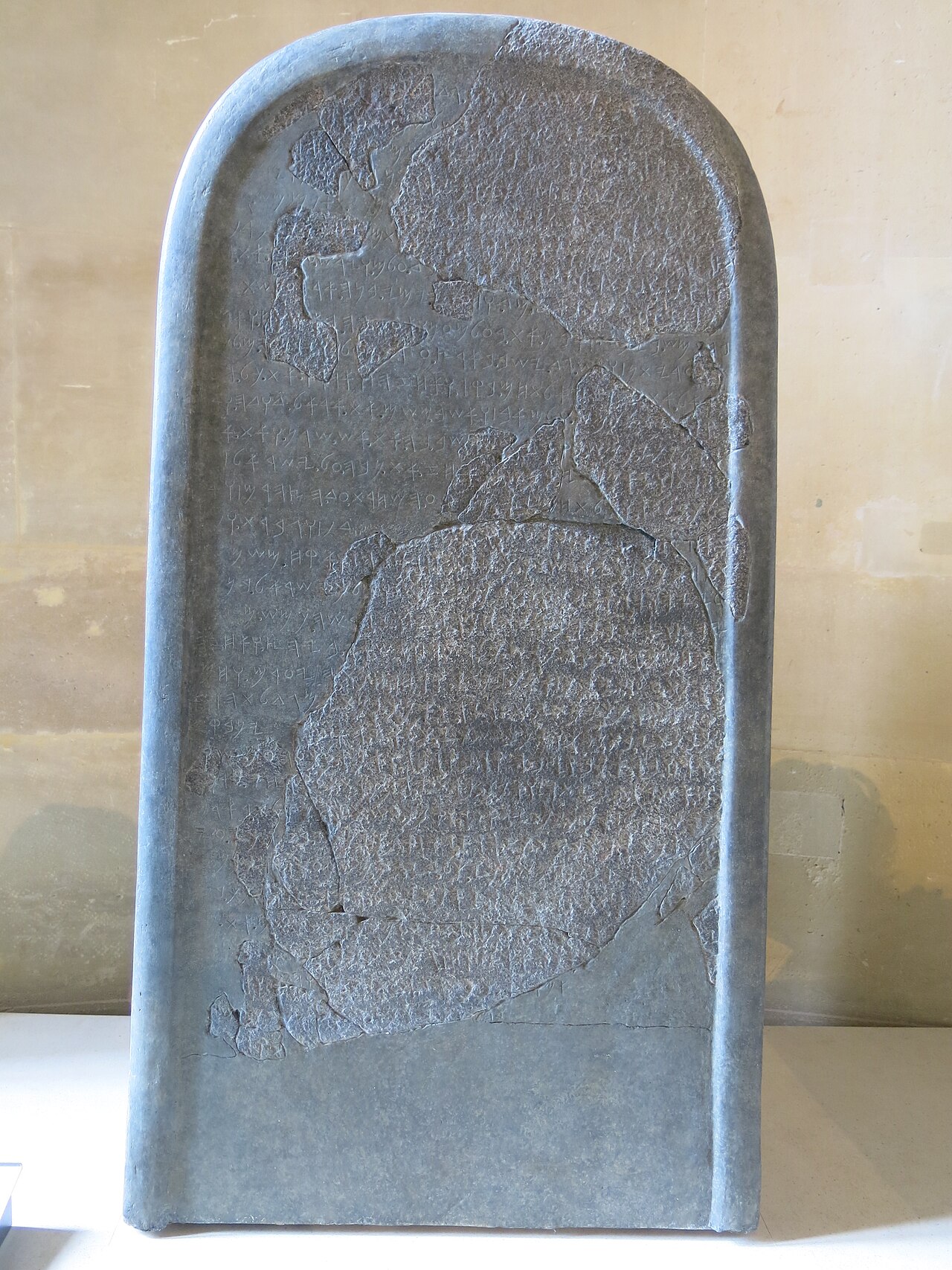
The Mesha Stele
In 1868 a missionary, F. A. Klein, saw a black basalt stone at Dhiban (Dibon) in Jordan. Before it could be taken, local people heated and broke it, but a paper squeeze had been made, and most of the pieces were recovered. Now in the Louvre, it is the longest inscription ever found from Iron Age Transjordan. King Mesha of Moab (c. 840 BC) boasts of throwing off the rule of Israel's King Omri and his son.
Lines 10–11: "The men of Gad had dwelt in the land of Ataroth from of old, and the king of Israel had built Ataroth for himself." Mesha says he took Ataroth and Nebo from Israel, and dragged "the altar-hearth of… YHWH" before his god Chemosh. Numbers 32:34 says Gad built Ataroth; the Moabite king independently says the men of Gad had lived there "from of old."
Ataroth excavated
Excavations at Khirbet Ataruz since 2000 by Chang-ho Ji have uncovered a sanctuary with altars, standing stones and cult objects from the 9th century BC, built under Israelite rule and then taken over by Moab, matching the Mesha Stele's account of the town changing hands.
The stone itself
| Mesha Stele | |
|---|---|
| Museum | Louvre, Paris, inventory AO 5066 |
| Material | Black basalt |
| Size | About 125 cm tall, 69 cm wide, 37 cm thick |
| Text | 34 lines in Moabite, in the Old Hebrew–Phoenician alphabet |
| Date | Reign of Mesha, roughly 830–805 BC (museum dating) |
| Found | Dhiban (Dibon), Jordan, 1868 |
| Condition | Broken in 1869; reassembled from recovered pieces and a paper squeeze. Many photographs show a restored stone or a cast. |
The stele is evidence for Moab and Israel in the 9th century BC: Israelites, including "the men of Gad," lived in towns Numbers 32 names, and Moab took them back. It does not record the settlement Numbers describes, and it cannot date it. Several of the towns' locations are also still debated.
The Case for the Biblical Account
Scripture's account
Reuben and Gad settle east of the Jordan and build towns including Dibon and Ataroth (Numbers 32).
What evidence would we expect?
Gadite and Israelite presence in these towns; Moabite records of the region.
The discoveries
The Mesha Stele (c. 840 BC): "the men of Gad had dwelt in the land of Ataroth from of old"; Israel's king built Ataroth; Mesha took Nebo; the Ataruz sanctuary.
Testing the discoveries
The stele is 9th century, centuries after the setting of Numbers, but describes Gad's residence as long-standing.
The strongest reconstruction
Gad's presence in the Ataroth region was old by the 9th century BC, as Numbers says.
What remains possible
How far back "from of old" reaches, and how the Transjordanian tribes related to the western ones (Joshua 22).
What the evidence shows
- The Mesha Stele says the men of Gad had lived in Ataroth "from of old."Source: The Mesha Stele (Louvre AO 5066), c. 840 BC, lines 10–11 and 14–18; Mesha Stele, Louvre AO 5066 (museum catalogue) ↗
- The Mesha Stele confirms the settlement of Reuben and Gad under Moses. It describes the 9th century BC, centuries later.
- The Mesha Stele names YHWH and the town of Nebo.Source: The Mesha Stele (Louvre AO 5066), c. 840 BC, lines 10–11 and 14–18
- A 9th-century sanctuary at Khirbet Ataruz changed hands between Israel and Moab.Source: Chang-ho Ji, excavations at Khirbet Ataruz (2000–); "A Moabite Sanctuary at Khirbat ʿAtaruz," BASOR (2018)
- "Be sure your sin will find you out."
Continue the journey
Connected elsewhere in ScriptureThe Altar by the JordanJoshua 22: The eastern tribes return home and build an altar of witness.More from this lesson
Why this matters to the rest of Scripture
- The eastern tribes return home and build an altar of witness.
- Mesha's revolt from the Bible's side.
- Moses recalls the agreement.
- Reuben stays among the sheepfolds in Deborah's war.