In the first month Israel comes to the wilderness of Zin and stays at Kadesh. "And Miriam died there, and was buried there. And there was no water for the congregation."
God tells Moses: "Take the rod… and speak ye unto the rock before their eyes; and it shall give forth his water." Moses gathers the people: "Hear now, ye rebels; must we fetch you water out of this rock?" He strikes the rock twice, and water pours out. But God says: "Because ye believed me not, to sanctify me in the eyes of the children of Israel, therefore ye shall not bring this congregation into the land which I have given them."
Moses sends messengers to the king of Edom: "Thus saith thy brother Israel… We will go by the king's high way, we will not turn to the right hand nor to the left." Edom refuses and comes out with an army. Israel turns away.
At Mount Hor, on the border of Edom, Moses strips Aaron of his priestly garments and puts them on his son Eleazar. "And Aaron died there in the top of the mount." All Israel mourns him thirty days.
Kadesh-barnea
Most scholars identify Kadesh-barnea with the oasis of Ain el-Qudeirat in northeastern Sinai, the richest spring in the region. On a mound beside it, Tell el-Qudeirat, Moshe Dothan (1956) and Rudolph Cohen (1976–1982) excavated a series of Judahite fortresses from about the 10th to the 6th century BC. They found nothing from the Late Bronze Age, when either Exodus date would put Israel there.
Even the Iron Age picture is debated. The excavators interpreted the remains as three successive fortresses (Lower, Middle and Upper). Israel Finkelstein (2010) disputes that sequence and argues for an earlier Iron I settlement phase beneath the fort. What all agree on is that the visible fort is centuries later than any date proposed for the Exodus.
How to weigh this? A people living in tents for decades leaves little that survives. The biblical Kadesh may be a region rather than a single site (the "wilderness of Kadesh," Psalm 29:8), with several springs: Ain Qudeirat, Ain Qedeis and Ain Qoseimeh. And the Iron Age fortress shows that Judah's kings considered the spot important, perhaps because of its history. Cohen himself titled an article "Did I Excavate Kadesh-Barnea?"
The King's Highway and Edom
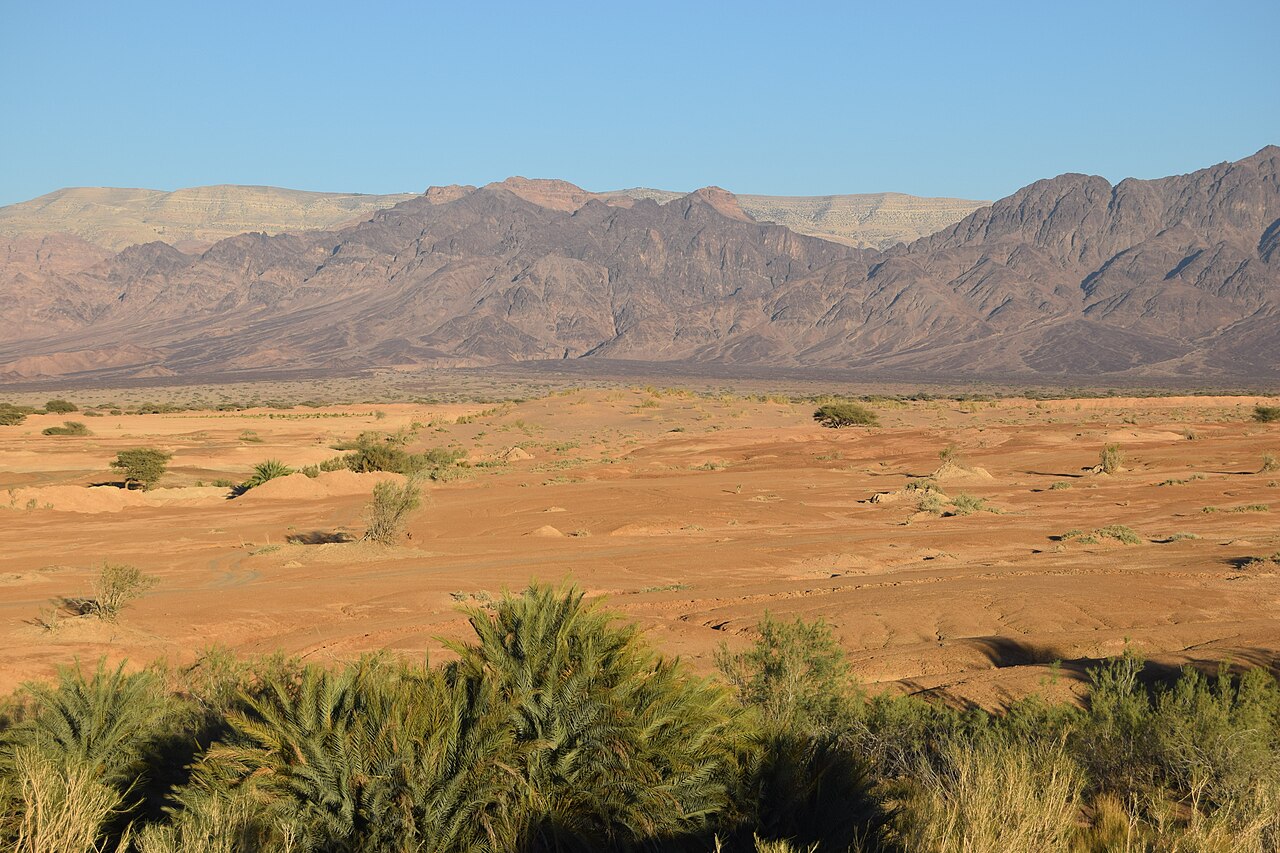
The King's Highway ran along the Transjordanian plateau from the Gulf of Aqaba to Damascus. Egyptian texts of the 13th century BC mention Edom and Seir and their Shasu nomads (Papyrus Anastasi VI). For years archaeologists said Edom had no kingdom until the 8th century BC, because there were no Edomite towns earlier. Excavations of the copper industry at Faynan and Timna by Erez Ben-Yosef and Thomas Levy have revealed a powerful, organized society in the Arabah in the 11th–9th centuries BC, living in tents. Ben-Yosef calls the old assumption "architectural bias": nomadic kingdoms can be real and leave few buildings.
Where is Mount Hor?
Tradition since at least Josephus places Aaron's death on Jebel Harun, "Aaron's mountain," above Petra, where a small shrine with a white dome stands on the summit. Numbers says Mount Hor was "by the coast of the land of Edom" near Kadesh, so some scholars prefer a mountain farther west, such as Jebel Madurah. The location is uncertain. Numbers 34:7–8 names a second "mount Hor" on Canaan's far northern border, near Lebo-hamath in Lebanon; it is a different mountain and is not Aaron's burial place.
The Case for the Biblical Account
Scripture's account
Miriam's death, water from the rock at Meribah, Edom's refusal, and Aaron's death (Numbers 20).
What evidence would we expect?
Occupation at Kadesh-barnea in the right period; Edom as a people in the Late Bronze Age; the King's Highway as a route.
The discoveries
Iron Age fortresses at Tell el-Qudeirat but no Late Bronze remains; Egyptian references to Edom and Shasu nomads in the 13th century; early Iron Age copper production in the Arabah by a tent-dwelling society.
Testing the discoveries
The absence at Qudeirat is real but expected for nomads; Edom's early existence as a nomadic polity is increasingly supported.
The strongest reconstruction
The story fits a world of nomadic peoples and Transjordanian routes. Kadesh-barnea's Late Bronze Age phase has not been found.
What remains possible
That Israel's camps left no surviving trace; that Kadesh lay elsewhere in the region; or that the account reflects later geography.
What the evidence shows
- Tell el-Qudeirat has Iron Age remains but no Late Bronze Age occupation.Source: R. Cohen, "Did I Excavate Kadesh-Barnea?" BAR 7:3 (1981); R. Cohen and H. Bernick-Greenberg, Excavations at Kadesh Barnea (2007)
- The Iron Age remains are three successive fortresses. The excavators' interpretation; Finkelstein argues otherwise.Source: R. Cohen, "Did I Excavate Kadesh-Barnea?" BAR 7:3 (1981); R. Cohen and H. Bernick-Greenberg, Excavations at Kadesh Barnea (2007); I. Finkelstein, "Kadesh Barnea: A Reevaluation of Its Archaeology and History," Tel Aviv 37 (2010) ↗
- The Samaritan Pentateuch adds Deuteronomy 3:24–28 and 2:2–6 after 20:13. Read in the site's Samaritan text.
- Egyptian texts mention Edom and Shasu nomads in the 13th century BC.
- A tent-dwelling Edomite polity ran a large copper industry in the 11th–9th centuries BC.Source: E. Ben-Yosef, "The Architectural Bias in Current Biblical Archaeology," Vetus Testamentum 69 (2019)
- Mount Hor is Jebel Harun near Petra.
- "Because ye believed me not, to sanctify me."
Two long additions in the Samaritan Pentateuch
After "This is the water of Meribah" (20:13), the Samaritan Pentateuch inserts two passages that Moses speaks in Deuteronomy. First, Deuteronomy 3:24–28: Moses pleads, "let me go over, and see the good land," and God answers, "Let it suffice thee; speak no more unto me of this matter… charge Joshua." Second, Deuteronomy 2:2–6: "Ye have compassed this mountain long enough: turn you northward… meddle not with them [the sons of Esau]… Ye shall buy meat of them for money." The result is that Moses' punishment and his request appear at the moment of his failure, and the approach to Edom is introduced by God's command. The passage page lays out the witnesses.
Continue the journey
Journey of a PassageNumbers 20:13: Meribah: two passages from DeuteronomyAfter "This is the water of Meribah," the Samaritan Pentateuch inserts two speeches that Deuteronomy places in Moses' mouth: his plea to cross the Jordan (Deuteronomy 3:24–28) and God's command to turn north past Edom (Deuteronomy 2:2–6).More from this lesson
On the map
Location securely identified Probable identification Proposed or debated location Biblical route (roads schematic) Scholarly proposal
- Proposal: from Kadesh to the plains of Moab. An illustrative proposal, not a confirmed route. Kadesh → Mount Hor on Edom's border → around Edom through the Arabah (Punon) → north along Moab → Dibon → the plains of Moab opposite Jericho. Punon, Dibon and the plains of Moab are securely located; Kadesh is probable; Mount Hor is debated. Most of the stations of Numbers 33 cannot be placed on a map (see the itinerary lesson); lines between stops are schematic.
Investigations
Optional deep dives: the ancient sources, the physical evidence, and every interpretation side by side, including unconventional ones, each labeled for what it is.
Kadesh-barnea and the Missing Late Bronze AgeIdentification: probable · Late Bronze remains: none found · Interpretation: debated
Why has archaeology found no trace of Israel at Kadesh-barnea, where Numbers says they stayed many years?
Kadesh-barnea, Israel's main wilderness base, is identified with the spring of Ain el-Qudeirat. The mound beside it holds Iron Age fortresses of the kings of Judah, but nothing from the Late Bronze Age. Similar gaps appear at Arad, Heshbon and Dibon. What does that mean?
Open the full investigation →Why this matters to the rest of Scripture
- The first water from the rock.
- Moses may see the land but not enter.
- "It went ill with Moses for their sakes."
- Esau, father of Edom.
- Edom's violence against his brother Jacob.
- "That Rock was Christ."