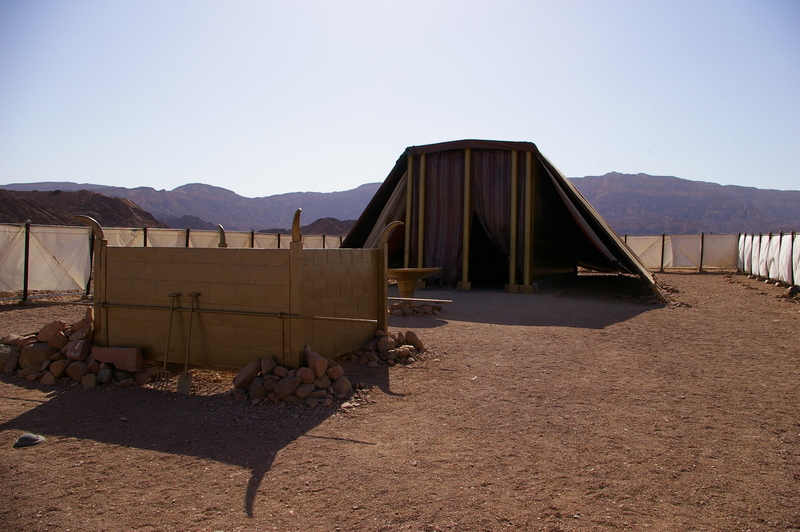
Era 4 · Covenant and WildernessNumbers
The Camp and Marching Order
"Every man… by his own standard": tribes, Levites, and the firstborn
"Every man of the children of Israel shall pitch by his own standard, with the ensign of their father's house: far off about the tabernacle of the congregation shall they pitch."
- East, toward the sunrise: Judah, Issachar, Zebulun, who set out first.
- South: Reuben, Simeon, Gad.
- West: Ephraim, Manasseh, Benjamin.
- North: Dan, Asher, Naphtali, who set out last.
Moses, Aaron and the priests camp at the east, before the entrance; the three Levite clans on the other three sides. "Then the tabernacle of the congregation shall set forward with the camp of the Levites in the midst of the camp."
Chapter 3 names Aaron's surviving sons, Eleazar and Ithamar, after the deaths of Nadab and Abihu, and separates the priests from the wider tribe of Levi. The Levites are counted from one month old: Gershon 7,500, Kohath 8,600, Merari 6,200. "All that were numbered of the Levites… were twenty and two thousand" (3:39). Israel's firstborn sons number 22,273; the 273 more than the Levites are redeemed at five shekels each, 1,365 shekels given to Aaron.
Chapter 4 counts the men aged thirty to fifty who will carry the sanctuary. When the camp moves, Aaron and his sons cover the ark with the veil, a covering of fine leather and a cloth of blue, and cover the table, lampstand and altars; only then may the Kohathites lift them, "but they shall not touch any holy thing, lest they die." Gershon carries the curtains and coverings, Merari the boards, bars, pillars and sockets. Kohath 2,750, Gershon 2,630, Merari 3,200: 8,580 bearers.
A king's camp
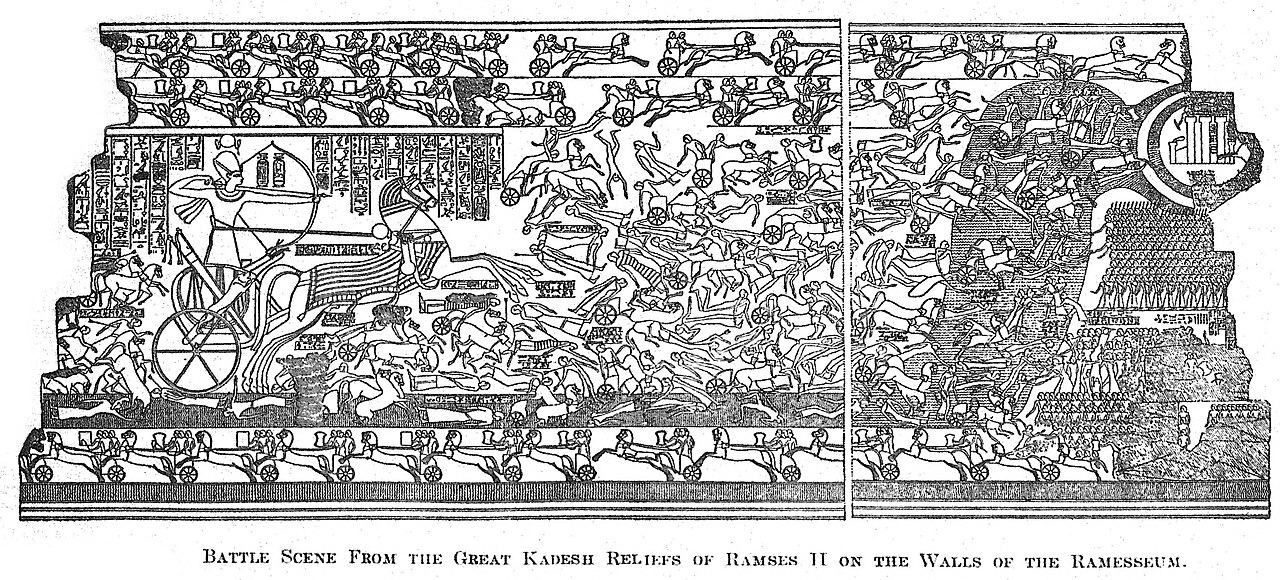
Ramesses II's reliefs of his camp at the Battle of Kadesh show a rectangle with the royal tent at the center, guarded on all sides, the army grouped in divisions named after gods (Amun, Ra, Ptah, Seth). Israel's camp follows the same plan with the LORD's tent at the center: the camp is the army of the divine King. See the Echoes topic on portable sanctuaries.
The banners
Numbers does not say what the banners looked like. Jewish tradition (Numbers Rabbah 2:7) gave each of the four leading tribes an emblem from Jacob's and Moses' blessings: a lion for Judah, a man for Reuben, an ox for Ephraim, an eagle for Dan. These match the four faces of Ezekiel's living creatures (Ezekiel 1:10) and the four creatures of Revelation 4:7. The tradition is late, but it shows how readers connected the camp with the throne of God.
Judah first
Judah, the largest tribe, camps at the east and leads the march. Genesis 49:10 had promised "the sceptre shall not depart from Judah." The tribe of the future kings already leads the way.
The Levites' work
| Family | Camp | Carries (ch. 4) | Bearers aged 30–50 |
|---|---|---|---|
| Gershon | West | Curtains, coverings, hangings of the court | 2,630 |
| Kohath | South | Ark, table, lampstand, altars, once covered by the priests | 2,750 |
| Merari | North | Boards, bars, pillars, sockets, pegs and cords | 3,200 |
| Moses, Aaron and the priests | East, at the entrance | Cover the holy things; Eleazar oversees oil, incense and grain offering |
The Case for the Biblical Account
Scripture's account
The tribes camp in fixed positions around the tabernacle and march in the same order (Numbers 2).
What evidence would we expect?
Ancient military camps organized around a royal or divine center; tribal or divisional standards.
The discoveries
Ramesses II's Kadesh camp reliefs; Egyptian army divisions with divine standards; Assyrian camp reliefs with the king's tent in the center.
Testing the discoveries
These show the camp's layout fits ancient military practice; they do not show the wilderness camp itself.
The strongest reconstruction
The camp is presented as a royal war camp, with the LORD as King at its center.
What remains possible
A real wilderness arrangement, or an idealized portrait of Israel as God's army.
A puzzle in the Levite numbers
| Family | Numbers 3 (Hebrew) | Some Greek manuscripts |
|---|---|---|
| Gershon (3:22) | 7,500 | 7,500 |
| Kohath (3:28) | 8,600 | 8,300 |
| Merari (3:34) | 6,200 | 6,200 |
| Sum | 22,300 | 22,000 |
| Stated total (3:39) | 22,000 | 22,000 |
In the standard Hebrew text the three families add up to 22,300, but the total given is 22,000. The Hebrew and Codex Vaticanus read 8,600 for Kohath; a group of Greek (Lucianic) manuscripts reads 8,300, which makes the sum exact; other Greek witnesses are reported with 8,500 or 8,800. Hebrew "six" (shesh) and "three" (shalosh) could be confused in copying, but the 8,300 reading could equally be an ancient correction made to fix the arithmetic. Jewish tradition (Talmud, Bekhorot 5a) explained the gap as 300 Levites who were themselves firstborn and could not redeem others. None of these explanations is stated in the text; we show the numbers as they stand. See the passage page.
Thirty or twenty-five?
Numbers 4:3 counts Levites "from thirty years old and upward even until fifty"; Numbers 8:24 says "from twenty and five years old and upward they shall go in to wait upon the service." Rabbinic tradition read the five years as an apprenticeship; Chronicles lowers the age to twenty (1 Chronicles 23:24–27). Critical scholars see a legal development over time. The harmonization is an interpretation, not something either chapter says.
A longer verse in two traditions
In Numbers 4:14 the Samaritan Pentateuch and the Septuagint add a sentence: the priests are also to take a purple cloth and cover the bronze basin and its stand, put them in a covering of fine leather, and set them on the carrying frame. The Masoretic Text lacks it. This is one of the sixteen major Samaritan variants in Numbers identified by Ingrid Hjelm, and here the Greek agrees with the longer text (checked against the Samaritan text and Giguet's Septuagint in our library).
What the evidence shows
- Ramesses II's Kadesh reliefs show the royal tent at the center of a rectangular camp.Source: M. M. Homan, To Your Tents, O Israel! (2002)
- Egyptian army divisions marched under the standards of gods.
- The four banners showed a lion, a man, an ox and an eagle. A later Jewish tradition.
- The Levite family counts in Numbers 3 (Hebrew) add up to 22,300, not the stated 22,000.
- Some Greek manuscripts read 8,300 for Kohath, which makes the total exact.Source: D. M. Fouts, The Use of Large Numbers in the Old Testament (diss., 1992), text-critical discussion ↗
- 8,300 is the original reading. It may be a correction made to fix the arithmetic.
- The Samaritan Pentateuch and Septuagint add the covering of the basin at Numbers 4:14.Source: I. Hjelm, "The Samaritan and Jewish Versions of the Pentateuch: A Survey," Religions 11:2 (2020) ↗
- God dwelt at the center of His people.
Continue the journey
Journey of a PassageNumbers 3:28: The Kohathites: 8,600 or 8,300?Numbers counts the three Levite clans at 7,500, 8,600 and 6,200, which make 22,300, yet the total in 3:39 is 22,000.More from this lesson
Why this matters to the rest of Scripture
- "The sceptre shall not depart from Judah."
- Faces of a man, a lion, an ox and an eagle.
- The four living creatures around the throne.
- The holy city lies foursquare.
- "God is in the midst of her; she shall not be moved."
- "Sanctify unto me all the firstborn."
- Levite duties in David's time, from age twenty.
- Jesus presented as a firstborn son.