Era 4 · Covenant and WildernessNumbers
Gifts, Lamps, and the Levites
"He heard the voice of one speaking unto him from off the mercy seat"
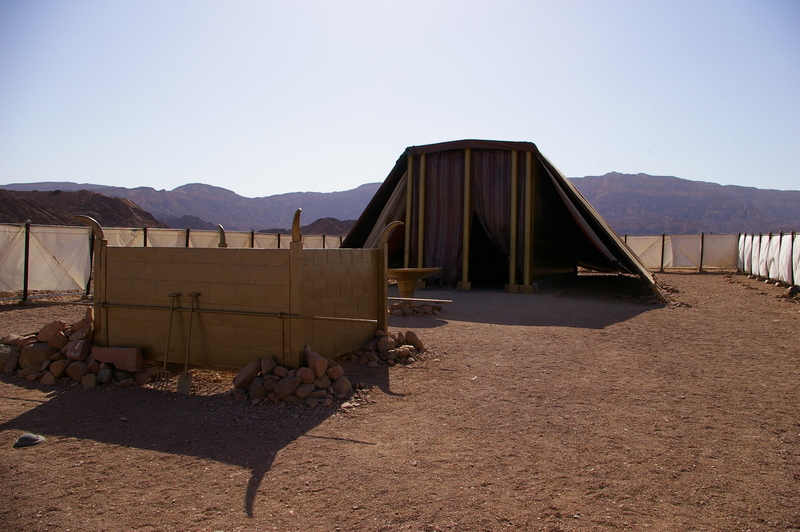
When the tabernacle is anointed, the twelve leaders bring six covered wagons and twelve oxen to carry it. For twelve days, one leader each day brings a silver plate, a silver bowl, a gold spoon of incense, and animals for offerings. The list is repeated in full for each tribe, from Nahshon of Judah to Ahira of Naphtali, then totaled.
"And when Moses was gone into the tabernacle… to speak with him, then he heard the voice of one speaking unto him from off the mercy seat… from between the two cherubims."
Aaron sets the seven lamps of the lampstand "over against the candlestick," made of beaten gold "according unto the pattern which the LORD had shewed Moses."
The Levites are sprinkled with water of purification, shave their whole bodies, wash their clothes, and the people lay their hands on them. Aaron presents them before the LORD "for an offering of the children of Israel," in place of the firstborn. They serve from twenty-five years old, and at fifty retire from heavy service to assist their brothers.
Why repeat it twelve times?
Numbers 7 is the longest chapter in the Torah, because it lists the same gifts twelve times. It reads like an ancient temple inventory or donation record, where each contribution is recorded under the giver's name. Jewish tradition saw honor in the repetition: no tribe's gift was summarized or overlooked.
| Each leader's gift | Weight or number | Twelve tribes in all |
|---|---|---|
| Silver plate (charger) | 130 shekels | 1,560 shekels |
| Silver bowl | 70 shekels | 840 shekels |
| Silver vessels together | 2,400 shekels (7:85) | |
| Gold spoon (dish) of incense | 10 shekels | 120 shekels (7:86) |
| Burnt offering | 1 bull, 1 ram, 1 lamb | 36 animals |
| Purification offering | 1 male goat | 12 goats |
| Peace offering | 2 oxen, 5 rams, 5 goats, 5 lambs | 204 animals |
A flashback
Numbers 7 begins "on the day that Moses had fully set up the tabernacle", the first day of the first month (Exodus 40:17), a month before the census of Numbers 1. Like many ancient narratives, Numbers arranges material by theme as well as by date. The site's timelines mark the difference between where a passage stands in the book and when its events are dated.
Seven branches, not nine
The tabernacle and Temple lampstand had seven lamps. The nine-branched lamp (hanukkiah) lit at Hanukkah commemorates the rededication of the Temple in 164 BC; its extra lights are a later development, and Jewish law discouraged copying the Temple's seven-branched menorah outside it.
The Case for the Biblical Account
Scripture's account
The leaders' dedication gifts, the lamps, and the Levites' purification (Numbers 7–8).
What evidence would we expect?
Ancient lists of temple donations; precious metal vessels with fixed weights; festival rules with alternatives.
The discoveries
Mesopotamian and Egyptian temple inventories listing vessels by weight and donor; the menorah on the Arch of Titus and on Hasmonean coins; Levite service rules in Chronicles and the Mishnah.
Testing the discoveries
The documentary style is ancient. The particular gifts are known only from Numbers.
The strongest reconstruction
Numbers 7 preserves an inventory-style record of the altar's dedication.
What remains possible
That the list is an archival record, or a literary celebration in archival form.
What the evidence shows
- Ancient temples kept inventories of donated vessels by weight and donor.
- The silver vessels total 2,400 shekels and the gold 120 shekels. Numbers 7:85–86; the figures add up.
- Numbers 8:24 (age 25) and 4:3 (age 30) give different starting ages for Levites.
- The two ages refer to training and full service. A traditional harmonization not stated in the text.
- God spoke to Moses from above the mercy seat.
Then and Later
The lampstand, then and later
- SinaiNumbers 8. Aaron lights the seven lamps.
- c. 950 BCSolomon's Temple. Ten lampstands of gold.
- 164 BCRededication. The Maccabees relight the Temple lamps, remembered at Hanukkah.
- 40–37 BCCoins. Antigonus, the last Hasmonean king, puts the menorah on his coins.
- AD 70The Arch of Titus. Roman soldiers carry the menorah in triumph.
- 1949Israel's emblem. The State of Israel adopts the menorah as its symbol.
Continue the journey
Connected elsewhere in ScriptureGod Dwells Among His PeopleExodus 40: The tabernacle set up.More from this lesson
Why this matters to the rest of Scripture
- The tabernacle set up.
- The Levites in place of the firstborn.
- Seven golden lampstands.
- Leaders give freely for the Temple.
- The widow's offering.