Era 4 · Covenant and WildernessNumbers
The Cloud Moves
"Rise up, LORD, and let thine enemies be scattered"
At the first anniversary of the Exodus, Israel keeps Passover. But some men are unclean from a dead body. "Wherefore are we kept back, that we may not offer an offering of the LORD in his appointed season?" Moses asks God, who answers: anyone unclean, or far away on a journey, may keep it on the fourteenth day of the second month. But whoever is clean and not traveling and simply fails to keep it "shall be cut off." The stranger who wishes may keep it too: "ye shall have one ordinance."
"At the commandment of the LORD the children of Israel journeyed, and at the commandment of the LORD they pitched." Whether the cloud stayed two days, a month or a year, they stayed; when it lifted, they moved.
"Make thee two trumpets of silver; of a whole piece shalt thou make them." Both blown together gather the congregation; one, the leaders. An alarm sets the camps moving, east first, then south. In war, "ye shall blow an alarm… and ye shall be remembered before the LORD your God." On feast days and new moons, they are blown over the offerings.
On the twentieth day of the second month of the second year, the cloud lifts. Israel leaves Sinai for the wilderness of Paran, Judah's banner first. Moses asks his brother-in-law Hobab to guide them: "thou mayest be to us instead of eyes."
"And it came to pass, when the ark set forward, that Moses said, Rise up, LORD, and let thine enemies be scattered; and let them that hate thee flee before thee. And when it rested, he said, Return, O LORD, unto the many thousands of Israel."
Tutankhamun's trumpets
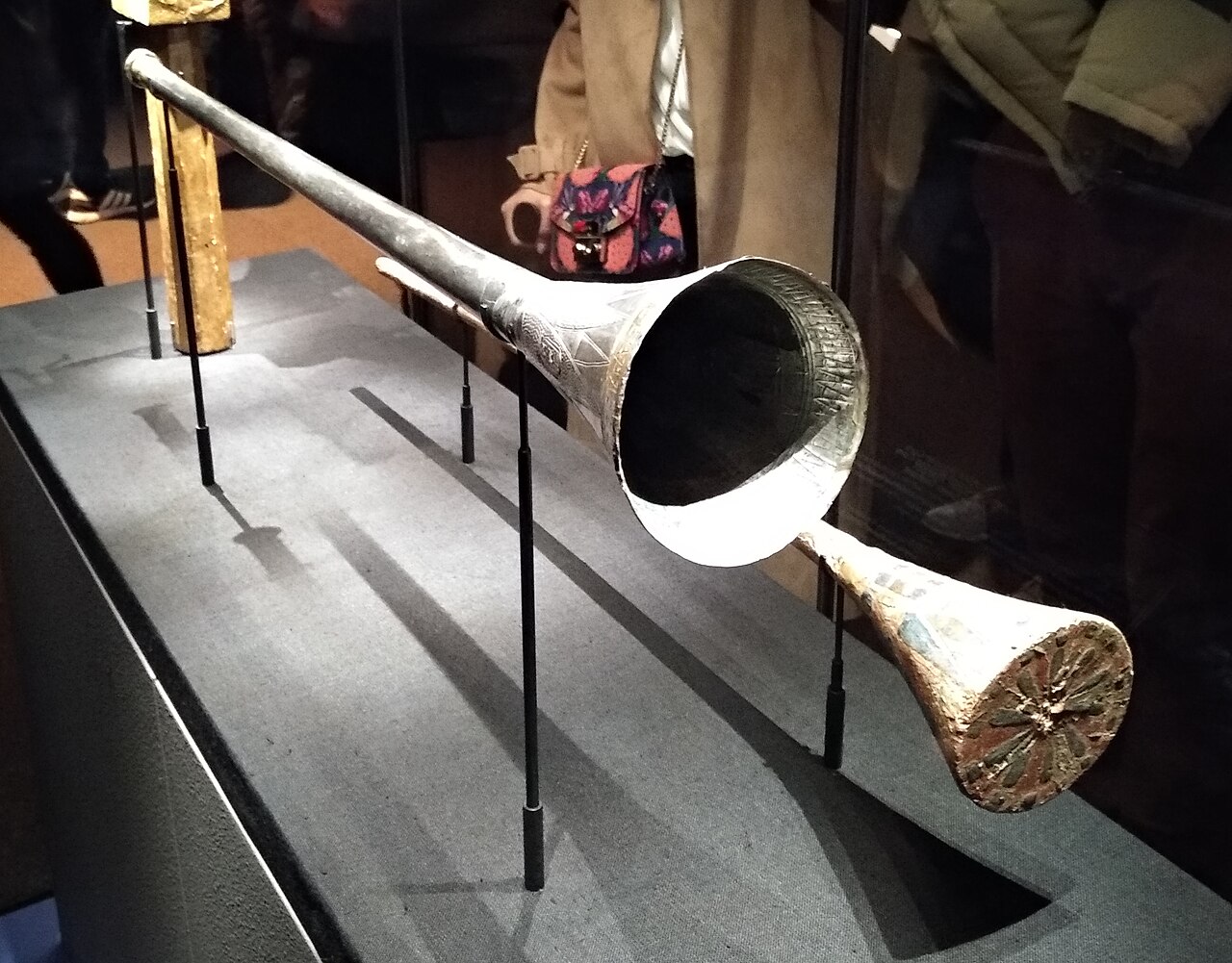
Two trumpets were found in Tutankhamun's tomb (c. 1323 BC): one of silver, one of bronze or copper, with wooden stoppers. They are the oldest playable trumpets in the world, and were sounded on BBC radio in 1939. They show what a Late Bronze Age silver trumpet, "of a whole piece," looked like. Egyptian trumpets were used in war and in religious processions.
The Temple trumpets appear among the spoils on the Arch of Titus in Rome, leaning against the table of the bread. The Dead Sea Scrolls' War Scroll describes trumpets inscribed with slogans for each stage of battle; Bar Kokhba revolt coins show a pair of trumpets.
The upside-down letters
In Hebrew Bibles, Numbers 10:35–36 is framed by two inverted letter nuns (׆). The Talmud records a debate: the marks show that the passage is out of place (belonging after the camp arrangement in chapter 2), or that these two verses are a book of their own, making the Torah seven books rather than five. In many Septuagint manuscripts, the verse about the cloud (10:34) comes after the two prayers instead of before them. Follow the passage to see the witnesses.
"Let God arise"
Moses' first prayer opens Psalm 68: "Let God arise, let his enemies be scattered." The prayers became part of the synagogue service: "Rise up, LORD" is sung when the Torah scroll is taken out of the ark, and "Return, O LORD" when it is put back.
A second chance, within limits
The "second Passover" (Pesach Sheni) is the only festival given a make-up date, and only for the unclean or the traveler. King Hezekiah used the same principle when the priests were not ready (2 Chronicles 30:2–3, 18–20): "The good LORD pardon every one that prepareth his heart to seek God." Jews still mark the 14th of the second month (Iyar) as Pesach Sheni.
Trumpets and shofars
The silver trumpets (chatsotsrot) are made by craftsmen and blown by priests. They are different from the shofar, a natural ram's horn, which anyone could blow and which sounded at Sinai and at Jericho.
Who was Hobab?
Numbers 10:29 calls Hobab "the son of Raguel [Reuel] the Midianite, Moses' father in law"; Judges 4:11 calls Hobab himself "the father in law of Moses"; Exodus calls Moses' father-in-law Reuel (2:18) and Jethro (3:1; 18:1). Interpreters suggest that Jethro and Reuel are one man with two names and Hobab his son; that Reuel was Zipporah's grandfather; or that the Hebrew word can mean a broader in-law. The Bible does not settle it, and we do not either.
The Case for the Biblical Account
Scripture's account
A second Passover; the cloud guides Israel; silver trumpets signal the camp; the ark leads the march from Sinai (Numbers 9–10).
What evidence would we expect?
Metal trumpets for signals in war and worship; scribal traditions marking special passages.
The discoveries
Tutankhamun's silver trumpet; Temple trumpets on the Arch of Titus; the War Scroll's trumpets; the inverted nuns of the Masoretic tradition and the different order in the Greek.
Testing the discoveries
The trumpets show the technology existed in the Late Bronze Age. The scribal marks are ancient (attested in the Talmud and Sifre) but their meaning was debated even then.
The strongest reconstruction
Numbers 10 fits an ancient world of signal trumpets and processional shrines; its text carries one of the oldest scribal puzzles in the Torah.
What remains possible
Why the passage was marked: misplacement, an independent "book," or emphasis.
What the evidence shows
- A silver trumpet was found in Tutankhamun's tomb.Source: The silver and bronze trumpets of Tutankhamun (Egyptian Museum, Cairo), found by Howard Carter in 1922–23
- Numbers 10:35–36 is framed by inverted nuns in the Masoretic tradition.Source: Babylonian Talmud, Shabbat 115b–116a; Sifre Numbers 84; "Inverted nun" ↗
- Numbers 10:35–36 was originally a separate book.Source: Babylonian Talmud, Shabbat 115b–116a; Sifre Numbers 84; "Inverted nun" ↗
- The relationship of Hobab, Reuel and Jethro is settled.
- A physical ark of the covenant can be recovered today. See the Ark investigation.
- "Rise up, LORD, and let thine enemies be scattered."
Continue the journey
Journey of a PassageNumbers 10:35–36: Two verses between upside-down lettersIn Hebrew Bibles, Moses' two prayers when the ark moved and rested are set apart by inverted nun letters.More from this lesson
Why this matters to the rest of Scripture
- "Let God arise, let his enemies be scattered."
- "Arise, O LORD, into thy rest; thou, and the ark of thy strength."
- Trumpets at Jericho.
- "The trumpet shall sound."
- The cloud by day and fire by night.
- Hezekiah's Passover in the second month.
- Hobab, of the Kenites.