Era 4 · Covenant and WildernessNumbers
Balaam and the Donkey
"The word that God putteth in my mouth, that shall I speak"
Israel camps on the plains of Moab. Balak son of Zippor, king of Moab, is terrified: "Now shall this company lick up all that are round about us, as the ox licketh up the grass of the field." He sends elders of Moab and Midian with fees for divination to "Balaam the son of Beor to Pethor, which is by the river": "Come now therefore, I pray thee, curse me this people… for I wot that he whom thou blessest is blessed, and he whom thou cursest is cursed."
God comes to Balaam at night: "Thou shalt not go with them; thou shalt not curse the people: for they are blessed." Balak sends more important princes and promises great honor. Balaam answers, "If Balak would give me his house full of silver and gold, I cannot go beyond the word of the LORD my God", yet asks again. God says: go, "but yet the word which I shall say unto thee, that shalt thou do."
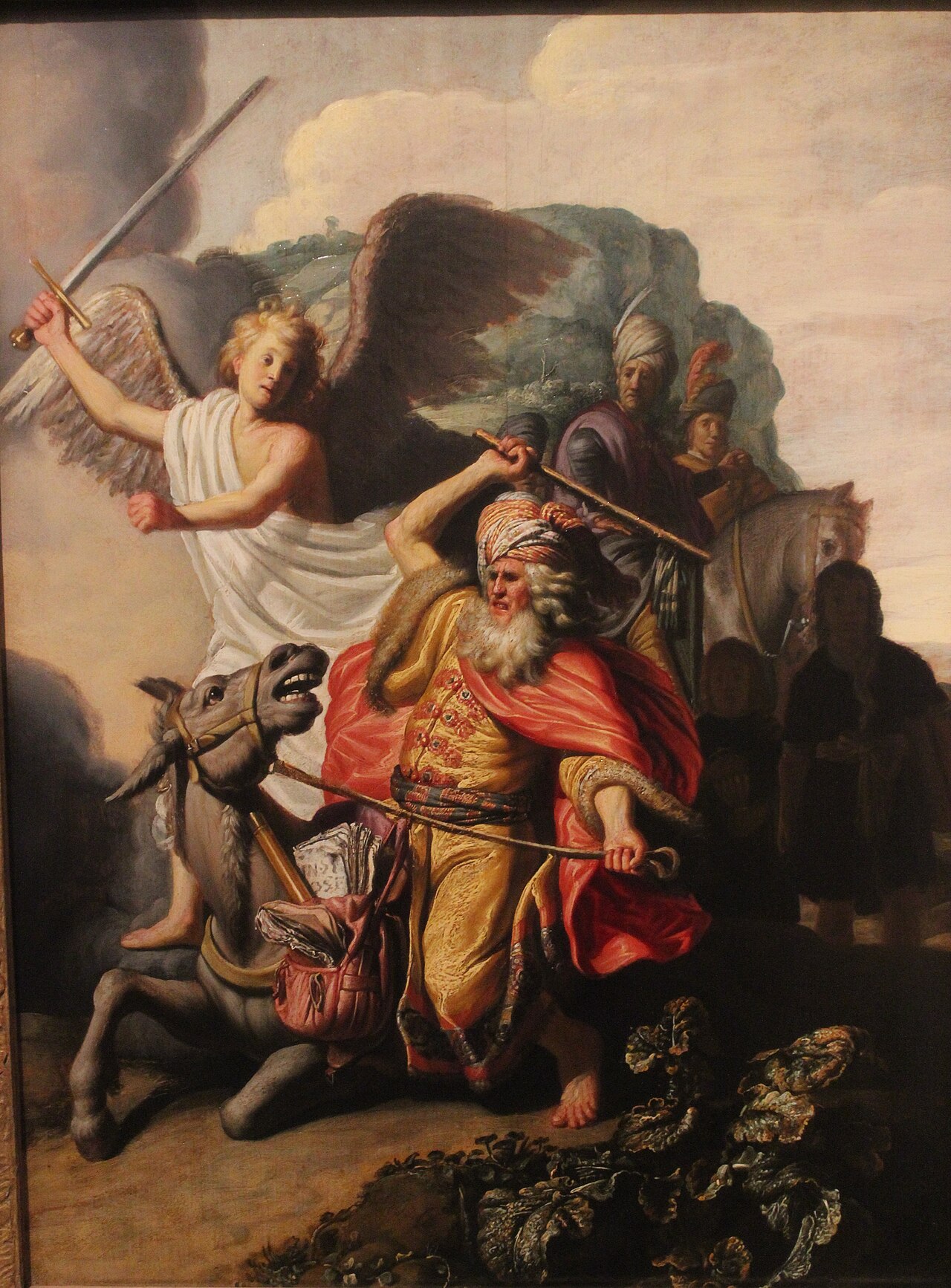
On the road, the angel of the LORD stands in the way with a drawn sword. The donkey sees him and turns into a field; Balaam beats her. In a narrow path between vineyard walls she crushes his foot against the wall; he beats her again. Where there is no room to turn, she lies down; he beats her with his staff.
"And the LORD opened the mouth of the ass, and she said unto Balaam, What have I done unto thee, that thou hast smitten me these three times?" Balaam: "Because thou hast mocked me: I would there were a sword in mine hand, for now would I kill thee." Then God opens Balaam's eyes, and he sees the angel. "I have sinned… if it displease thee, I will get me back again." "Go with the men: but only the word that I shall speak unto thee, that thou shalt speak."
Balak meets him at the border of Moab, at the Arnon: "Am I not able indeed to promote thee to honour?" Balaam answers, "Lo, I am come unto thee: have I now any power at all to say any thing? the word that God putteth in my mouth, that shall I speak." Balak offers sacrifices and the next morning takes him up to the high places of Baal, where he can see the edge of Israel's camp.
Pethor by the river
"The river" in the Bible usually means the Euphrates. Pethor is generally identified with Pitru, on the Sajur river near its junction with the Euphrates, named in the annals of the Assyrian king Shalmaneser III (9th century BC). Deuteronomy 23:4 says Balaam came "from Pethor of Mesopotamia [Aram-naharaim]." Some ancient versions read "the land of the children of Ammon" for "the land of the children of his people" in 22:5, which would place him closer. Either way, Balaam was an internationally known seer.
Seers for hire
Kings across the ancient Near East consulted diviners and prophets before battle and sought curses on enemies. Letters from Mari (18th century BC) report prophets' messages to King Zimri-Lim; Neo-Assyrian prophecies were collected for Esarhaddon; Egyptian Execration Texts wrote enemies' names on figurines and pots that were then smashed. Balak's request was standard royal practice. And Balaam was famous enough that, centuries later, his name was written on a wall east of the Jordan.
A talking animal
Talking animals appear in ancient stories: in the Egyptian Tale of Two Brothers, cows warn their herdsman of danger; in Genesis, the serpent speaks. The point in Numbers is irony: the animal sees God's messenger, the professional seer does not. 2 Peter 2:16 recalls "the dumb ass speaking with man's voice forbad the madness of the prophet."
Balaam on a wall
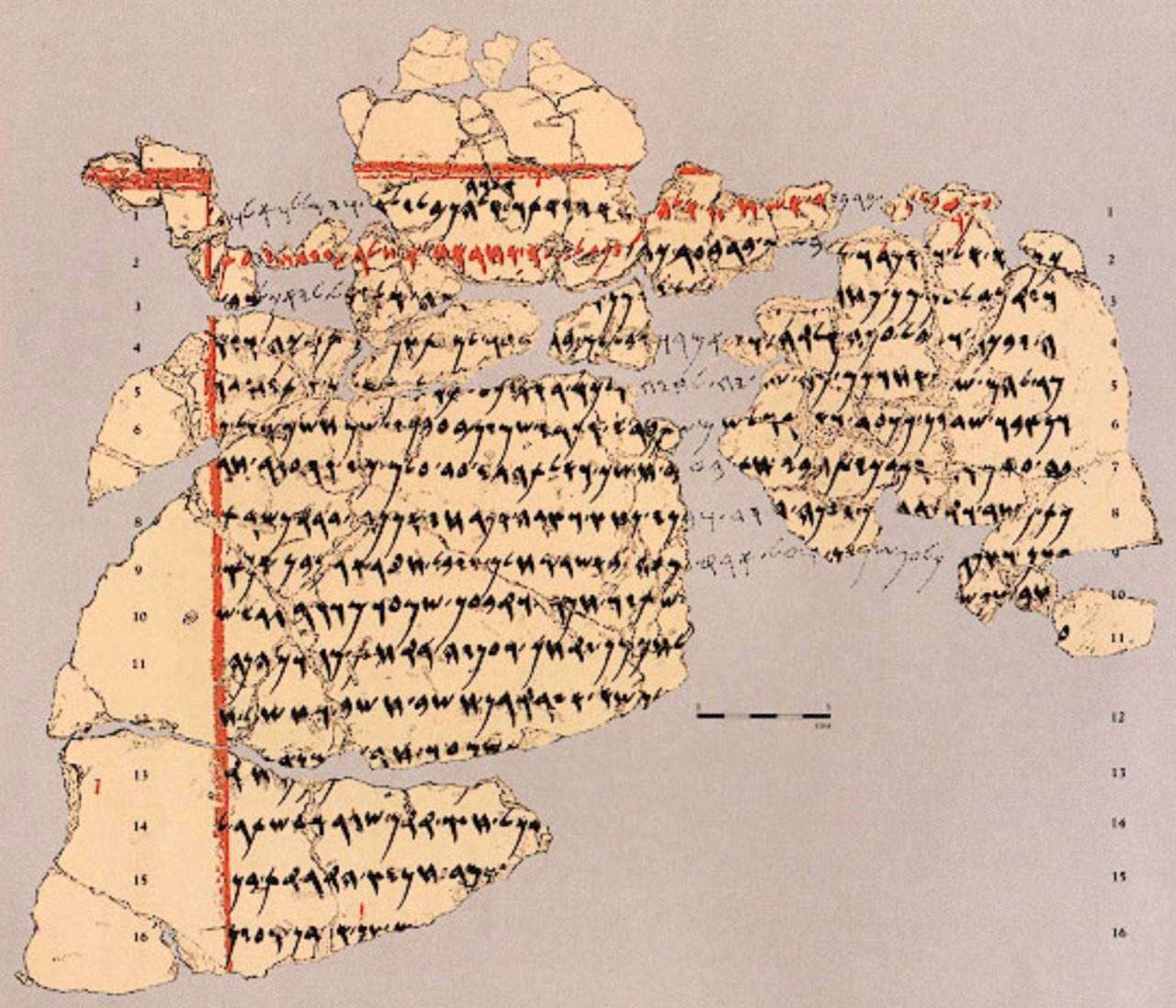
In 1967 a Dutch team digging at Tell Deir Alla in the Jordan valley, near where the Jabbok enters the Jordan and not far from the plains of Moab, found fragments of plaster written in black and red ink: "the book of Balaam son of Beor… a seer of the gods." It is the first text outside the Bible to name a biblical prophet. It is not a copy of Numbers: it tells a different vision, and it never mentions Israel, Balak or a donkey.
The discovery
Tell Deir Alla (often identified with biblical Succoth or Penuel) was excavated by a Dutch team under H. J. Franken from 1960. In March 1967 they found 119 fragments of inscribed plaster in the ruins of a multi-room building destroyed by an earthquake; a loom with fine textile lay in the next room. Jacob Hoftijzer and Gerrit van der Kooij published the texts in 1976. The fragments are in the Jordan Archaeological Museum in Amman. Other inscriptions were also found at Deir Alla, so a photograph labeled "Deir Alla inscription" is not necessarily the Balaam text.
How it was written
The text was written in black ink, with red ink for headings and emphasis, in columns framed like the page of a scroll, as if a book had been copied onto the wall. Scholars assemble the fragments into two "combinations." Combination I tells Balaam's night vision; Combination II, more broken, speaks of death, Sheol and a child.
The date
The inscription is conventionally dated about 800 BC, from the building's destruction by earthquake and the style of the script. Estimates range from the late 9th century into the 8th, and some researchers prefer a date as late as 750–700 BC. On any of these dates it is centuries after the time Numbers describes, and it is roughly as old as, or older than, most scholars' dates for the written book of Numbers.
What language?
The script is Aramaic-like, and some grammar is Aramaic ("bar" for son), but much of the vocabulary and grammar is Canaanite. Scholars call it early Aramaic, a local "Gileadite" dialect, or, with Holger Gzella, a Canaanite story written down in literary Aramaic. That mix fits a crossroads region between Israel, Ammon and Aram.
Compared with Numbers
| Numbers 22–24 | Deir Alla | |
|---|---|---|
| Name | Balaam son of Beor | Balaam son of Beor |
| Role | A seer hired to curse | "A seer of the gods" |
| Revelation | God comes to him at night (22:9, 20) | The gods come to him at night |
| Divine names | God, the LORD, the Almighty (Shaddai, 24:4) | The gods (elohin), the Shaddayin, El, a goddess Shagar-and-Ishtar |
| Message | Blessing on Israel | A coming darkness and disaster; Balaam weeps |
| Israel | Central | Not mentioned |
| Morning | "Balaam rose up in the morning" (22:13, 21) | "Balaam rose in the morning" |
The Case for the Biblical Account
Scripture's account
Balak hires Balaam to curse Israel; God restrains him; the donkey and the angel (Numbers 22).
What evidence would we expect?
Professional seers and curse rituals in the ancient Near East; a place called Pethor; Balaam as a known figure outside the Bible.
The discoveries
Mari and Assyrian prophetic texts; Execration Texts; Pitru in Shalmaneser III's annals; the Deir Alla plaster inscription (c. 800 BC, possibly later) naming "Balaam son of Beor" as "a seer of the gods" who receives night visions from a divine council including the Shaddayin.
Testing the discoveries
The inscription is authentic and was found in a controlled excavation. It is centuries later than the setting of Numbers, tells a different vision, and does not mention Balak, Israel or the donkey.
The strongest reconstruction
Balaam was a well-known seer in Transjordanian tradition. Numbers and Deir Alla independently preserve his name, his father's name, his role and his night revelations. Numbers uses this real figure of regional memory to show that God alone controls blessing and cursing.
What remains possible
That Balaam lived as Numbers describes; that a famous seer's legend was told in Israel and Transjordan in different ways; or both.
What the evidence shows
- Mari letters and Assyrian archives preserve messages from prophets to kings.Source: M. Nissinen, Prophets and Prophecy in the Ancient Near East (2003; 2nd ed. 2019)
- Pethor is Pitru near the Euphrates.Source: Pethor = Pitru on the Sajur river, named in the annals of Shalmaneser III (9th century BC)
- A plaster inscription found at Deir Alla in 1967 names "Balaam son of Beor… a seer of the gods."Source: J. Hoftijzer and G. van der Kooij, Aramaic Texts from Deir ʿAlla (1976); J. A. Hackett, The Balaam Text from Deir ʿAllā (1984); Deir Alla inscription, record and images (Zenodo) ↗
- The inscription dates to about 800 BC. Some prefer the 8th century, as late as 750–700 BC.Source: "The Deir Alla Inscription" (Biblical Archaeology Society sidebar) ↗; "Deir Alla inscription" (overview with bibliography) ↗
- It is the first text outside the Bible to name a prophet known from the Bible.
- The Deir Alla text describes the events of Numbers 22–24. It tells a different story and does not mention Israel, Balak or the donkey.
- Balaam was a historical person.
- The angel of the LORD stood in Balaam's way.
Continue the journey
Ancient MysteriesBalaam Son of Beor at Deir AllaDoes a plaster inscription from the Jordan valley prove that the Bible's Balaam was real?More from this lesson
Investigations
Optional deep dives: the ancient sources, the physical evidence, and every interpretation side by side, including unconventional ones, each labeled for what it is.
Balaam Son of Beor at Deir AllaInscription: authentic · Name and role: match Numbers · Events of Numbers: not mentioned
Does a plaster inscription from the Jordan valley prove that the Bible's Balaam was real?
In 1967 Dutch archaeologists found fragments of an ink inscription on plaster at Tell Deir Alla, east of the Jordan: "the book of Balaam son of Beor, who was a seer of the gods." Conventionally dated about 800 BC (some prefer the 8th century, as late as 750–700 BC), it is the first text outside the Bible to name a prophet known from the Bible. It shows Balaam was a famous seer in the region's own tradition. It does not confirm the events of Numbers.
Open the full investigation →Echoes Across Civilizations
Optional: how other ancient peoples told similar stories. Open one to compare, then come back to the lesson.
Seers, prophets and curses for hireTransjordan · Mari · Egypt · Assyria
Did kings in Israel's world hire seers and prophets, and curse their enemies?
- Transjordan: The Deir Alla plaster inscription ("the book of Balaam son of Beor") Possible historical contact
- Mari: The prophetic letters of Mari Shared literary world
- Egypt: The Execration Texts Resemblance only
- Assyria: Neo-Assyrian prophecies to Esarhaddon Possible historical contact
Why this matters to the rest of Scripture
- "The LORD thy God turned the curse into a blessing unto thee."
- "I would not hearken unto Balaam."
- "Remember now what Balak… consulted, and what Balaam… answered."
- Balaam "loved the wages of unrighteousness."
- "I will bless them that bless thee, and curse him that curseth thee."
- Balaam killed among the kings of Midian.
- "Balaam also the son of Beor, the soothsayer."