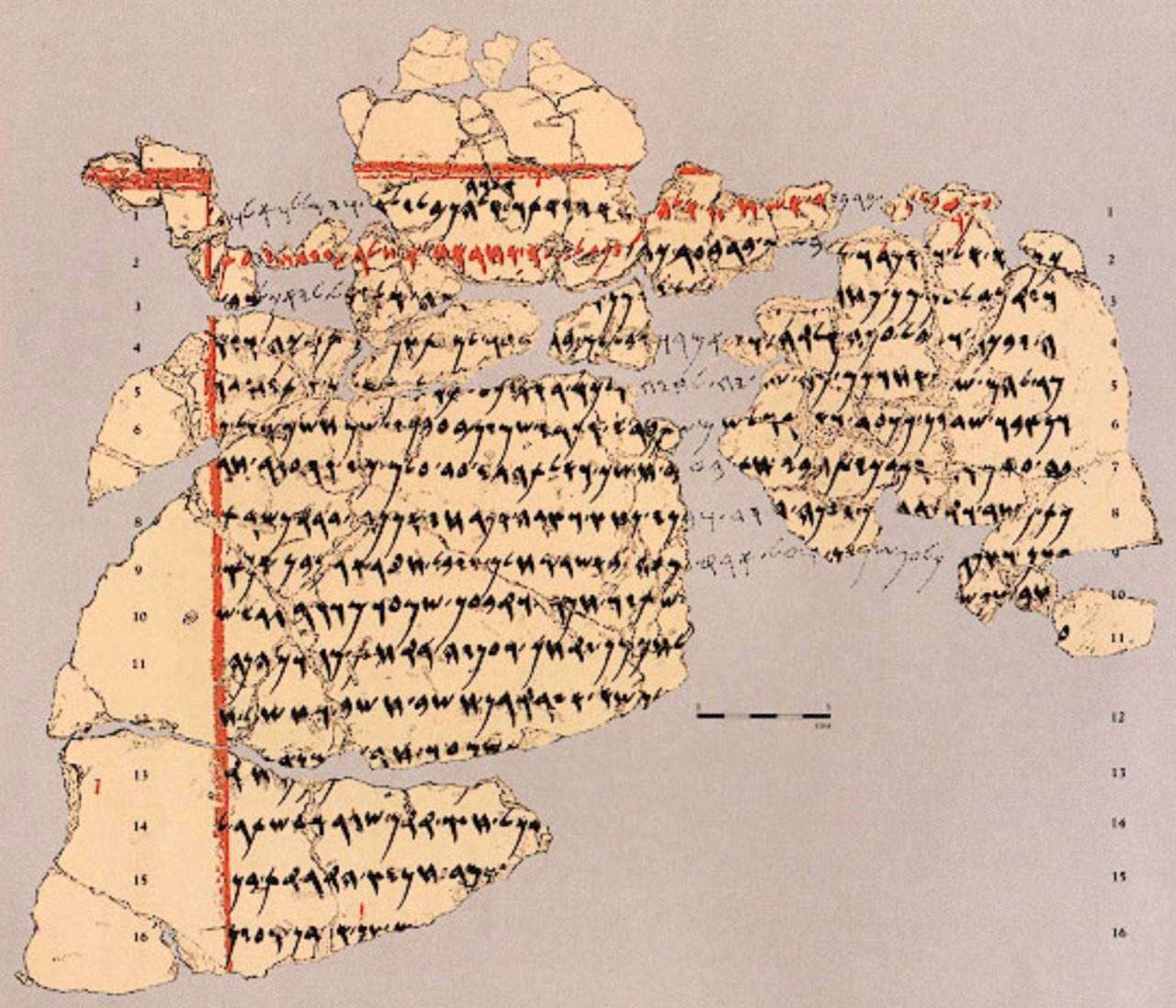
Balaam son of Beor, "a seer of the gods," receives a night vision of the gods in council, including the Shaddayin, and weeps at the disaster announced: darkness covering the heavens and the world turned upside down.
Similar
The same name and father: Balaam son of Beor
A seer receiving divine messages at night
"Shaddayin" beside the biblical "Almighty" (Shaddai, Numbers 24:4)
"Balaam rose in the morning"
Different
Many gods and a goddess
Announces disaster, not blessing
No Israel, Moab or donkey
Read it: J. Hoftijzer and G. van der Kooij, Aramaic Texts from Deir ʿAlla (1976)
Mari · Middle Euphrates, Syria
The prophetic letters of Mari
Shared literary world
Composed
18th century BC
Earliest surviving copy
Clay tablets from the palace of Zimri-Lim
Officials report to King Zimri-Lim messages from prophets and ecstatics (āpilum, muḫḫûm), and from dreams, often about enemies and wars; prophets were paid or rewarded.
Similar
Prophets advising kings about enemies
Messages received in dreams at night
Prophets from the Euphrates region, Balaam's homeland
Different
Messages from many gods
No hired curse in the same form
Read it: M. Nissinen, Prophets and Prophecy in the Ancient Near East (2003)
Egypt · Egypt
The Execration Texts
Resemblance only
Composed
19th–18th centuries BC
Earliest surviving copy
Inscribed bowls and figurines (Berlin, Brussels, Cairo)
The names of foreign rulers and peoples, including Canaanite cities, were written on pots or figurines of bound captives, which were then smashed or buried to curse them.
Similar
Ritual cursing of foreign enemies by name
Different
Magic by destroying objects, not a seer's spoken oracle
Assyria · Mesopotamia
Neo-Assyrian prophecies to Esarhaddon
Possible historical contact
Composed
7th century BC
Earliest surviving copy
Tablets from Nineveh
Oracles of Ishtar of Arbela through prophets, collected on tablets, promise the king victory over his enemies: "Fear not, Esarhaddon."
Balaam and the Donkey →Balak, king of Moab, sends for a famous seer from the Euphrates to curse Israel. God tells Balaam not to go, then lets him go on condition he speaks only God's word. On the road his donkey sees an angel he cannot, and speaks. Outside the Bible, a plaster inscription from Deir Alla in the Jordan valley names the same "Balaam son of Beor, a seer of the gods."
Prophecy, Divination, and Moses' Successor →The priests and Levites live from the offerings. Every form of divination is forbidden: no augurs, no sorcerers, no consulting the dead. Instead, God will raise up a prophet like Moses. And a test: a prophet whose word does not come true has not been sent by God.
Samuel's Call →In days when the word of the LORD was rare, the boy Samuel sleeps in the sanctuary near the ark. Three times he hears his name and runs to Eli. Eli realizes it is the LORD. The fourth time Samuel answers, "Speak; for thy servant heareth," and receives a hard message against Eli's house. All Israel comes to know that Samuel is a prophet.
Saul and the Lost Donkeys →Saul, the tall son of Kish of Benjamin, searches for his father's lost donkeys. When he is ready to give up, his servant suggests asking the seer in the next town. God has told Samuel the day before that he will send a man of Benjamin to be prince over Israel. Samuel seats Saul at the head of the feast and keeps him overnight.
Saul Anointed and Chosen →Samuel privately anoints Saul with oil and gives him three signs, the last a band of prophets at Gibeah; Saul prophesies with them. Then at Mizpah the tribes are chosen by lot: Benjamin, the clan of Matri, Saul, who is found hiding among the baggage. "God save the king." Some worthless men despise him.