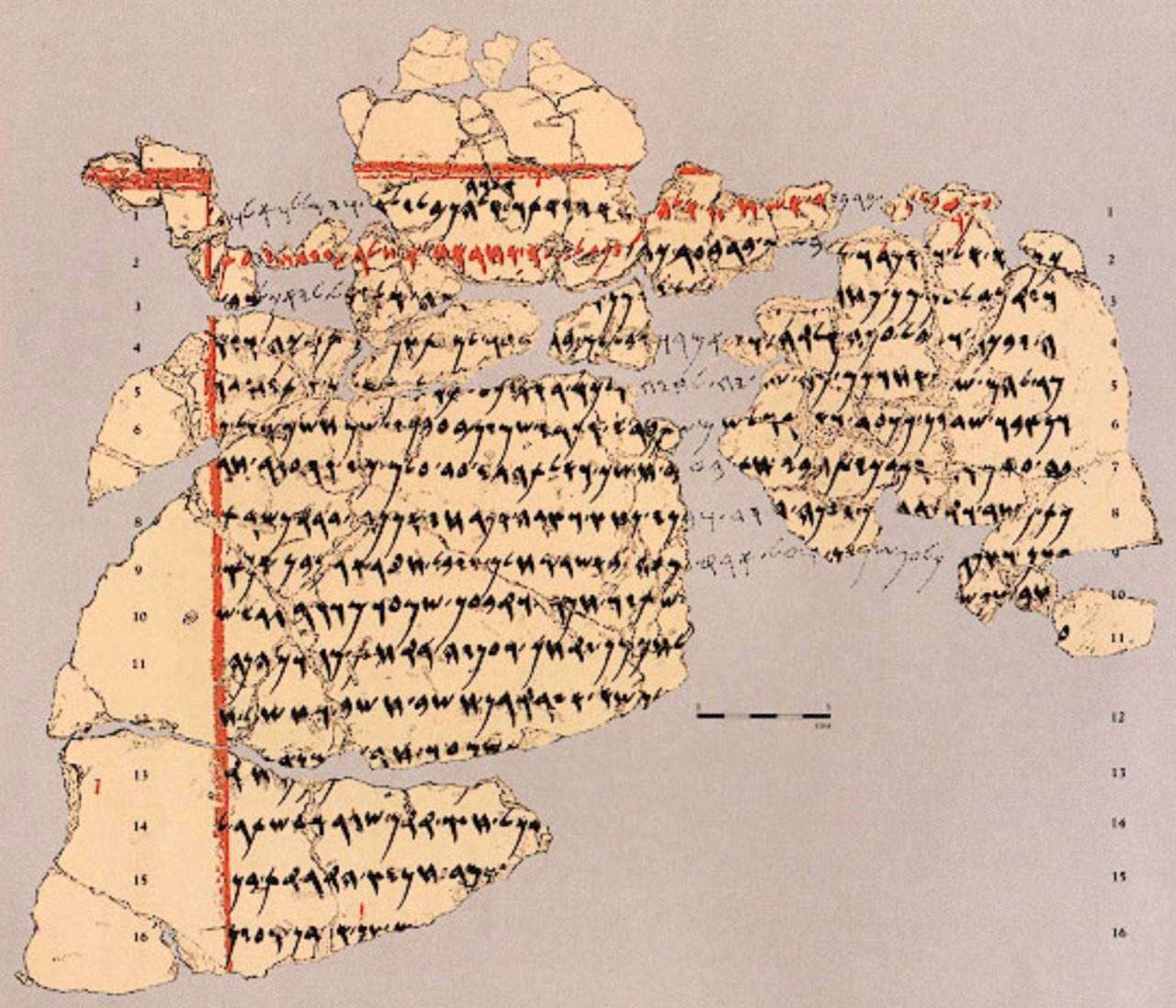
In 1967 Dutch archaeologists found fragments of an ink inscription on plaster at Tell Deir Alla, east of the Jordan: "the book of Balaam son of Beor, who was a seer of the gods." Conventionally dated about 800 BC (some prefer the 8th century, as late as 750–700 BC), it is the first text outside the Bible to name a prophet known from the Bible. It shows Balaam was a famous seer in the region's own tradition. It does not confirm the events of Numbers.
Inscription: authentic · Name and role: match Numbers · Events of Numbers: not mentioned
Authentic ancient artifactA transcription of the Deir Alla inscription, Combination I, naming "Balaam son of Beor" (original c. 800 BC, Jordan Archaeological Museum, Amman).Image credit
1 What Scripture says
"He sent messengers therefore unto Balaam the son of Beor to Pethor, which is by the river" (Numbers 22:5). "God came unto Balaam at night" (22:20). "He hath said, which heard the words of God, which saw the vision of the Almighty [Shaddai]" (24:4). "Balaam also the son of Beor, the soothsayer, did the children of Israel slay with the sword" (Joshua 13:22).
2 What evidence we might expect
If Balaam was a real, famous seer, traditions about him might survive outside Israel.
Those traditions would likely portray him in their own religious terms, not Israel's.
3 What ancient sources survive
The Deir ʿAlla plaster texts (Combinations I and II)
Language
Debated: early Aramaic, a local Canaanite (Gileadite) dialect, or a Canaanite story in literary Aramaic
Composed
Conventionally c. 800 BC; estimates run from the late 9th century to the 8th, some as late as 750–700 BC
Oldest surviving copy
119 plaster fragments, Jordan Archaeological Museum, Amman
Status
Non-biblical text, apparently a copy of a book or story
Written in black ink with red for headings and emphasis, in columns framed like a scroll.
Source: J. Hoftijzer and G. van der Kooij, Aramaic Texts from Deir ʿAlla (Leiden, 1976); The Balaam Text from Deir ʿAlla Re-evaluated (1991); J. A. Hackett, The Balaam Text from Deir ʿAllā (1984)
4 What discoveries exist
The discovery
Tell Deir ʿAlla lies in the Jordan valley near the Jabbok river. A Dutch team led by H. J. Franken excavated there from 1960. In March 1967 they found the plaster fragments in a multi-room building destroyed by an earthquake, with a loom and fine textile in an adjoining room. Jacob Hoftijzer and Gerrit van der Kooij published them in 1976, and a 1989 Leiden symposium re-examined them.
Authentic ancient artifactA transcription of the Deir Alla inscription, Combination I, naming "Balaam son of Beor" (original c. 800 BC, Jordan Archaeological Museum, Amman).Image credit
What it says (Combination I, abridged)
"The misfortunes of the book of Balaam son of Beor, who was a seer of the gods. The gods came to him at night, and he saw a vision like an oracle of El. They said to Balaam son of Beor: Thus will it be done… And Balaam rose in the morning… he fasted and wept bitterly. His people came to him and said: Why do you weep? He said to them: Sit down, I will tell you what the Shaddayin have done. The gods gathered, and the Shaddayin met in council, and said to Shagar[-and-Ishtar]: Sew up the heavens with your thick cloud, let there be darkness and not light…" Then follows a scene of the world reversed: the swallow defies the eagle, the poor mock the rich.
Side by side
Feature
Numbers
Deir ʿAlla
Name
Balaam son of Beor
Balaam son of Beor
Title
One who sees the vision of Shaddai
Seer of the gods
Revelation
God comes at night
The gods come at night
Divine beings
God (El), the LORD, Shaddai
El, the gods, the Shaddayin, Shagar-and-Ishtar
Morning
"Balaam rose up in the morning"
"Balaam rose in the morning"
Message
Blessing Israel
Calamity; the heavens darkened
Place
Moab, near the Jordan
Found in the Jordan valley, near Gilead
5 How interpretations compare
Traditional reading
A real prophet, remembered
Balaam was a historical seer whose fame lasted centuries in Transjordan. Numbers records his encounter with Israel; Deir ʿAlla preserves a different story of the same man.
Assessment: Consistent with the evidence. The inscription cannot confirm the Numbers events, but it shows Balaam was not a biblical invention.
Scholarly reconstruction
A legendary seer
Balaam was a famous figure of regional legend; Israel and its neighbors told different stories about him. Numbers adapted him to show the LORD's power over foreign prophecy.
Source: J. A. Hackett, The Balaam Text from Deir ʿAllā (1984); P. K. McCarter, "The Balaam Texts from Deir ʿAllā: The First Combination," BASOR 239 (1980)
Scholarly reconstruction
Evidence of shared religion
The Shaddayin and El in the inscription, beside Shaddai and El in Balaam's oracles, show the religious vocabulary Israel shared with its Transjordanian neighbors.
Source: J. Hoftijzer and G. van der Kooij, Aramaic Texts from Deir ʿAlla (Leiden, 1976); The Balaam Text from Deir ʿAlla Re-evaluated (1991)
6 The strongest supported reconstruction
The Deir ʿAlla inscription is authentic, excavated, and dated about 800 BC or somewhat later. It is not a manuscript of Numbers and tells a different vision. It names Balaam son of Beor as a seer who received night visions from the gods. It confirms that Balaam was a celebrated figure east of the Jordan, the region where Numbers sets his story, and shares striking details with Numbers. It neither mentions Israel nor retells Numbers 22–24.
7 What remains possible or unknown
The exact language and date of the text.
Whether the wall text copied an older book of Balaam.
How Combination II, about death and Sheol, relates to Combination I.
8 How this material came to us
After its discovery, the text was reconstructed from fragments by several scholars (Hoftijzer, Caquot and Lemaire, McCarter, Hackett, Levine, Weippert), with different readings of broken lines. The core lines naming Balaam are secure.
What the evidence shows
Independently documentedThe Deir ʿAlla inscription names "Balaam son of Beor… a seer of the gods."
Conflicts with current evidencePhotographs labeled "Deir Alla inscription" always show the Balaam text. Other inscriptions were found at the site; check the object.