"And Rehoboam went to Shechem: for all Israel were come to Shechem to make him king." Jeroboam returns from Egypt. "Thy father made our yoke grievous: now therefore make thou the grievous service of thy father, and his heavy yoke which he put upon us, lighter, and we will serve thee."
The old men advise: "If thou wilt be a servant unto this people this day… then they will be thy servants for ever." The young men who grew up with him say: "My little finger shall be thicker than my father's loins… my father hath chastised you with whips, but I will chastise you with scorpions." Rehoboam speaks roughly. "What portion have we in David?… to your tents, O Israel: now see to thine own house, David." They stone Adoram, "who was over the tribute"; Rehoboam flees to Jerusalem. Israel makes Jeroboam king; only Judah (with Benjamin) follows David's house.
Rehoboam gathers 180,000 men, but the word of God comes to Shemaiah: "Ye shall not go up, nor fight against your brethren… for this thing is from me." Jeroboam builds Shechem and Penuel. "If this people go up to do sacrifice in the house of the LORD at Jerusalem, then shall the heart of this people turn again unto their lord." He makes two calves of gold: "Behold thy gods, O Israel, which brought thee up out of the land of Egypt." One at Bethel, one at Dan. He makes priests who were not Levites and a feast in the eighth month, "which he had devised of his own heart."
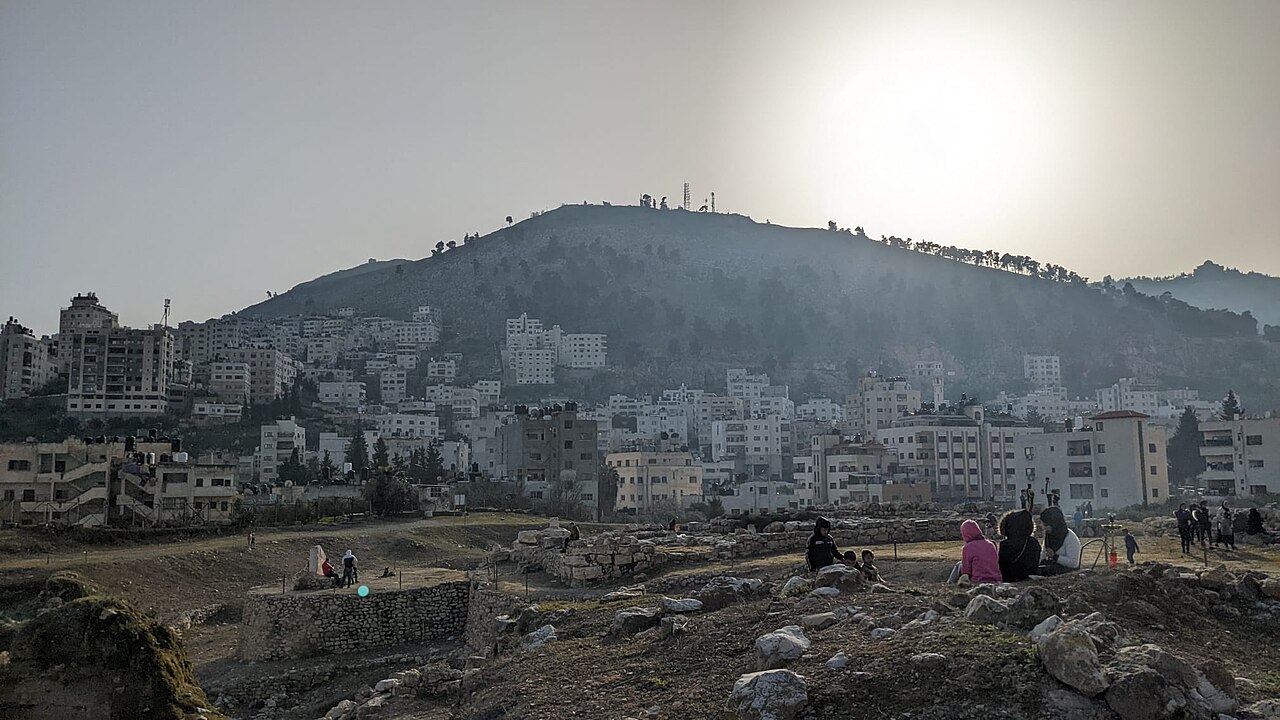
Shechem
Tel Balata near Nablus is securely identified as Shechem, with a Middle Bronze Age fortress-temple and Iron Age occupation. It had been the place of covenant renewal under Joshua (Joshua 24) and of Abimelech's kingship (Judges 9).
The calves of Bethel and Dan
At Tel Dan, Avraham Biran excavated a large Iron Age sacred precinct with a platform ("high place"), an altar area and cultic objects, which he linked to Jeroboam's sanctuary. Bethel is usually placed at Beitin, though the identification has been questioned. The calves' meaning is debated: images of Israel's God, or pedestals on which an invisible God stood, as cherubim were in Jerusalem. Bull imagery was used for several gods in the region (El, Baal-Hadad). The Bible's description reflects Jerusalem's judgment of a rival sanctuary; it does not show that the calves were statues of Baal.
A second version of Jeroboam's story
The Greek 3 Kingdoms has, after 12:24, a long additional account of Jeroboam (12:24a–z): a different sequence, with his Egyptian marriage, his son's illness and Shemaiah (not Ahijah) tearing a garment. It is not in the library's digital Greek text and has not been checked by the site. See the passage page.
The Case for the Biblical Account
Scripture's account
The division of the kingdom (1 Kings 12).
What evidence would we expect?
Two kingdoms from the late 10th century BC; northern sanctuaries at Dan and Bethel.
The discoveries
Tel Dan's sacred precinct; the 9th-century Tel Dan Stele naming a king of Israel and the House of David as separate kingdoms; Assyrian references to Israel and Judah.
Testing the discoveries
Two kingdoms are well attested by the 9th century; the events of 12:1–20 are known only from the Bible.
The strongest reconstruction
A northern revolt against Jerusalem's labor demands; the narrator writes from Judah's perspective.
What remains possible
The size and nature of the kingdom before the division; the date of the Tel Dan precinct phases.
What the evidence shows
- Israel and Judah were separate kingdoms by the 9th century BC.Source: The Jewish Museum, "Tel Dan Stele" ↗
- Tel Dan had an Iron Age cultic precinct.
- Jeroboam's calves represented Baal.
- The Greek 12:24a–z is a separate version of Jeroboam's rise. Reported; not in the library's digital Greek.Source: M. A. Sweeney, "A Reassessment of the Masoretic and Septuagint Versions of the Jeroboam Narratives" (2007) ↗
Continue the journey
Journey of a Passage1 Kings 12:24 (3 Kingdoms 12:24a–z): A second story of JeroboamAfter 12:24 the Greek 3 Kingdoms tells the story of Jeroboam's rise a second time, differently: his mother is a prostitute named Sarira, he marries Pharaoh's sister-in-law Ano, his son falls sick before the division, and the prophet who tears a garment is Shemaiah, not Ahijah.More from this lesson
Investigations
Optional deep dives: the ancient sources, the physical evidence, and every interpretation side by side, including unconventional ones, each labeled for what it is.
The Sanctuaries of Bethel and DanTel Dan precinct: documented · Bethel sanctuary: not found · Meaning of the calves: debated
What did Jeroboam's golden calves represent, and what has been found?
Jeroboam set up golden calves at Bethel and Dan. At Tel Dan, Avraham Biran excavated a large sacred precinct with a raised platform and altar area. Bethel (probably Beitin) has not produced its sanctuary. The calves may have been images of Israel's God or pedestals for an invisible God; the text's charge of idolatry reflects Jerusalem's view.
Open the full investigation →Echoes Across Civilizations
Optional: how other ancient peoples told similar stories. Open one to compare, then come back to the lesson.
Bulls, gods and sanctuariesCanaanite / Ugaritic · Israelite · Egyptian
What did bull images mean in the ancient Near East?
- Canaanite / Ugaritic: El the bull; Baal-Hadad with the bull Shared literary world
- Israelite: The "Bull Site" bronze bull Possible historical contact
- Egyptian: The Apis bull Resemblance only
Why this matters to the rest of Scripture
- "These be thy gods, O Israel."
- "We have no part in David."
- The Chronicler's version.
- Hosea 8:5–6; 10:5Hosea on the calf of Samaria and Beth-aven.
- Bethel, "the king's chapel."