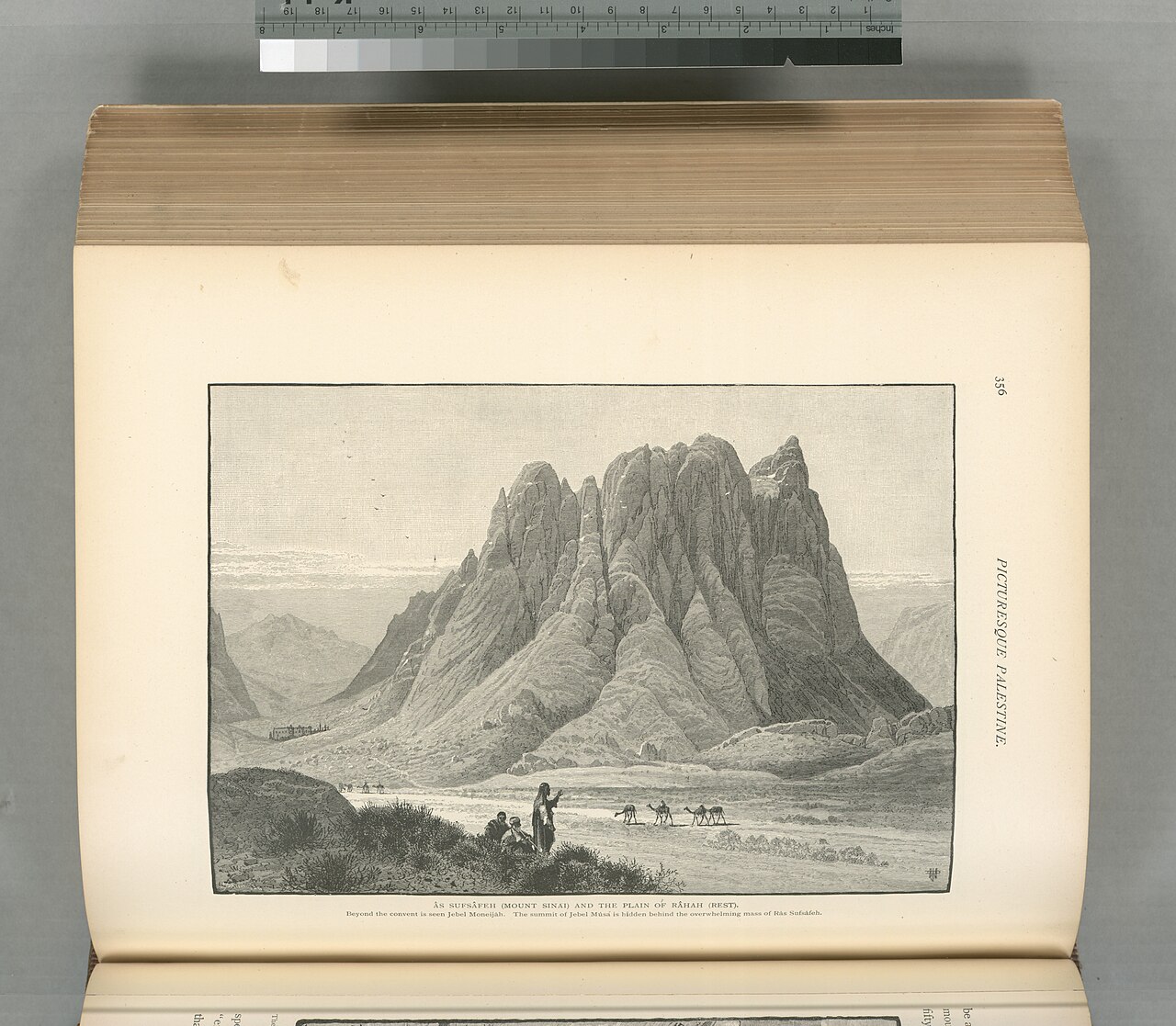
"So let the gods do to me, and more also, if I make not thy life as the life of one of them by to morrow about this time." Elijah flees to Beersheba and a day's journey into the wilderness, sits under a juniper (broom) tree: "It is enough; now, O LORD, take away my life; for I am not better than my fathers." An angel touches him: "Arise and eat." A cake baked on coals and a cruse of water. Again: "Arise and eat; because the journey is too great for thee." "In the strength of that meat forty days and forty nights unto Horeb the mount of God."
"What doest thou here, Elijah?" "I have been very jealous for the LORD God of hosts… and I, even I only, am left; and they seek my life." "Go forth, and stand upon the mount before the LORD. And, behold, the LORD passed by, and a great and strong wind rent the mountains… but the LORD was not in the wind: and after the wind an earthquake; but the LORD was not in the earthquake: And after the earthquake a fire; but the LORD was not in the fire: and after the fire a still small voice."
Elijah wraps his face in his mantle. The question and answer are repeated. "Go, return… anoint Hazael to be king over Syria: And Jehu the son of Nimshi shalt thou anoint to be king over Israel: and Elisha the son of Shaphat… shalt thou anoint to be prophet in thy room." "Yet I have left me seven thousand in Israel, all the knees which have not bowed unto Baal." Elijah finds Elisha plowing with twelve yoke of oxen and casts his mantle on him. Elisha kills the oxen, boils their flesh with the yokes, feeds the people, and follows Elijah.
"A still small voice"
The Hebrew qol demamah daqqah is famously hard to translate: qol is "voice" or "sound"; demamah is "silence" or "stillness"; daqqah is "thin" or "fine." Translations include "a still small voice" (KJV), "a sound of sheer silence" (NRSV), "a gentle whisper" (NIV). The library's Greek (Giguet) has "the murmur of a light breeze," the Latin Vulgate "the whistling of a gentle air." This is a question of translation, not of differing manuscripts. See the passage page.
Elijah and Moses
Forty days and nights, Horeb, a cave or cleft, God "passing by": the scene deliberately recalls Moses (Exodus 33:21–23; 34:28). Both appear with Jesus at the Transfiguration (Mark 9:4). Where Horeb is, is the same question as where Sinai is; no route is given.
Hazael and Jehu
Both are known outside the Bible. An inscription of Shalmaneser III calls Hazael "son of a nobody" who seized the throne of Damascus; the Black Obelisk shows Jehu (or his envoy) bowing before Shalmaneser in 841 BC. Their stories are told in 2 Kings 8–10, where Elisha, not Elijah, sets them in motion.
Elijah's despair is told with sympathy. The site does not diagnose him; the text shows sleep, food and companionship as part of God's care.
The Case for the Biblical Account
Scripture's account
Elijah at Horeb (1 Kings 19).
What evidence would we expect?
Hazael and Jehu as historical kings.
The discoveries
Shalmaneser III's records of Hazael; the Black Obelisk showing Jehu's tribute (841 BC); the Tel Dan Stele, probably by Hazael.
Testing the discoveries
Hazael and Jehu are documented; Elijah's journey and vision are known only from Kings.
The strongest reconstruction
A prophetic narrative presenting Elijah as a new Moses and linking him to the later revolutions of Hazael and Jehu.
What remains possible
The location of Horeb.
What the evidence shows
- The Black Obelisk names Jehu.Source: Oracc, "The Black Obelisk of Shalmaneser III" ↗
- Assyrian records call Hazael a usurper.
- Qol demamah daqqah has a single certain meaning.
- "The LORD passed by."
Continue the journey
Journey of a Passage1 Kings 19:12: "A still small voice"All witnesses agree on the Hebrew words qol demamah daqqah.More from this lesson
On the map
Location securely identified Probable identification Proposed or debated location Biblical route (roads schematic) Scholarly proposal
- Elijah's flight to Horeb. Illustrative. Carmel → Jezreel → Beersheba → forty days to Horeb. Horeb's location is debated; Jebel Musa is the traditional site.
Why this matters to the rest of Scripture
- Moses in the cleft of the rock.
- Paul on the seven thousand.
- Moses and Elijah at the Transfiguration.
- Elijah's mantle passes to Elisha.