Era 6 · The First Kings1 Kings
Palaces and Bronze
"He called the name of the right pillar Jachin… and the left pillar Boaz"
"But Solomon was building his own house thirteen years." The House of the Forest of Lebanon, a hundred cubits long, on four rows of cedar pillars; a porch of pillars; a porch for the throne, "the porch of judgment"; and a house for Pharaoh's daughter.
"And king Solomon sent and fetched Hiram out of Tyre. He was a widow's son of the tribe of Naphtali, and his father was a man of Tyre, a worker in brass." He casts two pillars eighteen cubits high, with capitals of lily-work and pomegranates. "And he set up the right pillar, and called the name thereof Jachin: and he set up the left pillar, and called the name thereof Boaz."
"And he made a molten sea, ten cubits from the one brim to the other: it was round all about… It stood upon twelve oxen, three looking toward the north, and three… west… south… east… it contained two thousand baths." Ten bronze stands on wheels with lavers; pots, shovels, basins; all cast in clay ground in the Jordan plain between Succoth and Zarethan. The bronze was not weighed, "because they were exceeding many."
Jachin and Boaz
The names may mean "He establishes" and "In strength"; perhaps the first words of royal inscriptions or blessings. Freestanding pillars flanking temple entrances are known at 'Ain Dara, Tell Tayinat and in temple models.
The Sea: 2,000 or 3,000 baths?
1 Kings 7:26 gives the Sea 2,000 baths; 2 Chronicles 4:5 gives 3,000. A bath is variously estimated at about 22 or about 40 liters. Harmonizations (a capacity versus normal fill) exist; the texts are shown side by side.
Bronze-casting in the Jordan valley
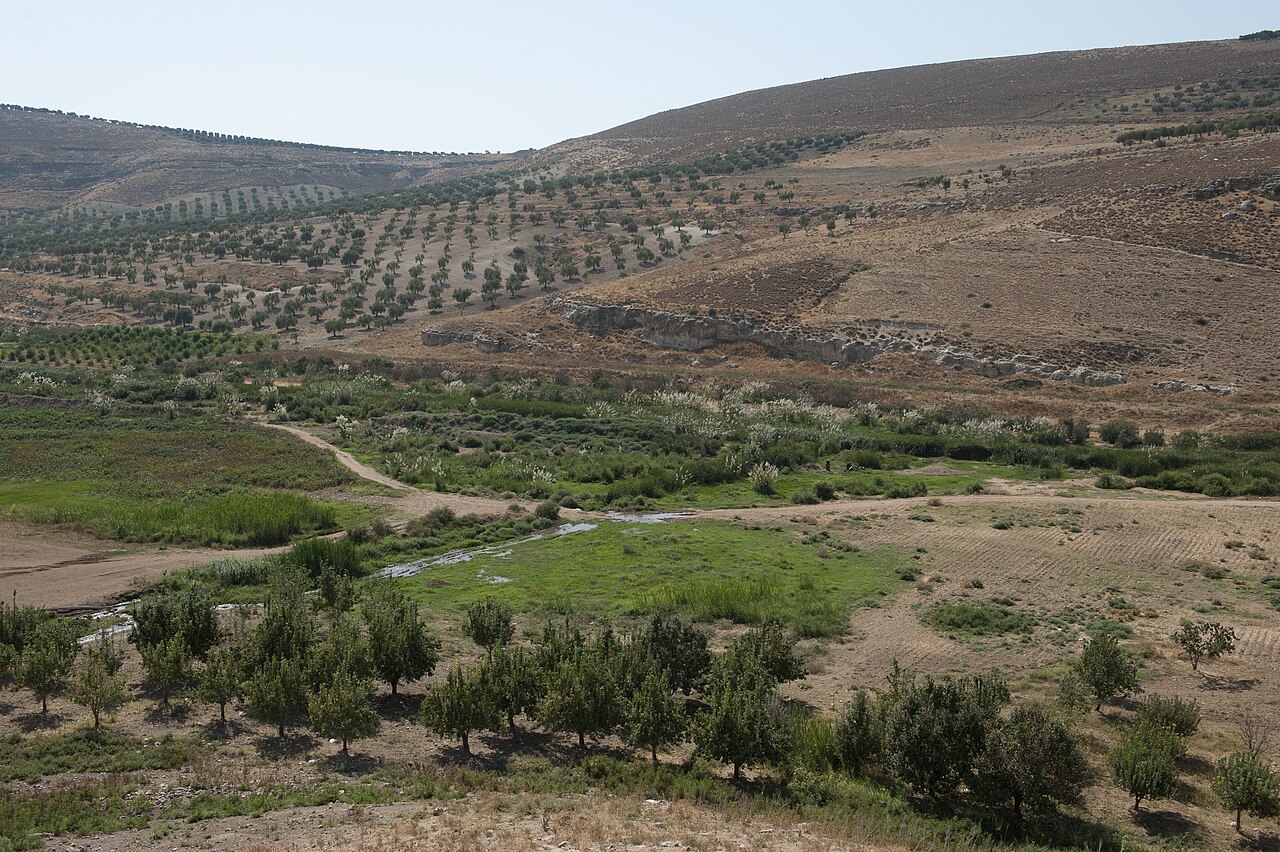
Excavations at Tell es-Sa'idiyeh and Tell Deir Alla, in the area named (Succoth, Zarethan), found evidence of metalworking. Copper came from the Arabah (Faynan and Timna), where large-scale 10th-century BC copper production is documented.
The Case for the Biblical Account
Scripture's account
Palaces and bronze work (1 Kings 7).
What evidence would we expect?
Pillared halls; large-scale bronze casting; copper supply.
The discoveries
Pillared buildings at Megiddo and Hazor; 10th-century copper mining at Faynan and Timna; metalworking in the Jordan valley.
Testing the discoveries
Copper production and metalworking are documented; Solomon's palace is not.
The strongest reconstruction
A detailed tradition of temple furnishings, perhaps from temple inventories.
What remains possible
The volume of the Sea.
What the evidence shows
- Large-scale copper production took place at Faynan and Timna in the 10th century BC.
- 1 Kings 7:26 and 2 Chronicles 4:5 give different capacities.
- Solomon's palace has been found.
Continue the journey
Journey of a Passage1 Kings 7:23–26: The bronze Sea: 2,000 or 3,000 baths?1 Kings 7:26 says the Sea held 2,000 baths; 2 Chronicles 4:5 says 3,000.More from this lesson
Investigations
Optional deep dives: the ancient sources, the physical evidence, and every interpretation side by side, including unconventional ones, each labeled for what it is.
Temples like Solomon'sRegional parallels: documented · Solomon's temple: not excavated · Closest parallel: debated
Do excavated temples show what Solomon's temple was like?
Solomon's temple has never been excavated; its site lies under the Temple Mount. But temples with the same long-room, three-part plan, porch pillars and side chambers have been found at 'Ain Dara and Tell Tayinat in Syria and Turkey, and a monarchic-period temple at Tel Motza near Jerusalem. They show that the biblical description fits its time and region. None of them is Solomon's temple.
Open the full investigation →Why this matters to the rest of Scripture
- The Chronicler's inventory.
- The Babylonians break up the bronze.
- The pillars and the Sea carried off.