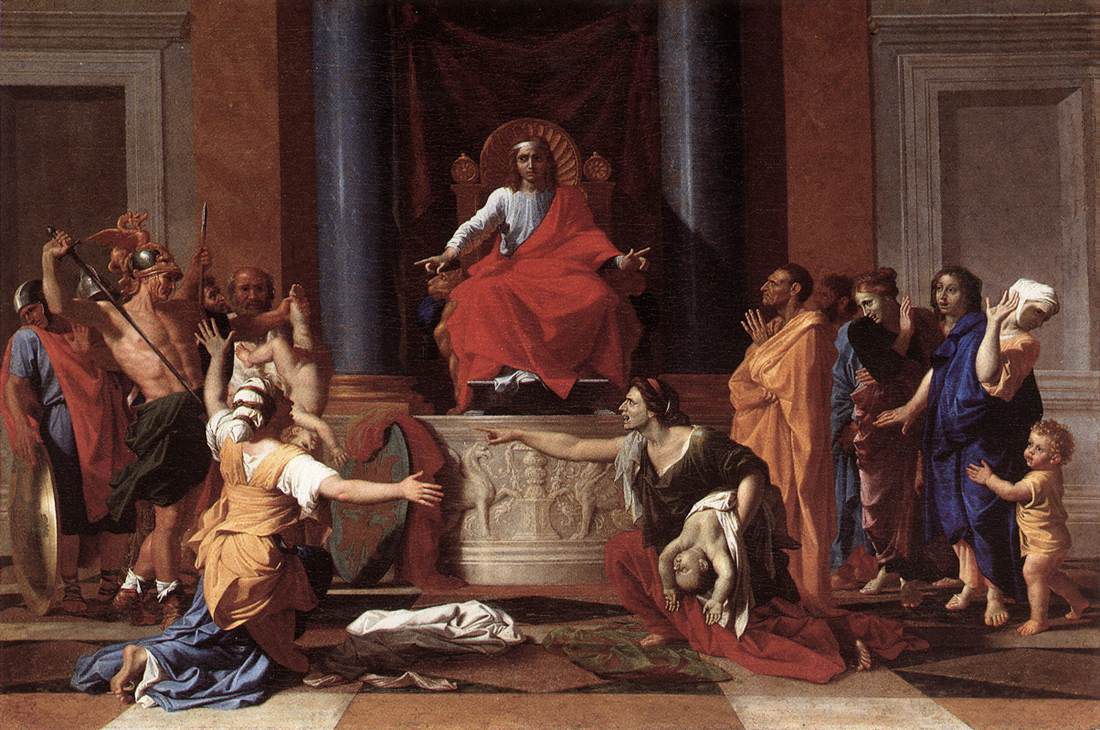
"But king Solomon loved many strange women, together with the daughter of Pharaoh, women of the Moabites, Ammonites, Edomites, Zidonians, and Hittites… And he had seven hundred wives, princesses, and three hundred concubines: and his wives turned away his heart." He goes after Ashtoreth of the Zidonians and Milcom of the Ammonites, and builds high places for Chemosh of Moab and Molech "in the hill that is before Jerusalem."
"Forasmuch as this is done of thee… I will surely rend the kingdom from thee… Notwithstanding in thy days I will not do it for David thy father's sake… but I will give one tribe to thy son for David my servant's sake, and for Jerusalem's sake which I have chosen."
Hadad the Edomite, who had fled to Egypt as a child and married Pharaoh's sister-in-law, returns to trouble Israel. Rezon rules in Damascus. Jeroboam son of Nebat, an Ephraimite in charge of the labor of the house of Joseph, meets the prophet Ahijah of Shiloh on the road. Ahijah tears his new garment into twelve pieces: "Take thee ten pieces: for thus saith the LORD… I will rend the kingdom out of the hand of Solomon, and will give ten tribes to thee." Solomon seeks to kill Jeroboam, who flees "unto Shishak king of Egypt." "And the rest of the acts of Solomon… are they not written in the book of the acts of Solomon?" Solomon reigns forty years and is buried in the city of David.
Seven hundred wives
Ancient kings sealed alliances with marriages (the Amarna letters, Mari). The numbers are the book's claim and may be rhetorical; Song of Songs 6:8 gives sixty queens and eighty concubines. The library's Greek in 11:1–3 is arranged differently from the Hebrew. For many of these women marriage was a political arrangement made for them; the text blames them for Solomon's choices, but it is Solomon who builds the shrines.
Chemosh and Molech
Chemosh was the god of Moab, named on the Mesha Stele. Milcom was the god of Ammon. The high places Solomon built are said to have stood until Josiah destroyed them about three centuries later (2 Kings 23:13).
Shishak and the lost Book of the Acts of Solomon
Shishak is the first pharaoh named in the Bible, usually identified with Shoshenq I (c. 945–924 BC). The "book of the acts of Solomon" (11:41) is one of the sources Kings cites by name. It has not survived; no fragment or quotation outside Kings is known. See the passage page.
The Case for the Biblical Account
Scripture's account
Solomon's apostasy and adversaries (1 Kings 11).
What evidence would we expect?
Diplomatic marriages; Edom and Damascus as rival powers; an Egyptian pharaoh named Shishak.
The discoveries
Chemosh on the Mesha Stele; Aramean Damascus in 9th-century inscriptions; Shoshenq I's reign and campaign record.
Testing the discoveries
The names are real; Solomon's marriages and adversaries are known only from Kings.
The strongest reconstruction
A theological explanation of the kingdom's division, using real neighboring powers.
What remains possible
The number of Solomon's wives; Hadad's Egyptian connections.
What the evidence shows
- Chemosh was the god of Moab. Mesha Stele.
- Shishak is Shoshenq I.Source: Ancient Israel and Ancient Egypt (Cambridge Elements), on Shoshenq I ↗
- Solomon had 700 wives and 300 concubines.
- A copy of the Book of the Acts of Solomon survives. None is known.
Continue the journey
Journey of a Passage1 Kings 11:41: The lost Book of the Acts of SolomonKings tells readers to look for "the rest of the acts of Solomon" in "the book of the acts of Solomon." The wording is stable across the witnesses checked.More from this lesson
Why this matters to the rest of Scripture
- "Neither shall he multiply wives… that his heart turn not away."
- "Did not Solomon king of Israel sin by these things?"
- Josiah destroys Solomon's high places.
- Another torn garment, another torn kingdom.