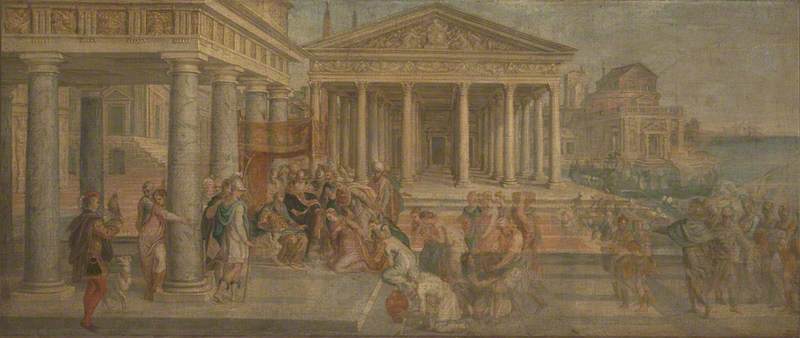
"And when the queen of Sheba heard of the fame of Solomon concerning the name of the LORD, she came to prove him with hard questions. And she came to Jerusalem with a very great train, with camels that bare spices, and very much gold, and precious stones." "And Solomon told her all her questions: there was not any thing hid from the king, which he told her not."
"It was a true report that I heard in mine own land of thy acts and of thy wisdom. Howbeit I believed not the words, until I came, and mine eyes had seen it: and, behold, the half was not told me." "Blessed be the LORD thy God, which delighted in thee… because the LORD loved Israel for ever, therefore made he thee king, to do judgment and justice."
She gives a hundred and twenty talents of gold and "of spices very great store." Solomon gives her "all her desire, whatsoever she asked." The weight of gold that came to Solomon in one year was 666 talents. He makes shields of gold, a great throne of ivory overlaid with gold with lions on the steps; "silver… was nothing accounted of in the days of Solomon." Ships of Tarshish bring "gold, and silver, ivory, and apes, and peacocks." Horses come from Egypt and Kue; chariots are sold to the kings of the Hittites and of Aram.
Saba in South Arabia
Sheba is usually identified with Saba, a kingdom in what is now Yemen, centered on Marib, with its great dam and temples. Saba grew rich on the incense trade (frankincense and myrrh) carried north by camel caravan. Sabaean inscriptions become numerous from about the 8th century BC; when the kingdom first emerged is debated. No inscription names a queen who visited Solomon, and known early Sabaean rulers are men (mukarribs).
An Assyrian connection
Assyrian records of the 8th century BC mention tribute from Saba (from It'amra under Sargon II) and Arabian queens such as Zabibe and Samsi, who ruled Arab tribes in north Arabia. They show that queens and the incense trade were real features of the Arabian world, though centuries after Solomon's traditional date.
Gold and the throne
666 talents a year (about 20 tonnes) is vast. Some read it as a literary number of glory; others compare large royal gold claims in Egyptian and Assyrian records. Ivory-inlaid furniture is known from Samaria and Nimrud in the 9th–8th centuries BC.
Deuteronomy 17:16–17 forbids a king to multiply horses, wives, silver and gold, and to send people back to Egypt for horses. Chapter 10 reports exactly these, setting up chapter 11.
The Case for the Biblical Account
Scripture's account
The queen of Sheba visits Solomon (1 Kings 10).
What evidence would we expect?
A South Arabian kingdom with incense trade and links to the Levant.
The discoveries
Sabaean inscriptions and monuments at Marib and Sirwah; Assyrian references to Saba and Arabian queens; South Arabian objects in the Levant (dates debated).
Testing the discoveries
Saba and its trade are documented; the visit is known only from the Bible and later traditions.
The strongest reconstruction
A story of Solomon's international fame shaped around the real incense trade with South Arabia.
What remains possible
Whether a Sabaean or Arabian queen visited Jerusalem in the 10th century BC.
What the evidence shows
- Saba was a South Arabian kingdom enriched by the incense trade.
- An inscription names the queen of Sheba.
- Assyrian records name Arabian queens in the 8th century BC.
- The visit took place as described.
Continue the journey
Ancient MysteriesThe Queen of ShebaWho was the queen of Sheba, and is there evidence of her visit?More from this lesson
Investigations
Optional deep dives: the ancient sources, the physical evidence, and every interpretation side by side, including unconventional ones, each labeled for what it is.
The Queen of ShebaSaba: documented · Arabian queens: documented (8th c. BC) · The visit: unverified
Who was the queen of Sheba, and is there evidence of her visit?
Sheba is usually identified with Saba in Yemen, a kingdom made rich by the incense trade. Sabaean and Assyrian inscriptions document Saba and Arabian queens, but none names a queen who visited Solomon. Jewish, Christian, Islamic and Ethiopian traditions later retold her story richly (Bilqis, Makeda). These are reception history, not evidence of the visit.
Open the full investigation →Echoes Across Civilizations
Optional: how other ancient peoples told similar stories. Open one to compare, then come back to the lesson.
Queens of Arabia and the incense roadAssyrian · Sabaean
Were there queens in ancient Arabia who traded with the Levant?
- Assyrian: Zabibe and Samsi, queens of the Arabs Possible historical contact
- Sabaean: Sabaean royal inscriptions Possible historical contact
Why this matters to the rest of Scripture
- "The queen of the south shall rise up in the judgment."
- The law of the king.
- The Chronicler's version.
- "The kings of Sheba and Seba shall offer gifts."
- "All they from Sheba shall come."