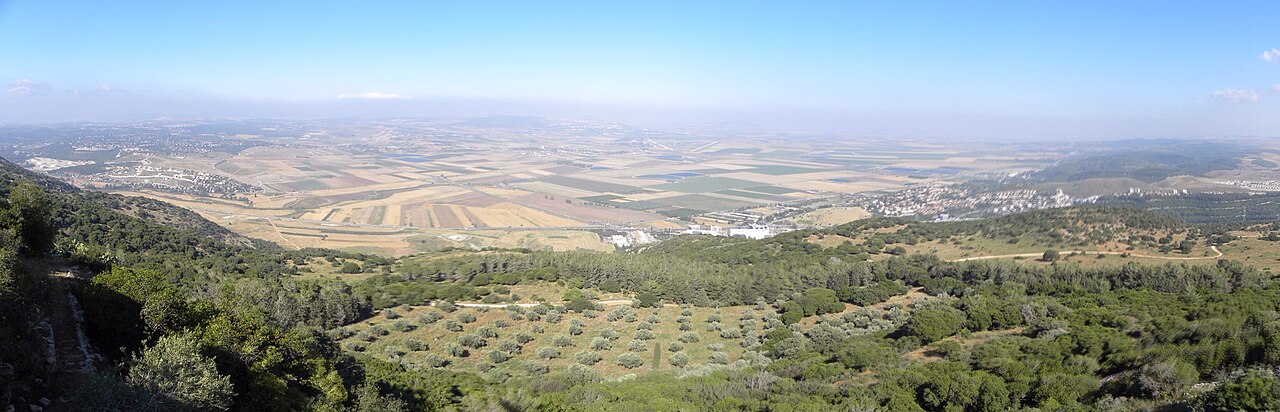
Obadiah, over Ahab's house, "feared the LORD greatly: For it was so, when Jezebel cut off the prophets of the LORD, that Obadiah took an hundred prophets, and hid them by fifty in a cave, and fed them with bread and water." Ahab meets Elijah: "Art thou he that troubleth Israel?" "I have not troubled Israel; but thou, and thy father's house."
On Carmel: "How long halt ye between two opinions? if the LORD be God, follow him: but if Baal, then follow him." The prophets of Baal call from morning to noon, "O Baal, hear us. But there was no voice, nor any that answered." Elijah mocks: "Cry aloud: for he is a god; either he is talking, or he is pursuing, or he is in a journey, or peradventure he sleepeth." They cut themselves "till the blood gushed out upon them."
Elijah repairs the altar of the LORD with twelve stones, digs a trench, and has twelve barrels of water poured on the sacrifice. "Hear me, O LORD, hear me, that this people may know that thou art the LORD God, and that thou hast turned their heart back again." "Then the fire of the LORD fell, and consumed the burnt sacrifice, and the wood, and the stones, and the dust, and licked up the water." "The LORD, he is the God; the LORD, he is the God." The prophets of Baal are taken to the brook Kishon and killed. Elijah prays seven times on Carmel's top; "a little cloud… like a man's hand" rises from the sea, and a great rain falls. Elijah runs before Ahab's chariot to Jezreel.
Baal the storm god
Texts from Ugarit (13th century BC) describe Baal, the storm god, who gives rain and fertility, battles Death (Mot), and in one myth is dead while the land dries up. Baal is shown with a raised club and a lightning spear on a stele from Ugarit (Louvre). The Phoenician Baal of Jezebel's Tyre was probably Baal Shamem or Melqart, a related but distinct figure. The Carmel story puts Israel's God against Baal on Baal's own ground: rain and fire.
Mount Carmel and the Kishon
Carmel is a ridge about 25 km long running to the sea at Haifa; the Kishon flows below its northern side. Tradition places the contest at el-Muhraqa ("the place of burning") on the southeast ridge, where a Carmelite monastery stands; the Bible gives no exact spot.
The killing of the prophets
Elijah has 450 prophets killed, as Deuteronomy 13 prescribed for those enticing Israel to other gods, and as Jezebel had killed the LORD's prophets. Jewish and Christian readers have discussed this ethically for centuries; Jesus rebukes disciples who want to call fire down "as Elias did" (Luke 9:54–55, in some manuscripts). The site reports the violence as the text gives it.
The Case for the Biblical Account
Scripture's account
The contest on Carmel (1 Kings 18).
What evidence would we expect?
Baal worship in 9th-century Israel; storm-god religion.
The discoveries
Ugaritic Baal myths; the Baal stele from Ugarit; Samaria Ostraca names with Baal (8th century BC).
Testing the discoveries
Baal religion and its rain theology are documented; the contest is known only from Kings.
The strongest reconstruction
A prophetic narrative of YHWH's victory over Baal during the Omride dynasty's Phoenician alliance.
What remains possible
The site of the contest; the size of Baal's prophetic order.
What the evidence shows
- Ugaritic texts present Baal as the storm god who gives rain.Source: USCCB, notes on 1 Kings 18 (Baal as storm god) ↗
- Some Israelites bore Baal-names in the 8th century BC. Samaria Ostraca.
- El-Muhraqa is the site of the contest.
- "The fire of the LORD fell."
Continue the journey
Ancient MysteriesBaal, Rain and Mount CarmelWho was Baal, and why is the contest about fire and rain?More from this lesson
On the map
Location securely identified Probable identification Proposed or debated location Biblical route (roads schematic) Scholarly proposal
- Elijah's flight to Horeb. Illustrative. Carmel → Jezreel → Beersheba → forty days to Horeb. Horeb's location is debated; Jebel Musa is the traditional site.
Investigations
Optional deep dives: the ancient sources, the physical evidence, and every interpretation side by side, including unconventional ones, each labeled for what it is.
Baal, Rain and Mount CarmelBaal religion: documented · Site of the contest: tradition · The miracle: faith
Who was Baal, and why is the contest about fire and rain?
Ugaritic texts (13th century BC) portray Baal as the storm god who brings rain, fights Death, and whose absence dries the land. The Carmel story challenges Baal on exactly these powers. The Phoenician Baal of Jezebel's Tyre was probably Baal Shamem or Melqart. The contest itself is known only from Kings.
Open the full investigation →Echoes Across Civilizations
Optional: how other ancient peoples told similar stories. Open one to compare, then come back to the lesson.
Storm gods, drought and rainUgaritic · Hittite
How did Israel's neighbors explain drought and rain?
- Ugaritic: The Baal Cycle Shared literary world
- Hittite: The vanishing god (Telipinu) Resemblance only
Why this matters to the rest of Scripture
- Prophets who lead to other gods.
- Elijah prayed, and the heaven gave rain.
- Fire from before the LORD.
- Fire from heaven, rebuked.