Era 6 · The First Kings1 Kings
The Warning and the Kingdom's Works
"If ye shall at all turn from following me… then will I cut off Israel"
"I have hallowed this house… to put my name there for ever; and mine eyes and mine heart shall be there perpetually." But "if ye shall at all turn from following me… Then will I cut off Israel out of the land… and this house, which I have hallowed… will I cast out of my sight; and Israel shall be a proverb and a byword among all people."
Solomon gives Hiram twenty cities in Galilee. Hiram is not pleased: "What cities are these which thou hast given me, my brother? And he called them the land of Cabul unto this day." Hiram sends a hundred and twenty talents of gold.
"And this is the reason of the levy which king Solomon raised; for to build the house of the LORD, and his own house, and Millo, and the wall of Jerusalem, and Hazor, and Megiddo, and Gezer." Pharaoh had taken Gezer, burnt it, killed its Canaanites, "and given it for a present unto his daughter, Solomon's wife." The remaining Amorites, Hittites, Perizzites, Hivites and Jebusites are made forced laborers; Israelites serve as soldiers and officers. "And king Solomon made a navy of ships in Ezion-geber… And they came to Ophir, and fetched from thence gold, four hundred and twenty talents."
Hazor, Megiddo and Gezer
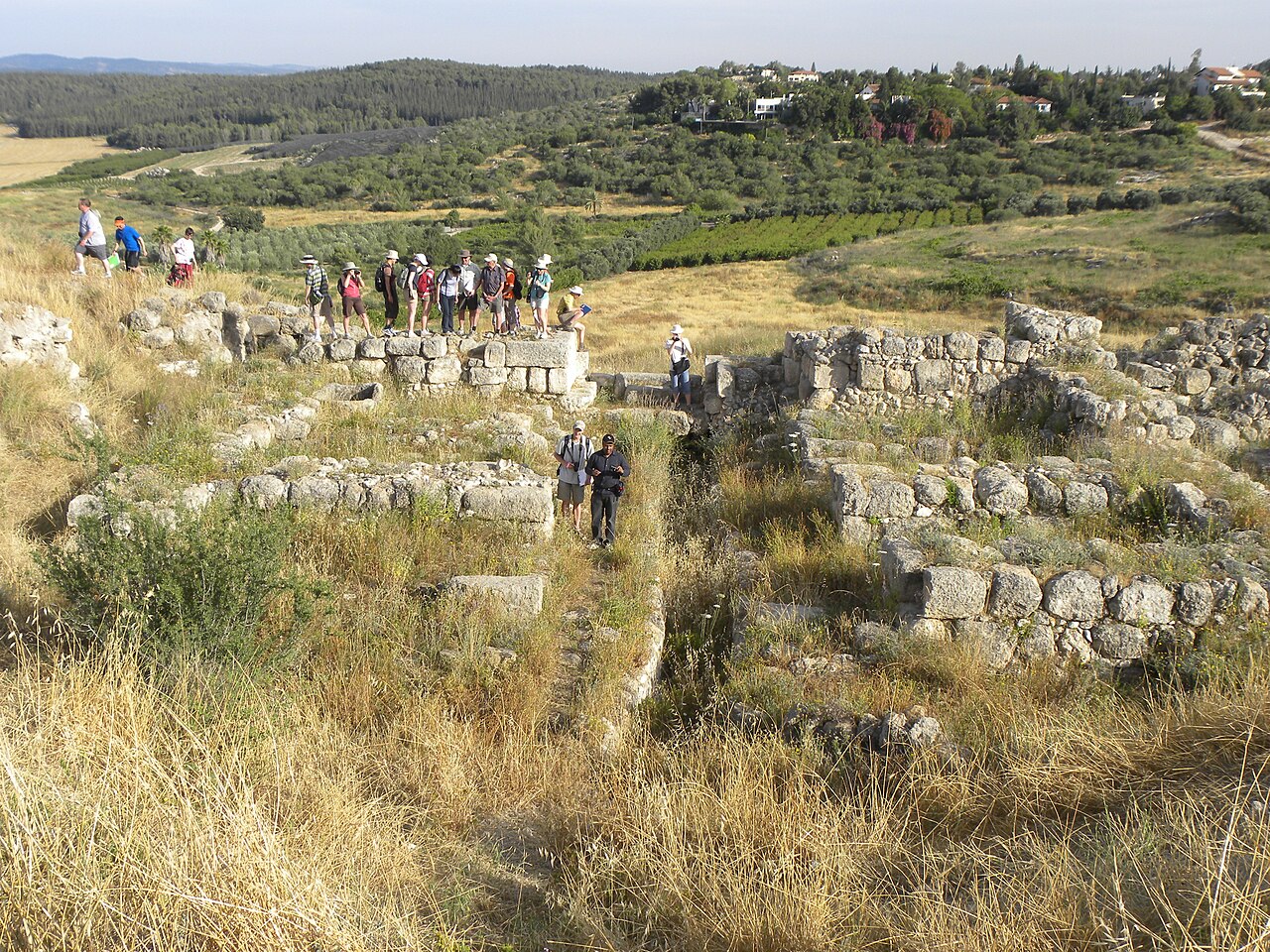
In the 1950s–60s Yigael Yadin noticed that Hazor, Megiddo and Gezer each had a similar six-chambered gate and connected them with 9:15. Later work disputes the date: under the "low chronology" (Israel Finkelstein and others) these gates belong to the 9th century BC, the time of Omri and Ahab; others (Amihai Mazar, William Dever) keep a 10th-century date for some of them. Radiocarbon studies have narrowed but not settled the question. The gates are real; whether they are Solomon's is debated.
Cabul
Hebrew kabul may sound like "as nothing" or "bound." A village called Kabul still exists in western Galilee, and an Iron Age site near it (Horvat Rosh Zayit) has Phoenician-style remains. The library's Greek has a different name for the land, "Orion" (Giguet); the Greek tradition renders the name differently.
Ophir
Ophir is unknown: proposals include southern Arabia, the Horn of Africa and India. An 8th-century BC ostracon from Tell Qasile reads "gold of Ophir to Beth-horon, 30 shekels," showing that Ophir gold was a real trade term in Israel.
The Case for the Biblical Account
Scripture's account
Solomon's building works, labor and trade (1 Kings 9).
What evidence would we expect?
Monumental building at the named cities; Red Sea trade.
The discoveries
Six-chambered gates at Hazor, Megiddo and Gezer; the Tell Qasile "gold of Ophir" ostracon; Iron Age sites at the head of the Gulf of Aqaba (Tell el-Kheleifeh).
Testing the discoveries
The gates' date is the center of the high/low chronology debate.
The strongest reconstruction
A royal building tradition attached to Solomon; how much belongs to his reign is disputed.
What remains possible
The location of Ophir; the date of the gates.
What the evidence shows
- Hazor, Megiddo and Gezer had similar Iron Age gates.
- The gates were built by Solomon.Source: I. Finkelstein, "High or Low: Megiddo and Rehov" ↗
- "Gold of Ophir" was a trade term in ancient Israel. Tell Qasile ostracon.
- Ophir has been located.
Continue the journey
Ancient MysteriesSolomon's Gates and the Chronology DebateDid Solomon build the gates of Hazor, Megiddo and Gezer?More from this lesson
Investigations
Optional deep dives: the ancient sources, the physical evidence, and every interpretation side by side, including unconventional ones, each labeled for what it is.
Solomon's Gates and the Chronology DebateGates: documented · Date: disputed · Builder: disputed
Did Solomon build the gates of Hazor, Megiddo and Gezer?
Yigael Yadin connected similar six-chambered gates at Hazor, Megiddo and Gezer with 1 Kings 9:15. The "low chronology" redates them to the 9th century BC, the time of Omri and Ahab. Radiocarbon studies (including Tel Rehov) have narrowed the debate but not ended it. The gates are real; their builder is disputed.
Open the full investigation →Why this matters to the rest of Scripture
- Why has the LORD done thus to this land?
- The house of the LORD burnt.
- The Chronicler's version.
- "Go ye now unto my place which was in Shiloh."