Era 6 · The First Kings1 Kings
Solomon Asks for Wisdom
"Give therefore thy servant an understanding heart"
"And Solomon made affinity with Pharaoh king of Egypt, and took Pharaoh's daughter." The people sacrifice at high places, "because there was no house built unto the name of the LORD." At Gibeon, "the great high place," Solomon offers a thousand burnt offerings.
"In Gibeon the LORD appeared to Solomon in a dream by night: and God said, Ask what I shall give thee." "I am but a little child: I know not how to go out or come in… Give therefore thy servant an understanding [listening, shomea] heart to judge thy people, that I may discern between good and bad." "Because thou… hast not asked for thyself long life; neither hast asked riches… lo, I have given thee a wise and an understanding heart… And I have also given thee that which thou hast not asked, both riches, and honour."
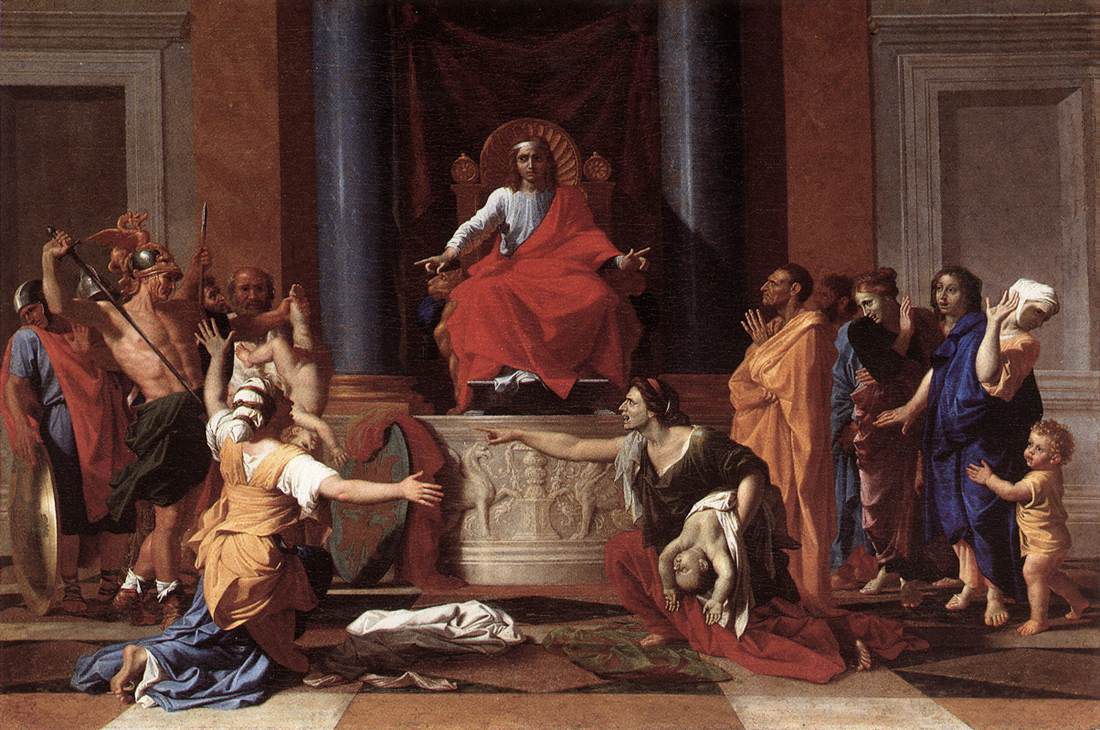
Two prostitutes come before the king. Each had a baby; one died in the night, and each claims the living child. "Bring me a sword… Divide the living child in two, and give half to the one, and half to the other." The true mother: "O my lord, give her the living child, and in no wise slay it." The other: "Let it be neither mine nor thine, but divide it." "Give her the living child… she is the mother thereof." "And all Israel… feared the king: for they saw that the wisdom of God was in him, to do judgment."
Pharaoh's daughter
A marriage to an Egyptian princess would be remarkable: the Amarna letters record pharaohs refusing to send their daughters to foreign kings. Some scholars think 10th-century Egypt, weaker, might have done so; others doubt it. The pharaoh is unnamed; Siamun and Psusennes II are proposed. The site does not name any Egyptian woman as Solomon's wife.
Royal dreams
Kings received divine revelations in dreams in Egypt (the Sphinx Stele of Thutmose IV) and Mesopotamia. Solomon's request echoes the ideal of the just king who listens.
Gibeon
Gibeon (el-Jib) is securely identified; the "great high place" is often placed at Nebi Samwil nearby, a proposal.
The Case for the Biblical Account
Scripture's account
Solomon's dream and judgment (1 Kings 3).
What evidence would we expect?
Royal dream revelations; ideals of royal justice; diplomatic marriages.
The discoveries
Egyptian and Mesopotamian royal dream texts; Hammurabi's prologue on justice for the weak; Amarna diplomatic marriages.
Testing the discoveries
The genres are documented; the events are known only from Kings.
The strongest reconstruction
A royal wisdom tradition presenting Solomon as the ideal judge.
What remains possible
Whether Pharaoh gave Solomon a daughter.
What the evidence shows
- Pharaohs of the 14th century BC refused to send daughters abroad. Amarna letter EA 4.
- Solomon married a pharaoh's daughter.
- 6Q4 preserves part of 1 Kings 3:12–14. Reported; coverage to verify.Source: E. Tigchelaar, "Reading and Assessing the Books of Kings Manuscripts from Qumran," Oxford Handbook of the Books of Kings (2024) ↗
- "I have given thee a wise and an understanding heart."
Continue the journey
Echoes Across CivilizationsThe wise kingDid other ancient kings claim divine wisdom and fame for justice?More from this lesson
Echoes Across Civilizations
Optional: how other ancient peoples told similar stories. Open one to compare, then come back to the lesson.
The wise kingBabylonian · Egyptian · Aramaic / Assyrian
Did other ancient kings claim divine wisdom and fame for justice?
- Babylonian: Hammurabi's prologue and epilogue Shared literary world
- Egyptian: Royal and scribal instructions (Amenemope, Merikare) Possible historical contact
- Aramaic / Assyrian: The Words of Ahiqar Resemblance only
Why this matters to the rest of Scripture
- The Chronicler's account.
- "If any of you lack wisdom, let him ask of God."
- "All these things shall be added unto you."